
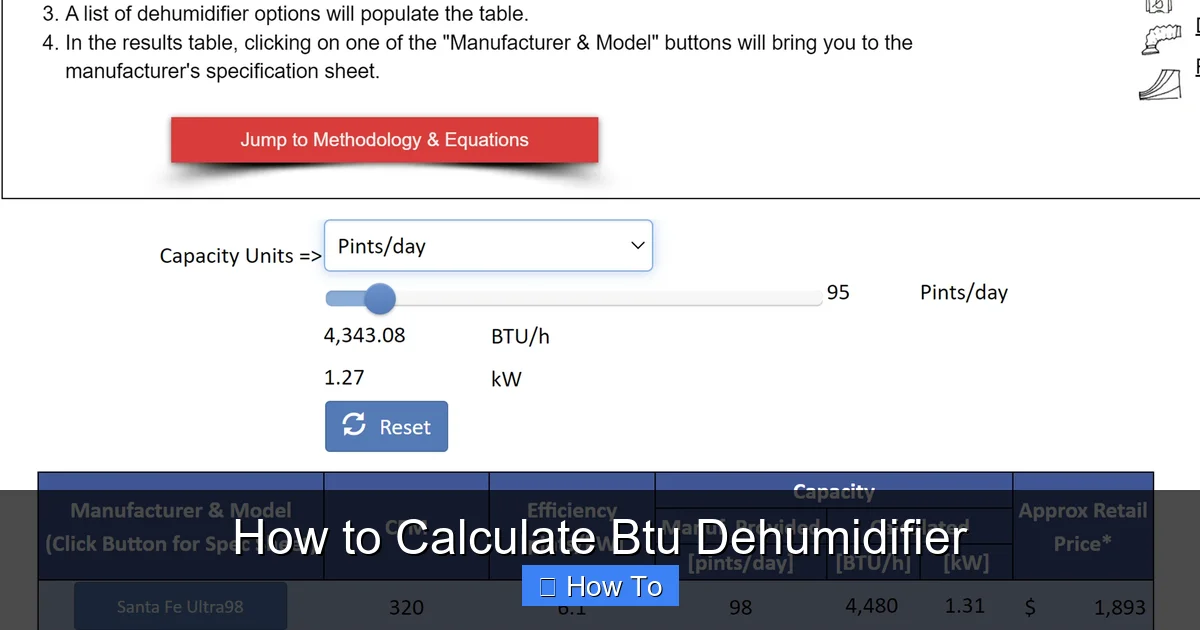
Choosing the right dehumidifier starts with calculating the correct BTU (British Thermal Unit) rating for your space. This guide walks you through measuring room size, assessing humidity levels, and matching those factors to the ideal BTU output. Follow these steps to pick a dehumidifier that works efficiently and saves energy.
Quick Answers to Common Questions
Tip/Question?
Can I use a dehumidifier as an air conditioner?
No, dehumidifiers are not designed to cool large spaces. While they remove some heat (measured in BTU), they don’t have the cooling power of an AC unit. Use them for moisture control, not temperature control.
Tip/Question?
How often should I run my dehumidifier?
Run it continuously during humid months or until humidity drops to 30–50%. Use a humidistat to automate the process and save energy.
Tip/Question?
Should I buy a dehumidifier with a higher BTU than recommended?
Not necessarily. Higher BTU may mean more energy use. Match BTU to your space and needs. Focus on PPD first, then consider BTU for efficiency and cooling effect.
Tip/Question?
Can I use one dehumidifier for my whole house?
Only if it’s a whole-house model connected to your HVAC system. Portable units are best for single rooms or open areas.
Tip/Question?
What’s the best place to put a dehumidifier in a basement?
Place it in the center or near the moisture source (like a sump pump or exterior wall). Keep it away from walls and ensure good airflow.
How to Calculate BTU Dehumidifier: A Complete Step-by-Step Guide
If you’re dealing with damp walls, musty smells, or mold growth, a dehumidifier can be a game-changer. But picking the right one isn’t just about grabbing the biggest model on the shelf. You need to calculate the correct capacity—and that’s where BTU comes into play.
Wait—BTU for a dehumidifier? Isn’t that for heaters and air conditioners?
Great question. While most dehumidifiers are rated in pints per day (PPD)—meaning how much moisture they can remove in 24 hours—BTU (British Thermal Unit) still matters. BTU measures the amount of heat energy a device can remove from the air. Some dehumidifiers, especially larger or combo units, include BTU ratings to show their cooling power or energy consumption.
In this guide, you’ll learn how to calculate the right BTU dehumidifier for your space—whether you’re tackling a damp basement, a humid bathroom, or a whole-house moisture issue. We’ll walk you through measuring your room, understanding humidity levels, and matching those factors to the ideal dehumidifier size. By the end, you’ll know exactly what to look for and how to avoid common mistakes.
Step 1: Understand What BTU Means for Dehumidifiers
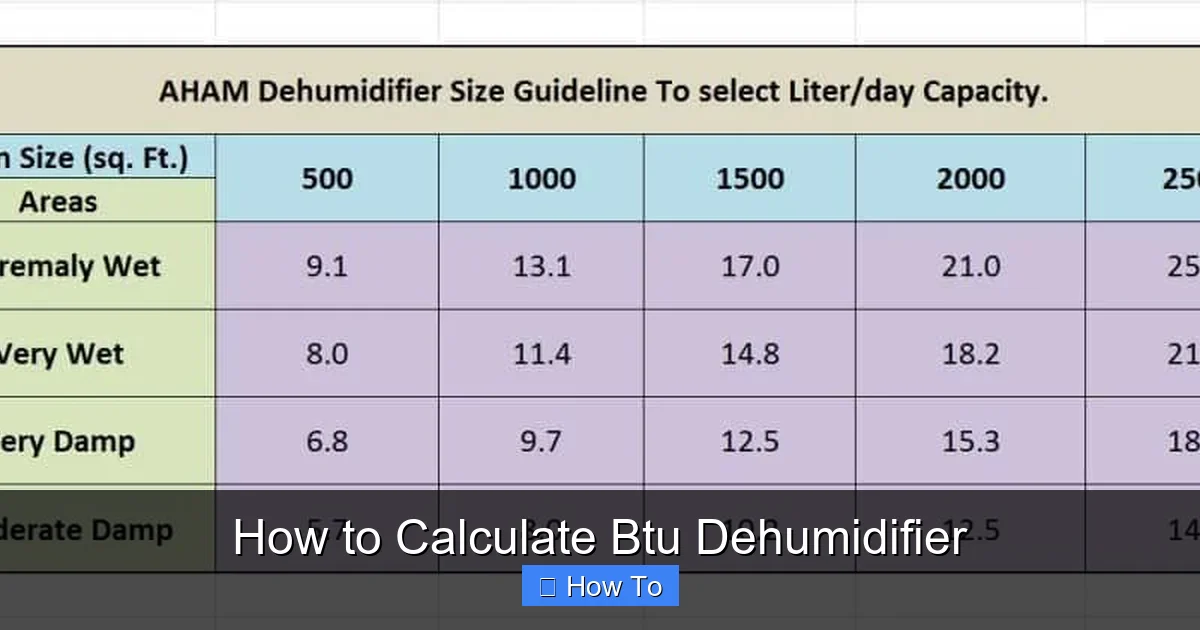
Visual guide about How to Calculate Btu Dehumidifier
Image source: dehumidifier-uae.com
Before diving into calculations, let’s clarify what BTU actually means in the context of dehumidifiers.
BTU stands for British Thermal Unit. It’s a measure of heat energy—specifically, the amount of energy needed to raise the temperature of one pound of water by one degree Fahrenheit. In air conditioners and heaters, BTU tells you how much cooling or heating power a unit has.
But dehumidifiers work differently. They remove moisture from the air using a refrigeration cycle—similar to an air conditioner—but their main job is dehumidification, not cooling. So while they do remove heat (and thus have a BTU output), their primary rating is in pints per day (PPD).
So why care about BTU?
Because BTU helps you understand:
– How much heat the dehumidifier removes from the room
– The energy efficiency of the unit
– Whether the unit is suitable for larger or hotter spaces
For example, a dehumidifier with a high BTU rating may be better at cooling the air as it removes moisture—useful in hot, humid climates. It may also consume more electricity, so balancing BTU with efficiency is key.
BTU vs. Pints Per Day: What’s the Difference?
Let’s break it down:
– Pints per day (PPD): This is the standard measure for dehumidifiers. It tells you how much water the unit can extract from the air in 24 hours. For example, a 30-pint dehumidifier removes 30 pints of moisture daily.
– BTU: This measures the cooling power. A 10,000 BTU dehumidifier removes as much heat as a 10,000 BTU air conditioner.
Some manufacturers list both. Others only list PPD. When BTU is provided, it’s usually for units that also function as air conditioners or have significant cooling effects.
When Does BTU Matter Most?
BTU becomes important in these situations:
– You’re comparing dehumidifiers with air conditioning features
– You live in a hot, humid climate and want a unit that also cools the air
– You’re evaluating energy consumption and efficiency
– You’re sizing a whole-house dehumidifier that integrates with your HVAC system
In most home cases, PPD is the primary factor. But knowing how to interpret BTU helps you make smarter, more efficient choices.
Step 2: Measure Your Room Size
The first step in calculating the right dehumidifier—whether by PPD or BTU—is knowing the size of the space you want to dehumidify.
Dehumidifiers are sized based on square footage. A unit that works perfectly in a 500-square-foot basement might struggle in a 1,500-square-foot home.
How to Calculate Square Footage
To find the square footage of your room:
1. Measure the length and width of the space in feet.
2. Multiply length × width.
For example:
– A room that’s 20 feet long and 15 feet wide = 300 square feet.
– A basement that’s 40 feet × 30 feet = 1,200 square feet.
If your room is irregularly shaped, break it into rectangles, calculate each area, and add them together.
Include All Affected Areas
Don’t forget to include:
– Basements
– Crawl spaces
– Attics (if accessible and prone to moisture)
– Garages (if attached and humid)
– Laundry rooms
– Bathrooms with poor ventilation
If multiple rooms are connected and share airflow (like an open-plan living area), treat them as one space.
Example: Calculating for a Basement
Let’s say your basement is 30 feet long and 25 feet wide:
– 30 × 25 = 750 square feet
This is a medium-sized basement. You’ll need a dehumidifier rated for at least 750 sq ft, but we’ll refine this in the next steps.
Step 3: Assess the Humidity Level
Room size is only part of the equation. The humidity level—how damp the air is—plays a huge role in determining the right dehumidifier capacity.
Dehumidifiers are typically rated for three humidity levels:
– Mildly damp: Slightly musty smell, occasional condensation
– Very damp: Noticeable dampness, wet spots, strong odor
– Wet or extremely wet: Standing water, mold, flooding history
You can use a hygrometer (a small, inexpensive device) to measure relative humidity (RH). Ideal indoor humidity is between 30% and 50%.
How Humidity Affects Dehumidifier Size
The higher the humidity, the more powerful the dehumidifier needs to be. Here’s a general guide:
| Humidity Level | Recommended PPD Capacity |
|———————-|—————————|
| Mildly damp (500–800 sq ft) | 20–30 pints/day |
| Very damp (500–800 sq ft) | 30–50 pints/day |
| Wet (500–800 sq ft) | 50+ pints/day |
For larger spaces, scale up accordingly. A 1,500-square-foot very damp basement may need a 70-pint dehumidifier.
Signs You Need a High-Capacity Unit
Look for these red flags:
– Water stains on walls or ceilings
– Peeling paint or wallpaper
– Mold or mildew growth
– Rust on metal surfaces
– Persistent musty odor
– Condensation on windows or pipes
If you see multiple signs, go for a higher PPD rating—even if your space is on the smaller side.
Step 4: Match Room Size and Humidity to Dehumidifier Capacity
Now that you know your square footage and humidity level, it’s time to match them to the right dehumidifier.
Most manufacturers provide sizing charts based on these two factors. Here’s a simplified version:
| Room Size (sq ft) | Mildly Damp | Very Damp | Wet |
|——————-|————-|———–|—–|
| 500–800 | 20–30 PPD | 30–50 PPD | 50+ PPD |
| 800–1,200 | 30–40 PPD | 40–60 PPD | 60+ PPD |
| 1,200–1,500 | 40–50 PPD | 50–70 PPD | 70+ PPD |
| 1,500+ | 50+ PPD | 70+ PPD | 90+ PPD |
Example: Sizing for a 1,000 Sq Ft Very Damp Basement
– Room size: 1,000 sq ft
– Humidity level: Very damp
– Recommended capacity: 40–60 PPD
You’d want a dehumidifier rated for at least 50 pints per day. Look for models in the 50–65 PPD range for safety.
What About BTU?
Now, where does BTU fit in?
While PPD tells you moisture removal, BTU gives you insight into:
– Energy use (higher BTU = more power consumed)
– Cooling effect (higher BTU = more heat removed)
– Suitability for hot climates
A typical 50-pint dehumidifier might have a BTU rating of 5,000 to 8,000. This means it removes 5,000 to 8,000 BTUs of heat per hour while dehumidifying.
If you live in a hot, humid area like Florida or Louisiana, a higher BTU dehumidifier may help cool the space slightly as it removes moisture. But don’t rely on it as an air conditioner—it’s not designed for that.
Step 5: Consider Climate and Seasonal Factors
Your local climate affects how hard your dehumidifier has to work.
Hot and Humid Climates
In regions with high temperatures and humidity (like the Southeast U.S.), moisture evaporates more quickly. This means:
– Dehumidifiers run more often
– Higher PPD and BTU ratings are beneficial
– Energy efficiency becomes critical
Look for ENERGY STAR-rated models. They use 15–30% less energy than standard units.
Cool and Damp Climates
In cooler areas (like the Pacific Northwest), humidity may be high, but temperatures are lower. In these cases:
– Refrigerant-based dehumidifiers may struggle below 65°F
– Consider desiccant dehumidifiers, which work better in cold spaces
– BTU is less relevant since cooling isn’t a priority
Seasonal Use
If you only need dehumidification during certain months (e.g., summer), you might opt for a smaller, portable unit. For year-round use—especially in basements—invest in a larger, more durable model.
Step 6: Factor in Energy Efficiency and Operating Costs
A bigger dehumidifier isn’t always better. Oversized units can short-cycle (turn on and off too quickly), reducing efficiency and lifespan.
Look for the ENERGY STAR Label
ENERGY STAR-certified dehumidifiers meet strict efficiency guidelines. They remove the same amount of moisture using less electricity.
For example:
– A standard 50-pint dehumidifier might use 500 watts
– An ENERGY STAR model might use only 400 watts
Over a year, that difference can save you $20–$50 on electricity.
Calculate Annual Operating Cost
To estimate how much your dehumidifier will cost to run:
1. Find the wattage (usually listed on the label or manual)
2. Estimate daily run time (e.g., 8 hours)
3. Multiply: Watts × Hours = Watt-hours per day
4. Convert to kilowatt-hours (kWh): Divide by 1,000
5. Multiply by your electricity rate (e.g., $0.12/kWh)
6. Multiply by 365 for annual cost
Example:
– 500-watt dehumidifier
– Runs 8 hours/day
– 500 × 8 = 4,000 watt-hours = 4 kWh/day
– 4 × $0.12 = $0.48/day
– $0.48 × 365 = $175.20/year
An ENERGY STAR model using 400 watts would cost about $140/year—saving $35.
BTU and Efficiency
Higher BTU doesn’t always mean less efficient. Some high-BTU models are designed to be energy-efficient. Check the Energy Factor (EF) rating—measured in liters of water removed per kilowatt-hour (L/kWh). Higher EF = more efficient.
Step 7: Choose the Right Type of Dehumidifier
Not all dehumidifiers are the same. The type you choose affects performance, BTU, and suitability for your space.
Refrigerant (Compressor) Dehumidifiers
– Most common type
– Use a cold coil to condense moisture
– Work best in warm, humid conditions (above 65°F)
– Typically have higher PPD and BTU ratings
– Best for basements, laundry rooms, and whole-house use
Desiccant Dehumidifiers
– Use a moisture-absorbing material (like silica gel)
– Work well in cold or dry environments
– Lower PPD, but effective in low temperatures
– Often used in crawl spaces, garages, or RVs
– Lower BTU output—less cooling effect
Whole-House Dehumidifiers
– Integrated with HVAC systems
– High capacity (70+ PPD)
– High BTU (10,000+)
– Ideal for large homes or severe humidity issues
– Require professional installation
Portable vs. Whole-House
– Portable: Great for single rooms or seasonal use. Easy to move. Lower BTU.
– Whole-house: Better for consistent, whole-home control. Higher BTU and PPD.
Step 8: Install and Position Your Dehumidifier Correctly
Even the best dehumidifier won’t work well if it’s poorly placed.
Best Placement Tips
– Place in the center of the room or near the source of moisture
– Keep at least 6–12 inches away from walls and furniture
– Ensure airflow isn’t blocked
– Use in a closed space (close doors and windows)
– Elevate slightly if on a concrete floor (use a stand or pads)
Use a Hygrometer to Monitor
Place a hygrometer in the room to check humidity levels. Adjust the dehumidifier setting to maintain 30–50% RH.
Empty the Water Tank Regularly
Most portable units have a tank that needs emptying every 1–2 days. Some models include a hose for continuous drainage—ideal for basements.
Troubleshooting Common Issues
Even with the right size, problems can occur.
Dehumidifier Isn’t Removing Enough Moisture
Possible causes:
– Unit is too small for the space
– Humidity level is higher than estimated
– Airflow is blocked
– Coils are frozen (in cold environments)
– Filter is dirty
Solution: Check size, clean the filter, ensure proper airflow, and verify temperature.
Unit Runs Constantly
This could mean:
– The space is extremely humid
– The unit is undersized
– There’s a water leak or poor ventilation
Solution: Upgrade to a higher-capacity model or fix underlying moisture sources.
Ice Builds Up on Coils
Common in cold basements or garages.
Solution: Use a desiccant dehumidifier or one with auto-defrost. Keep room above 65°F if possible.
High Energy Bills
If your dehumidifier is driving up costs:
– Check if it’s ENERGY STAR-rated
– Ensure it’s not oversized
– Clean the filter monthly
– Use a timer or humidistat to control run time
Conclusion
Calculating the right BTU dehumidifier isn’t about finding a magic number—it’s about understanding your space, your humidity levels, and how dehumidifiers work. While PPD is the primary measure, BTU helps you evaluate energy use, cooling effect, and overall efficiency.
Start by measuring your room, assessing moisture levels, and matching those to the recommended capacity. Consider climate, efficiency, and dehumidifier type. And don’t forget proper placement and maintenance.
By following this guide, you’ll choose a dehumidifier that keeps your home dry, comfortable, and energy-efficient—without overspending or underperforming. Remember: the right size isn’t the biggest one. It’s the one that fits your needs perfectly.