
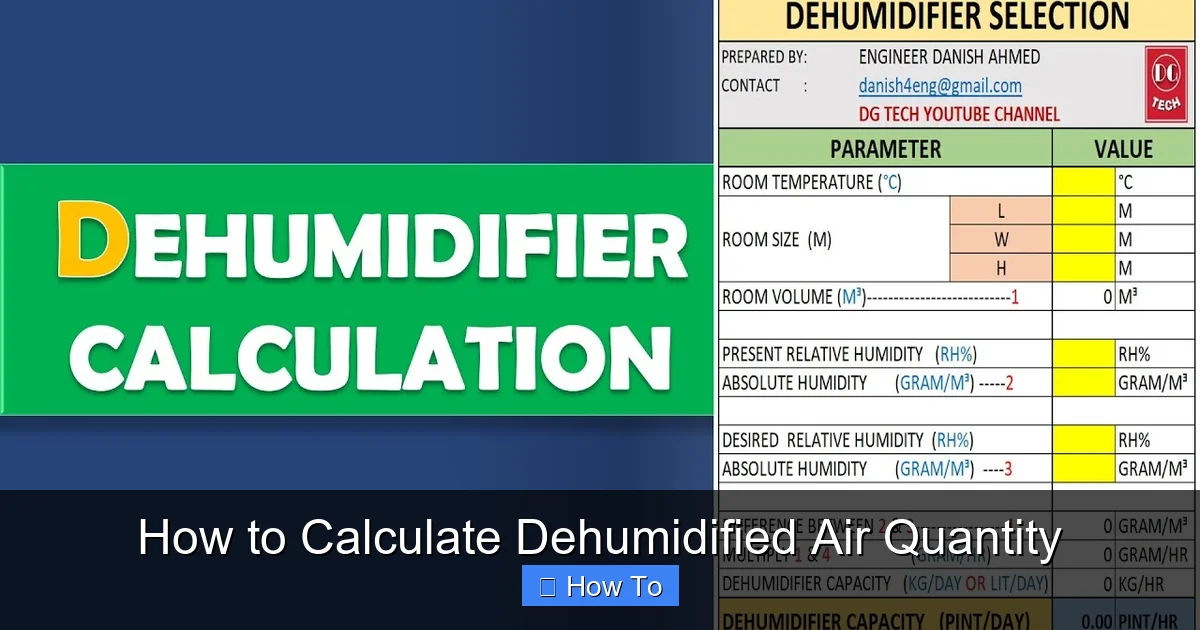
Understanding how to calculate dehumidified air quantity is essential for optimizing indoor air quality and HVAC system efficiency. This guide walks you through the process using practical formulas, real-world examples, and expert tips.
Quick Answers to Common Questions
Tip/Question?
What’s the easiest way to measure airflow from a dehumidifier?
Use a handheld anemometer at the intake or exhaust grille. Multiply the average velocity (ft/min) by the grille area (ft²) to get CFM.
Tip/Question?
Can I use relative humidity directly in the formula?
No. Relative humidity must be converted to absolute humidity (gr/lb or lbw/lbda) using temperature and a psychrometric chart or calculator.
Tip/Question?
How often should I recalculate dehumidified air quantity?
Recalculate seasonally or after any maintenance, filter change, or noticeable change in performance.
Tip/Question?
Is condensate measurement more accurate than calculation?
Yes, measuring actual water collected is the most direct method and can validate your calculated results.
Tip/Question?
What if my dehumidifier doesn’t list CFM?
Check the manual or contact the manufacturer. Alternatively, measure airflow with a flow hood or anemometer.
How to Calculate Dehumidified Air Quantity
Whether you’re an HVAC technician, a building manager, or a homeowner concerned about indoor air quality, knowing how to calculate dehumidified air quantity is a valuable skill. Excess moisture in the air can lead to mold growth, structural damage, and poor comfort levels. Dehumidifiers help remove this moisture, but to ensure they’re working efficiently, you need to quantify how much water they’re actually extracting.
This comprehensive guide will walk you through the entire process of calculating dehumidified air quantity—step by step. You’ll learn the essential formulas, understand the key variables involved, and discover practical tips to improve accuracy. By the end, you’ll be able to assess your dehumidification system’s performance with confidence and make informed decisions about maintenance, upgrades, or sizing new equipment.
Why Calculating Dehumidified Air Quantity Matters
Before diving into calculations, it’s important to understand why this matters. Simply running a dehumidifier doesn’t guarantee optimal performance. If the unit is undersized, it may run constantly without reaching the desired humidity level. If it’s oversized, it could cycle too frequently, wasting energy and reducing lifespan.
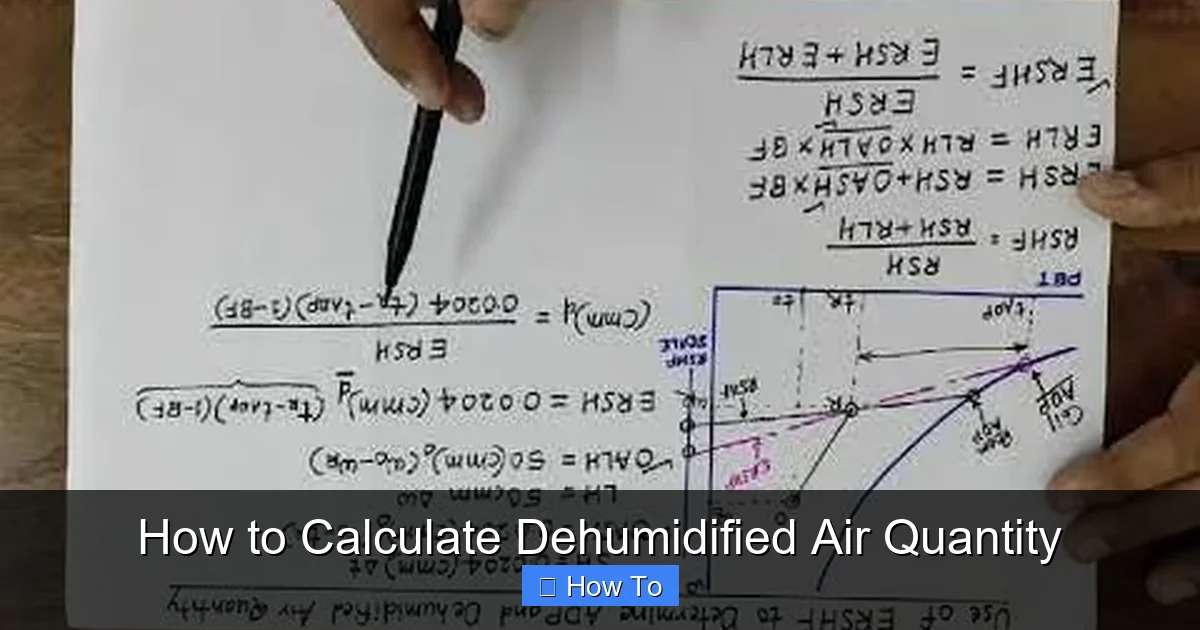
Visual guide about How to Calculate Dehumidified Air Quantity
Image source: i.ytimg.com
By calculating the actual quantity of moisture being removed, you can:
- Verify that your dehumidifier is performing as expected
- Compare different units or systems
- Identify inefficiencies or maintenance needs
- Ensure compliance with indoor air quality standards
- Optimize energy usage and reduce operating costs
For example, a basement dehumidifier might claim to remove 50 pints of water per day. But if your calculation shows it’s only removing 30 pints, you’ll know something’s wrong—maybe a clogged filter, low refrigerant, or improper placement.
Understanding the Key Variables
To calculate dehumidified air quantity, you need to understand three core variables: airflow, humidity levels, and time. Let’s break each one down.
1. Airflow Rate (CFM)
Airflow rate refers to how much air passes through the dehumidifier per minute, measured in cubic feet per minute (CFM). This is typically provided by the manufacturer or can be measured using an anemometer or flow hood.
For example, a residential dehumidifier might move 150 CFM of air. Industrial units can handle thousands of CFM. The higher the airflow, the more moisture the system can potentially remove—assuming it has enough contact time and cooling capacity.
2. Humidity Levels (Inlet vs. Outlet)
Humidity is measured in several ways, but for dehumidification calculations, we use absolute humidity—the actual amount of water vapor in the air. Common units include:
- Grains per pound of dry air (gr/lb)
- Pounds of water per pound of dry air (lbw/lbda)
- Parts per million by weight (ppm)
You’ll need two measurements:
- Inlet humidity: The moisture content of air entering the dehumidifier
- Outlet humidity: The moisture content of air leaving the dehumidifier
These are usually measured with a hygrometer or psychrometer, which can read relative humidity (RH) and temperature. You’ll then convert RH to absolute humidity using a psychrometric chart or online calculator.
3. Time Duration
Dehumidification is a continuous process, so you’ll calculate moisture removal over a specific time period—typically one hour or one day. This allows you to express results in practical units like pints per day or pounds per hour.
Step-by-Step Calculation Process
Now that you understand the variables, let’s go through the calculation step by step. We’ll use a real-world example to make it clear.
Step 1: Measure or Obtain Airflow Rate (CFM)
Start by determining how much air your dehumidifier moves. Check the product specifications or use a flow meter.
Example: Your dehumidifier has a rated airflow of 200 CFM.
Step 2: Measure Inlet and Outlet Humidity
Use a digital hygrometer to measure the relative humidity and temperature at the inlet and outlet of the dehumidifier.
Example:
- Inlet: 70°F, 60% RH
- Outlet: 65°F, 40% RH
Now convert these to absolute humidity. You can use a psychrometric chart or an online calculator. For simplicity, we’ll use grains per pound (gr/lb).
Using standard psychrometric data:
- 70°F at 60% RH ≈ 70 gr/lb
- 65°F at 40% RH ≈ 40 gr/lb
Step 3: Calculate Humidity Difference
Subtract the outlet humidity from the inlet humidity to find how much moisture was removed per pound of dry air.
Calculation:
70 gr/lb – 40 gr/lb = 30 gr/lb
This means 30 grains of moisture were removed per pound of dry air passing through the unit.
Step 4: Convert Airflow to Pounds of Dry Air per Minute
Airflow is in CFM (volume), but humidity is in grains per pound (mass). We need to convert CFM to pounds of dry air per minute.
The density of dry air at standard conditions (70°F, 14.7 psi) is approximately 0.075 lb/ft³.
Calculation:
200 CFM × 0.075 lb/ft³ = 15 lb/min
So, 15 pounds of dry air pass through the dehumidifier each minute.
Step 5: Calculate Moisture Removed per Minute
Multiply the humidity difference by the mass flow rate of dry air.
Calculation:
30 gr/lb × 15 lb/min = 450 grains/min
This is the rate of moisture removal in grains per minute.
Step 6: Convert to Practical Units
Most people think in terms of pints or gallons per day. Let’s convert grains to pints.
There are 7,000 grains in one pound of water.
One pint of water weighs approximately 1.043 pounds.
So, one pint = 1.043 lb × 7,000 gr/lb ≈ 7,301 grains.
Now convert grains per minute to pints per day:
Calculation:
450 grains/min × 60 min/hr × 24 hr/day = 648,000 grains/day
648,000 grains/day ÷ 7,301 grains/pint ≈ 88.8 pints/day
Result: Your dehumidifier is removing approximately 89 pints of water per day.
Using the Standard Dehumidification Formula
To streamline future calculations, you can use this standard formula:
Moisture Removed (lb/hr) = CFM × (W₁ – W₂) × 60 × 0.075
Where:
- CFM = airflow in cubic feet per minute
- W₁ = inlet humidity in lbw/lbda (pounds of water per pound of dry air)
- W₂ = outlet humidity in lbw/lbda
- 60 = minutes per hour
- 0.075 = density of air in lb/ft³ (at standard conditions)
If you prefer grains, use:
Moisture Removed (gr/hr) = CFM × (G₁ – G₂) × 60 × 0.075 × 7,000
Where G₁ and G₂ are in grains per pound.
This formula gives you hourly removal, which you can multiply by 24 for daily output.
Practical Tips for Accurate Calculations
Even with the right formula, real-world conditions can affect accuracy. Here are some tips to improve your results:
1. Use Calibrated Instruments
Always use high-quality, calibrated hygrometers and anemometers. Cheap sensors can have errors of 5–10%, which throws off your entire calculation.
2. Measure at Stable Conditions
Take readings when the dehumidifier has been running for at least 30 minutes and indoor conditions are stable. Avoid measuring during startup or shutdown cycles.
3. Account for Temperature and Pressure
Air density changes with temperature and altitude. If you’re at high elevation or in extreme temperatures, adjust the air density value accordingly. For most homes, 0.075 lb/ft³ is fine.
4. Consider System Efficiency
No dehumidifier is 100% efficient. Factors like coil fouling, refrigerant charge, and fan performance can reduce actual output. Use manufacturer performance curves if available.
5. Repeat Measurements
Take multiple readings over several days to account for variations in ambient humidity and usage patterns. Average the results for a more reliable estimate.
Common Mistakes to Avoid
Even experienced technicians make errors. Here are some pitfalls to watch out for:
1. Confusing Relative and Absolute Humidity
Relative humidity (RH) is temperature-dependent. Two spaces can have the same RH but very different moisture content. Always convert to absolute humidity (gr/lb or lbw/lbda) before calculating.
2. Ignoring Air Density
Using CFM directly without converting to mass flow (lb/min) will give incorrect results. Always multiply by air density.
3. Using Inconsistent Units
Mixing grains and pounds or CFM and liters will break your calculation. Stick to one system (Imperial or Metric) and convert carefully.
4. Assuming Constant Airflow
Airflow can vary with filter condition, duct resistance, and fan speed. Measure CFM under actual operating conditions.
5. Overlooking Condensate Drainage
If your dehumidifier has a drain hose, measure the actual water collected over 24 hours. Compare this to your calculated value to validate accuracy.
Troubleshooting Low Dehumidification Output
If your calculation shows lower-than-expected moisture removal, here’s what to check:
1. Dirty Air Filter
A clogged filter restricts airflow, reducing CFM and dehumidification capacity. Clean or replace filters monthly.
2. Frost on Coils
In cold environments, evaporator coils can frost over, blocking airflow and reducing efficiency. Ensure the unit is rated for low-temperature operation or use a defrost cycle.
3. Low Refrigerant Charge
Insufficient refrigerant reduces cooling capacity, limiting moisture removal. This requires a licensed technician to diagnose and repair.
4. Improper Sizing
If the space is too large for the unit, it may never reach the set humidity. Use a sizing calculator based on square footage, humidity level, and usage.
5. Air Leaks
Unconditioned air entering the space (e.g., through windows or vents) increases the moisture load. Seal leaks and ensure proper ventilation control.
Advanced Methods and Tools
For professionals, there are more advanced ways to calculate dehumidified air quantity:
1. Psychrometric Chart Analysis
A psychrometric chart plots air properties like temperature, humidity, and enthalpy. By plotting inlet and outlet conditions, you can visually determine moisture removal and system performance.
2. HVAC Software
Tools like Wrightsoft, Elite RHVAC, or EnergyPlus can simulate dehumidification performance based on weather data, building materials, and equipment specs.
3. Data Logging
Use data loggers to record temperature and humidity over time. This helps identify trends and validate long-term performance.
4. Condensate Measurement
The most direct method: collect and measure the actual water drained over 24 hours. Compare this to your calculated value to check accuracy.
Real-World Example: Basement Dehumidifier
Let’s apply this to a common scenario: a 1,000 sq ft basement with high humidity.
Given:
- Dehumidifier airflow: 180 CFM
- Inlet: 75°F, 70% RH → 85 gr/lb
- Outlet: 68°F, 45% RH → 50 gr/lb
- Air density: 0.075 lb/ft³
Step 1: Humidity difference = 85 – 50 = 35 gr/lb
Step 2: Mass flow = 180 × 0.075 = 13.5 lb/min
Step 3: Moisture removed = 35 × 13.5 = 472.5 gr/min
Step 4: Daily removal = 472.5 × 60 × 24 = 680,400 gr/day
Step 5: Convert to pints: 680,400 ÷ 7,301 ≈ 93.2 pints/day
Conclusion: This unit removes about 93 pints per day—well above the average 50-pint rating. It’s likely oversized, which could lead to short cycling. Consider a smaller unit or adjust settings.
Conclusion
Calculating dehumidified air quantity doesn’t have to be complicated. With the right tools, a clear understanding of the variables, and a systematic approach, you can accurately assess how much moisture your system is removing. This knowledge empowers you to optimize performance, save energy, and maintain a healthy indoor environment.
Remember: start with accurate measurements, use consistent units, and validate your results whenever possible. Whether you’re maintaining a home dehumidifier or designing a commercial HVAC system, mastering this calculation is a key step toward better air quality and efficiency.