

This guide teaches you how to calculate dehumidifier heating effectively, helping you understand energy consumption, heat output, and efficiency. Whether you’re managing humidity in a basement or improving indoor air quality, knowing how much heat your dehumidifier generates ensures comfort and cost savings.
Quick Answers to Common Questions
Tip/Question?
Can a dehumidifier replace a space heater in winter?
While dehumidifiers do produce heat, they’re not efficient or safe as primary heating sources. Use them for moisture control, not warmth.
Tip/Question?
Does a larger dehumidifier always produce more heat?
Not necessarily. A more efficient large unit may use less power per pint removed than a smaller, older model. Check the wattage and EF rating.
Tip/Question?
Should I turn off my dehumidifier in summer?
Not always. High humidity can still be a problem. Use a timer or smart humidistat to run it only when needed, reducing heat buildup.
Tip/Question?
How often should I clean my dehumidifier to maintain efficiency?
Clean the air filter every 2–4 weeks and check coils monthly. Dirty components increase energy use and heat output.
Tip/Question?
Can I use a dehumidifier in an unheated garage?
Only if temperatures stay above 65°F. Below that, frost can form on coils, reducing efficiency and potentially damaging the unit.
How to Calculate Dehumidifier Heating
If you’ve ever run a dehumidifier and noticed your room feeling warmer, you’re not imagining things. Dehumidifiers generate heat as a natural byproduct of their operation. While their main job is to remove excess moisture from the air, the process of condensing water vapor and powering internal components releases heat into your living space. Understanding how to calculate dehumidifier heating helps you manage indoor comfort, energy costs, and HVAC efficiency.
In this comprehensive guide, you’ll learn exactly how dehumidifiers produce heat, why it matters, and—most importantly—how to calculate that heat output using simple formulas and real-world examples. Whether you’re dealing with a damp basement, a humid crawl space, or just trying to improve air quality, knowing how much heat your dehumidifier adds can help you make smarter decisions about placement, runtime, and energy use.
Why Dehumidifiers Generate Heat
Before diving into calculations, it’s important to understand why dehumidifiers produce heat. Unlike air conditioners, which are designed to cool and dehumidify, most residential dehumidifiers focus solely on moisture removal. However, the physics of condensation and mechanical operation mean that heat is inevitably released.
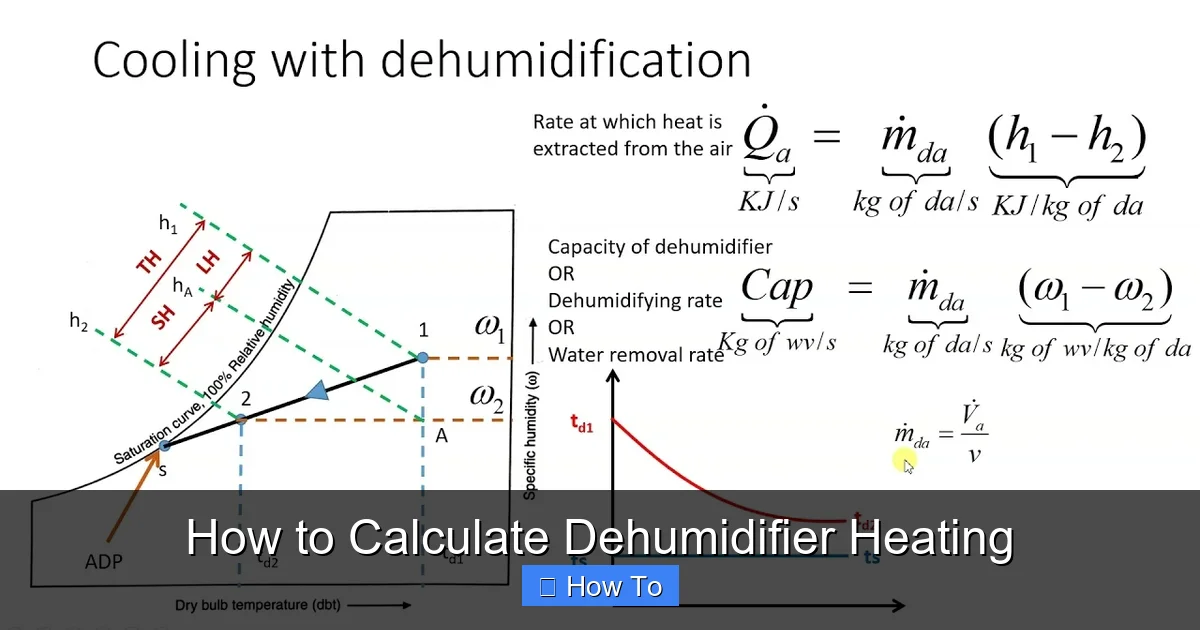
Visual guide about How to Calculate Dehumidifier Heating
Image source: i.ytimg.com
Here’s how it works: A dehumidifier pulls in humid air using a fan. The air passes over cold coils (the evaporator), where moisture condenses into water droplets and collects in a tank or drains away. The now-drier air then passes over warm coils (the condenser), where it’s reheated before being blown back into the room. This reheating step ensures the air isn’t too cold when it re-enters your space—but it also means the air coming out is warmer than when it went in.
Additionally, the compressor and fan motor generate heat simply by running. All electrical devices produce some heat during operation, and dehumidifiers are no exception. So, even if the air isn’t being intentionally heated, the machine itself adds thermal energy to the room.
Understanding the Heat Output
The total heat output of a dehumidifier comes from two sources:
- Sensible heat from reheating the air: This is the heat added when dry air passes over the condenser coils.
- Waste heat from electrical components: The compressor, fan, and controls generate heat as they consume electricity.
Together, these sources can raise the temperature in a closed room—especially in smaller spaces like basements, garages, or laundry rooms. In some cases, this extra heat can be beneficial, especially during colder months. But in summer or in already warm environments, it can make your space feel stuffy and increase the load on your air conditioner.
Step 1: Find Your Dehumidifier’s Power Rating
The first step in calculating dehumidifier heating is determining how much electricity the unit uses. This is measured in watts (W) or kilowatts (kW) and is usually listed on the product label, in the user manual, or on the manufacturer’s website.
Where to Find the Wattage
- Check the back or bottom of the unit for a sticker with electrical specs.
- Look for “Rated Power,” “Power Consumption,” or “Wattage.”
- If only amps and volts are listed, multiply them: Watts = Volts × Amps.
For example, a typical 50-pint dehumidifier might use around 500 watts. A smaller 30-pint model might use 350 watts, while a high-capacity 70-pint unit could draw 700 watts or more.
Example
Let’s say your dehumidifier is rated at 550 watts. That means it uses 550 joules of energy per second when running.
Step 2: Determine Daily Runtime
Next, estimate how many hours per day your dehumidifier runs. This depends on several factors:
- Humidity levels in the room
- Size of the space
- Desired humidity setting
- Season and climate
Most dehumidifiers have built-in humidistats that turn the unit on and off to maintain a set humidity level (e.g., 45–50%). In very humid conditions, the unit may run 8–12 hours a day. In drier conditions, it might only run 2–4 hours.
How to Track Runtime
- Use a smart plug with energy monitoring to log actual usage.
- Check the unit’s built-in timer or cycle indicator.
- Estimate based on how often you empty the water tank.
For our example, let’s assume the dehumidifier runs for 10 hours per day.
Step 3: Calculate Daily Energy Consumption
Now, calculate how much energy the dehumidifier uses each day. This is measured in kilowatt-hours (kWh), which is what your utility company charges you for.
Formula
Energy (kWh) = (Wattage × Hours of Use) ÷ 1,000
Example Calculation
Using our 550-watt dehumidifier running 10 hours a day:
(550 × 10) ÷ 1,000 = 5.5 kWh per day
This means the unit consumes 5.5 kilowatt-hours of electricity daily.
Step 4: Convert Energy to Heat Output
Here’s the key insight: Almost all the electrical energy used by a dehumidifier is converted into heat. This is due to the laws of thermodynamics—energy can’t be destroyed, only transformed. The electricity powers the compressor and fan, which do mechanical work, but that work ultimately becomes heat through friction, resistance, and air movement.
Even the water removed from the air contributes to heat. When water vapor condenses into liquid, it releases latent heat. This heat is absorbed by the coils and released into the air.
Heat Output Formula
To estimate the total heat output in British Thermal Units (BTUs) per hour, use this rule of thumb:
Heat Output (BTU/hr) ≈ Watts × 3.41
This conversion factor (3.41 BTU per watt-hour) comes from standard energy equivalents.
Example
For our 550-watt dehumidifier:
550 × 3.41 = 1,875.5 BTU/hr
So, the dehumidifier produces approximately 1,876 BTUs of heat per hour while running.
Step 5: Calculate Total Daily Heat Output
To find the total heat added to your space in a day, multiply the hourly heat output by the number of hours the unit runs.
Formula
Total Daily Heat (BTU) = Heat Output (BTU/hr) × Runtime (hours)
Example
1,876 BTU/hr × 10 hours = 18,760 BTU per day
That’s a significant amount of heat—equivalent to running a small space heater for several hours.
Step 6: Adjust for Efficiency and Real-World Conditions
While the above calculations give a solid estimate, real-world performance can vary. Here’s how to refine your numbers:
Factor in Energy Efficiency
ENERGY STAR-certified dehumidifiers use 15–30% less energy than standard models for the same moisture removal. This means they generate less waste heat.
Check the Energy Factor (EF) rating, measured in liters of water removed per kilowatt-hour (L/kWh). Higher EF = more efficient = less heat per pint removed.
Example
A dehumidifier with an EF of 2.0 removes 2 liters of water per kWh. A less efficient model with EF 1.5 removes only 1.5 liters. The more efficient unit uses less power and produces less heat for the same job.
Consider Ambient Temperature
Dehumidifiers work best between 65°F and 80°F. In colder environments (below 60°F), the coils can frost over, reducing efficiency and increasing runtime—and thus heat output.
Account for Airflow and Ventilation
In a well-ventilated room, some heat may dissipate. In a sealed basement, heat builds up quickly. Use a thermometer to monitor temperature changes over time.
Practical Example: Basement Dehumidifier
Let’s walk through a real-world scenario. You have a 1,000-square-foot basement with high humidity. You’re using a 50-pint dehumidifier rated at 520 watts with an EF of 1.8. It runs about 8 hours a day.
Step-by-Step Calculation
- Wattage: 520 watts
- Runtime: 8 hours/day
- Daily Energy Use: (520 × 8) ÷ 1,000 = 4.16 kWh
- Heat Output per Hour: 520 × 3.41 = 1,773 BTU/hr
- Total Daily Heat: 1,773 × 8 = 14,184 BTU/day
This means your dehumidifier adds over 14,000 BTUs of heat to your basement each day. In winter, this might help reduce your heating bill. In summer, it could make the space feel warmer and increase AC usage.
Seasonal Considerations
The impact of dehumidifier heating varies by season:
Winter
In cold months, the extra heat can be a bonus. If your basement is unheated, the dehumidifier may help maintain a more comfortable temperature. However, don’t rely on it as a primary heat source—it’s not designed for that.
Summer
During hot weather, the added heat can make your home feel stuffier. If you’re also running an air conditioner, the AC must work harder to remove both the ambient heat and the heat from the dehumidifier. This increases energy costs.
Spring and Fall
In mild weather, the effect is usually minimal. But in tightly sealed homes, even small heat gains can affect comfort.
Tips to Minimize Unwanted Heating
If the heat from your dehumidifier is causing issues, try these strategies:
- Use a timer: Run the dehumidifier only during off-peak hours or when humidity is highest (e.g., after showers or laundry).
- Improve ventilation: Open windows or use exhaust fans to let heat escape.
- Choose an efficient model: Look for ENERGY STAR certification and high EF ratings.
- Place it wisely: Avoid enclosed spaces. Keep the unit away from walls and furniture to allow proper airflow.
- Monitor humidity: Use a hygrometer to ensure you’re not over-dehumidifying. Aim for 30–50% relative humidity.
Troubleshooting Common Issues
Sometimes, dehumidifier heating can lead to problems. Here’s how to address them:
Room Gets Too Hot
If your space becomes uncomfortably warm, reduce runtime or relocate the unit. Consider using a dehumidifier with a built-in thermostat or smart controls that adjust based on temperature and humidity.
High Energy Bills
If your electricity usage spikes, check if the dehumidifier is running more than necessary. Clean the air filter monthly—a dirty filter reduces airflow and increases energy use.
Unit Overheats or Shuts Off
This could indicate a blocked airflow, dirty coils, or a malfunctioning compressor. Turn off the unit, clean the filters and coils, and ensure it’s in a well-ventilated area. If problems persist, consult a technician.
Frost on Coils
In cold environments, ice can build up on the evaporator coils, reducing efficiency. Use a dehumidifier with auto-defrost or only run it when temperatures are above 65°F.
Using Online Calculators and Tools
If manual calculations feel overwhelming, use online tools to simplify the process. Many energy websites and HVAC calculators allow you to input your dehumidifier’s specs and get instant estimates for energy use and heat output.
Look for calculators that include:
- Wattage and runtime inputs
- BTU conversion
- Cost estimation based on local electricity rates
These tools are especially helpful when comparing different models or planning for seasonal changes.
Conclusion
Calculating dehumidifier heating isn’t just about numbers—it’s about understanding how your appliance affects your home’s environment. By knowing how much heat your dehumidifier produces, you can make informed decisions about energy use, comfort, and efficiency.
Remember, every watt of electricity becomes heat, and every hour of operation adds up. Use the formulas and tips in this guide to estimate heat output, adjust usage, and optimize performance. Whether you’re managing a damp basement or improving indoor air quality, mastering how to calculate dehumidifier heating puts you in control of your home’s climate.