
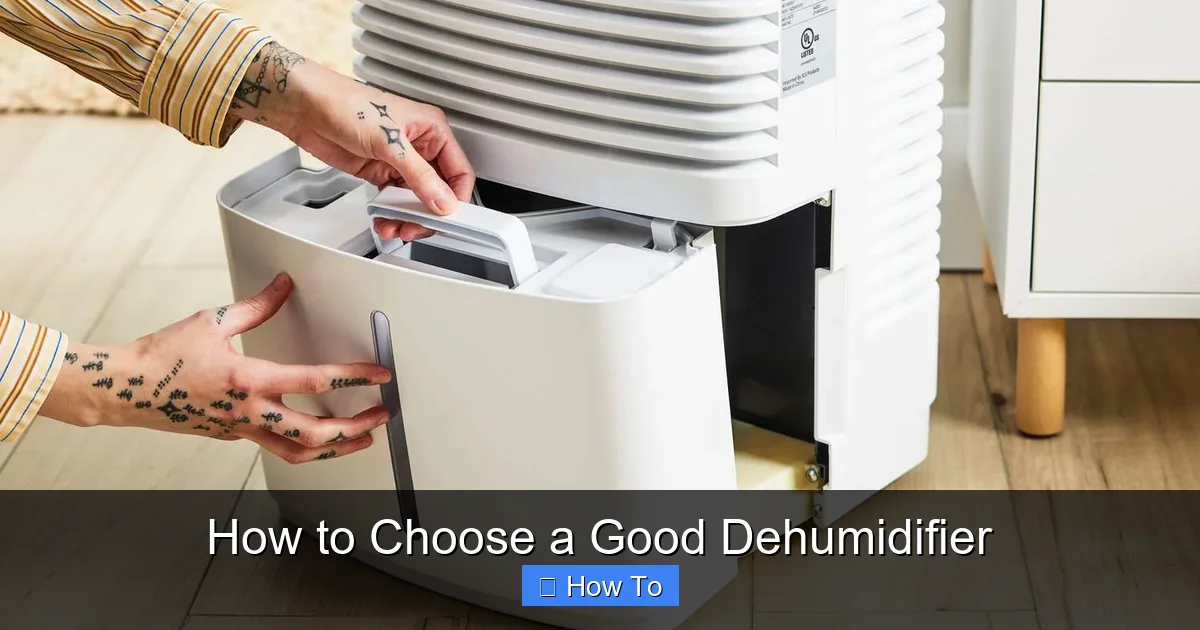
Choosing the right dehumidifier can improve air quality, prevent mold, and protect your home. This guide walks you through everything you need to know—from sizing and types to key features and placement tips—so you can pick the best dehumidifier for your space.
Quick Answers to Common Questions
Tip/Question?
How do I know if my dehumidifier is the right size?
Measure your room’s square footage and assess the humidity level. Use a sizing chart to match your needs with the correct pint capacity. If in doubt, go slightly larger.
Tip/Question?
Can I use a dehumidifier in a cold basement?
Yes, but choose a desiccant model or a compressor unit with a defrost function. Compressor models may freeze below 65°F.
Tip/Question?
Should I get a dehumidifier with a pump?
If you can’t empty the tank daily or don’t have a nearby drain, a built-in pump lets you drain water vertically or over long distances—great for basements.
Tip/Question?
How often should I clean my dehumidifier?
Clean the filter every 2–4 weeks and the water tank monthly. Wipe the exterior and coils as needed to maintain performance.
Tip/Question?
Is a more expensive dehumidifier worth it?
Often, yes. Higher-priced models offer better efficiency, durability, and features like auto-humidistat and continuous drainage, saving money and hassle long-term.
How to Choose a Good Dehumidifier
High humidity doesn’t just feel sticky—it can damage your home, trigger allergies, and encourage mold growth. A good dehumidifier removes excess moisture from the air, creating a healthier, more comfortable living environment. But with so many models on the market, how do you pick the right one?
In this guide, we’ll walk you through every step of choosing a dehumidifier that fits your needs. You’ll learn how to assess your space, understand different types of dehumidifiers, compare key features, and avoid common mistakes. Whether you’re dealing with a damp basement, a humid bathroom, or a musty closet, this guide will help you make a smart, informed decision.
Step 1: Assess Your Space and Humidity Level
Before buying any dehumidifier, you need to understand the problem you’re solving. Not all rooms or homes have the same humidity issues. Start by evaluating two key factors: the size of the area and the level of moisture present.
Visual guide about How to Choose a Good Dehumidifier
Image source: media.4rgos.it
Measure the Square Footage
The first step is to measure the room where you plan to use the dehumidifier. Use a tape measure to find the length and width, then multiply them to get the square footage. For example, a 10 ft x 12 ft room is 120 square feet.
Why does this matter? Dehumidifiers are rated by how much moisture they can remove in a 24-hour period, measured in pints. The larger the room, the higher the capacity you’ll need. Most manufacturers provide sizing charts based on square footage and humidity level.
Determine the Humidity Level
Next, figure out how damp your space really is. You can do this in two ways:
- Use a hygrometer: This inexpensive device measures relative humidity (RH). Ideal indoor humidity is between 30% and 50%. If it’s above 60%, you likely need a dehumidifier.
- Look for signs of high humidity: Condensation on windows, musty smells, peeling paint, or mold growth are all red flags.
Once you know your humidity level, you can classify your space as:
- Slightly damp: Occasional musty odor, no standing water.
- Moderately damp: Noticeable moisture, damp spots after rain.
- Very damp: Constant dampness, standing water, or flooding history.
- Wet: Frequent standing water, high condensation, or recent water damage.
For example, a slightly damp 500 sq ft basement might need a 20-pint dehumidifier, while a very damp 1,000 sq ft basement could require a 50-pint model.
Step 2: Choose the Right Type of Dehumidifier
Not all dehumidifiers work the same way. The two main types—compressor (refrigerant) and desiccant—use different technologies and are suited for different environments.
Compressor (Refrigerant) Dehumidifiers
These are the most common type. They work like a mini air conditioner: a fan pulls moist air over cold coils, causing water to condense and drip into a tank. The dry air is then reheated and released back into the room.
Best for: Warm, humid climates (above 65°F or 18°C). They’re highly effective in basements, laundry rooms, and living areas during summer.
Pros:
- High moisture removal capacity
- Energy-efficient in warm conditions
- Widely available and affordable
Cons:
- Less effective in cold temperatures
- Can be noisy
- May freeze up in unheated spaces
Desiccant Dehumidifiers
These use a moisture-absorbing material (like silica gel) to pull water from the air. The desiccant is then heated to release the moisture, which is collected or vented out.
Best for: Cool or cold environments (below 65°F or 18°C), such as garages, crawl spaces, or winter basements.
Pros:
- Works well in low temperatures
- Quiet operation
- Compact and lightweight
Cons:
- Lower moisture removal capacity
- Higher energy use
- Often more expensive
Hybrid Models: Some newer dehumidifiers combine both technologies for better performance across a range of temperatures. These are ideal if your space experiences seasonal temperature swings.
Step 3: Pick the Right Capacity (Pints per Day)
Dehumidifier capacity is measured in pints per day (PPD)—the amount of water it can remove in 24 hours. Choosing the right capacity ensures your unit can handle the moisture load without running constantly or underperforming.
Use a Sizing Chart
Most manufacturers provide a sizing guide based on room size and humidity level. Here’s a general rule of thumb:
| Room Size | Slightly Damp | Moderately Damp | Very Damp | Wet |
|---|---|---|---|---|
| 250–500 sq ft | 10–20 pints | 20–30 pints | 30–50 pints | 50+ pints |
| 500–1,000 sq ft | 20–30 pints | 30–50 pints | 50–70 pints | 70+ pints |
| 1,000–1,500 sq ft | 30–50 pints | 50–70 pints | 70–90 pints | 90+ pints |
For example, a 750 sq ft basement with moderate dampness would need a 30–50 pint dehumidifier. If you’re unsure, it’s better to go slightly larger—oversized units cycle on and off more efficiently than undersized ones that run nonstop.
Consider Continuous Operation
If your space is very wet or you want 24/7 moisture control, look for a model with a built-in pump or continuous drainage option. This allows the dehumidifier to run without you having to empty the tank manually.
Step 4: Look for Essential Features
Modern dehumidifiers come with a range of features that improve convenience, efficiency, and performance. Here are the most important ones to look for.
Auto-Humidistat
This feature lets you set your desired humidity level (e.g., 45%). The dehumidifier will automatically turn on and off to maintain that level. It saves energy and prevents over-drying.
Continuous Drainage Option
Instead of relying on a water tank, you can connect a hose to drain water directly into a floor drain, sink, or sump pump. This is ideal for basements or unattended areas.
Auto-Restart
If the power goes out, this feature ensures the dehumidifier turns back on at the previous settings when power returns. Great for storm-prone areas.
Washable Air Filter
A clean filter improves airflow and efficiency. Look for a removable, washable filter that’s easy to clean every few weeks.
Defrost Function
Essential for compressor models used in cold spaces. It prevents the coils from freezing, which can damage the unit or reduce performance.
Timer and Remote Control
A 24-hour timer lets you schedule operation, while a remote or app control adds convenience, especially for units in hard-to-reach places.
Low-Temperature Operation
If you’re using the dehumidifier in a garage or unheated basement, check the minimum operating temperature. Some models work down to 41°F (5°C), while others stop at 65°F (18°C).
Step 5: Consider Noise Levels
Dehumidifiers can be noisy, especially compressor models. If you’re placing it in a bedroom, living room, or home office, noise matters.
Check the Decibel (dB) Rating
Most dehumidifiers range from 45 to 65 dB. For reference:
- 45 dB: Quiet library
- 50 dB: Quiet conversation
- 60 dB: Normal conversation
- 65 dB: Dishwasher
For quiet spaces, aim for a model under 50 dB. Desiccant dehumidifiers are typically quieter than compressor types.
Look for “Quiet Mode” or “Sleep Mode”
Some models have a low-speed setting that reduces noise at night. This is helpful if you’re sensitive to sound while sleeping.
Step 6: Evaluate Energy Efficiency
Dehumidifiers can use a lot of electricity, especially if they run frequently. Choosing an energy-efficient model saves money and reduces your carbon footprint.
Look for ENERGY STAR Certification
ENERGY STAR-certified dehumidifiers are 10–20% more efficient than standard models. They meet strict guidelines set by the U.S. Environmental Protection Agency.
Check the Energy Factor (L/kWh)
This measures how many liters of water the unit removes per kilowatt-hour of electricity. Higher numbers mean better efficiency. For example:
- 1.5 L/kWh: Standard efficiency
- 2.0 L/kWh: High efficiency
- 2.5+ L/kWh: Very high efficiency
A higher energy factor means lower operating costs over time.
Estimate Annual Energy Use
Some manufacturers provide estimated yearly energy consumption (in kWh). Multiply this by your local electricity rate to estimate annual cost. For example, a 300 kWh/year unit at $0.12/kWh costs about $36 per year to run.
Step 7: Think About Placement and Portability
Where you place your dehumidifier affects its performance and convenience.
Choose the Right Location
Place the unit in a central area with good airflow. Avoid corners, behind furniture, or near walls. Keep at least 6–12 inches of clearance on all sides.
For basements, place it near the source of moisture—like a sump pump or damp wall. In living areas, position it where air circulates freely.
Consider Portability
If you plan to move the dehumidifier between rooms, look for:
- Built-in handles
- Wheels or casters
- Lightweight design (under 40 lbs)
Some models come with a carry handle and recessed wheels for easy transport.
Step 8: Compare Brands and Read Reviews
Not all dehumidifiers are created equal. Brand reputation, warranty, and customer reviews can help you avoid duds.
Top Brands to Consider
- Frigidaire: Reliable, energy-efficient models with good warranties.
- hOmeLabs: Popular for basements, with smart features and strong performance.
- GE: Affordable options with solid build quality.
- Eva-Dry: Known for compact, desiccant-based units.
- AprilAire: Whole-house systems for integrated HVAC setups.
Read Customer Reviews
Look for reviews that mention:
- Real-world performance (does it actually reduce humidity?)
- Noise level
- Ease of maintenance
- Durability and reliability
- Customer service experience
Avoid models with frequent complaints about leaks, breakdowns, or poor support.
Step 9: Set a Budget
Dehumidifiers range from $100 to $600+, depending on size, type, and features.
Price Ranges
- $100–$200: Small, portable units (10–20 pints). Good for closets or small bathrooms.
- $200–$400: Mid-range models (20–50 pints). Ideal for basements and living areas.
- $400–$600+: High-capacity or whole-house systems. Best for large or very damp spaces.
While it’s tempting to go cheap, investing in a quality dehumidifier pays off in performance, durability, and energy savings.
Step 10: Maintenance and Troubleshooting
A good dehumidifier needs regular care to work well and last longer.
Routine Maintenance
- Empty the water tank: Do this daily if not using continuous drainage.
- Clean the filter: Wash every 2–4 weeks with mild soap and water.
- Wipe the coils: Use a soft brush or vacuum to remove dust buildup.
- Check for mold: Clean the tank and interior with a vinegar solution monthly.
Common Problems and Fixes
- Unit won’t turn on: Check power cord, outlet, and settings. Ensure the tank isn’t full.
- Not removing moisture: Clean the filter, check for frost on coils, or move to a warmer area.
- Leaking water: Ensure the tank is seated properly. Check for cracks or hose leaks.
- Too noisy: Make sure the unit is level and not vibrating against a surface.
Regular maintenance prevents most issues and extends the life of your dehumidifier.
Conclusion
Choosing a good dehumidifier doesn’t have to be overwhelming. By assessing your space, understanding your humidity level, and comparing features, you can find a model that keeps your home dry, healthy, and comfortable.
Remember: size matters, but so do features like auto-humidistat, continuous drainage, and energy efficiency. Don’t forget to consider noise, placement, and maintenance. With the right dehumidifier, you’ll breathe easier and protect your home from moisture damage.
Take your time, read reviews, and invest in a quality unit. Your home—and your health—will thank you.