
Choosing the right dehumidifier size for your basement ensures effective moisture control and prevents mold, musty odors, and structural damage. This guide walks you through measuring your space, understanding capacity ratings, and selecting features that match your basement’s needs. With practical tips and expert advice, you’ll pick a dehumidifier that works efficiently and saves energy.
Quick Answers to Common Questions
Tip/Question?
How do I know if my basement is too damp for a standard dehumidifier?
If you see standing water, frequent leaks, or mold, you may need a commercial-grade dehumidifier or professional waterproofing first. A standard unit can’t fix structural water issues.
Tip/Question?
Can I use one dehumidifier for my whole house?
Most basement dehumidifiers are designed for single rooms. For whole-house dehumidification, consider a whole-house unit installed with your HVAC system.
Tip/Question?
Should I run the dehumidifier all the time?
It’s best to run it continuously during humid months or set it to maintain 40–50% humidity. Use a timer or humidistat to avoid overworking the unit.
Tip/Question?
What’s the difference between a 50-pint and 70-pint dehumidifier?
A 70-pint unit removes 20 more pints of water per day, making it better for larger or wetter basements. It’s more powerful but also larger and more expensive.
Tip/Question?
Can I place my dehumidifier in a corner?
It’s not ideal. Corners restrict airflow. Place it in the center or at least 6 inches away from walls for best performance.
How to Choose Dehumidifier Size Basement: A Complete Step-by-Step Guide
Basements are notorious for high humidity, musty smells, and mold growth. Whether you use your basement for storage, laundry, or as a living space, controlling moisture is essential. A dehumidifier is one of the most effective tools for keeping your basement dry and healthy. But here’s the catch: not all dehumidifiers are created equal. Choosing the wrong size can lead to wasted energy, poor performance, and ongoing humidity problems.
In this guide, you’ll learn exactly how to choose dehumidifier size basement. We’ll walk you through measuring your space, understanding humidity levels, matching capacity to your needs, and selecting the best features. By the end, you’ll know how to pick a dehumidifier that works efficiently, saves money, and protects your home. Let’s dive in!
Step 1: Measure Your Basement’s Square Footage
The first step in choosing the right dehumidifier is knowing how big your basement is. Dehumidifiers are rated by how much moisture they can remove in a day, measured in pints. But that number only makes sense when you know the size of the area you’re trying to dehumidify.

Visual guide about How to Choose Dehumidifier Size Basement
Image source: i.pinimg.com
How to Calculate Square Footage
Grab a tape measure and a notepad. Measure the length and width of your basement in feet. Multiply these two numbers to get the total square footage.
For example, if your basement is 20 feet long and 25 feet wide:
- 20 ft × 25 ft = 500 square feet
If your basement has an irregular shape, break it into rectangles, calculate each section, and add them together. Don’t forget to include closets, storage nooks, or finished areas—they all contribute to the total space.
Why Square Footage Matters
Dehumidifier manufacturers use square footage as a baseline for sizing recommendations. A unit rated for 500 square feet won’t be effective in a 1,000-square-foot basement. Oversized units may cycle too quickly, wasting energy. Undersized units will run constantly, struggle to keep up, and wear out faster.
Pro Tip: If your basement has high ceilings (over 8 feet), you may need a slightly larger unit. More air volume means more moisture to remove.
Step 2: Assess Your Basement’s Moisture Level
Not all basements are equally damp. Some are just slightly humid, while others have standing water or frequent leaks. The moisture level directly affects the dehumidifier size you need.
Use a Hygrometer to Measure Humidity
A hygrometer is a small, inexpensive device that measures relative humidity (RH). You can find digital hygrometers at hardware stores or online for under $20. Place it in your basement for 24–48 hours to get an accurate reading.
Ideal basement humidity is between 30% and 50%. If it’s above 60%, you have a moisture problem that needs attention.
Categorize Your Basement’s Condition
Based on your hygrometer reading and visual inspection, classify your basement into one of these categories:
- Slightly Damp: Feels cool and may have a faint musty smell. No visible water or mold. Humidity around 50–60%.
- Very Damp: Noticeable musty odor, damp spots on walls or floor, occasional condensation. Humidity 60–70%.
- Wet: Standing water after rain, frequent leaks, visible mold, or flooding. Humidity above 70%.
Your category determines the dehumidifier’s capacity (pints per day). A slightly damp basement needs less power than a wet one.
Look for Signs of Moisture Problems
Even without a hygrometer, you can spot clues:
- Peeling paint or wallpaper
- Warped wood or rust on metal
- Water stains on walls or floor
- Condensation on windows or pipes
- Spongy or soft spots on the floor
If you see these signs, your basement likely falls into the “very damp” or “wet” category.
Step 3: Match Dehumidifier Capacity to Your Needs
Dehumidifiers are rated by how many pints of moisture they can remove in 24 hours. This is called “pints per day” (PPD). The right capacity depends on your basement’s size and moisture level.
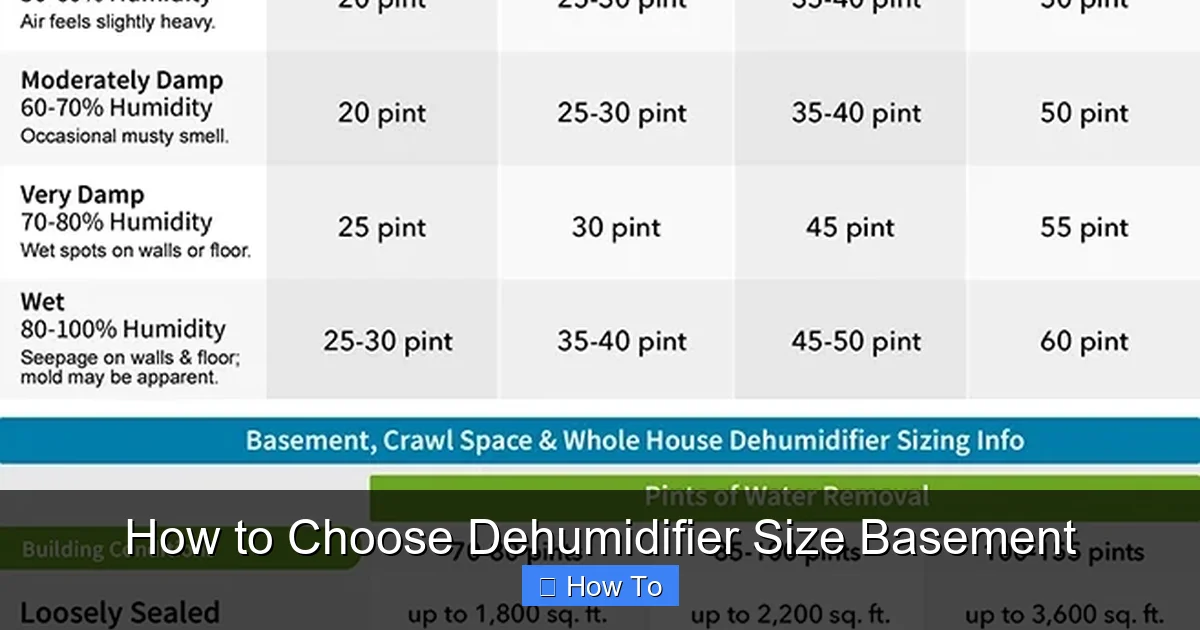
Use a Sizing Chart as a Starting Point
Most manufacturers provide guidelines like this:
| Basement Size (sq ft) | Slightly Damp | Very Damp | Wet |
|---|---|---|---|
| 500 | 20–30 pints | 30–50 pints | 50–70 pints |
| 1,000 | 30–40 pints | 40–60 pints | 60–70 pints |
| 1,500 | 40–50 pints | 50–70 pints | 70+ pints |
For example, a 500-square-foot basement that’s very damp needs a 30–50-pint dehumidifier. If it’s wet, go for 50–70 pints.
Don’t Overbuy—But Don’t Underbuy Either
It’s tempting to buy the biggest dehumidifier available, but oversized units can short-cycle—turning on and off too quickly. This wastes energy and doesn’t allow enough time to remove moisture effectively.
On the other hand, an undersized unit will run nonstop, struggle to keep up, and may overheat or fail prematurely. It’s better to slightly oversize than undersize, but aim for the right balance.
Consider Climate and Seasonal Changes
If you live in a humid region (like the Southeast U.S.), your basement may need more dehumidification during summer. In colder climates, basements can be damp in spring and fall due to temperature swings.
Some dehumidifiers have “auto-defrost” features for cold basements (below 65°F). These prevent ice buildup on coils, which can stop the unit from working.
Step 4: Choose the Right Features for Your Basement
Once you know the size, look for features that improve performance, convenience, and energy efficiency.
ENERGY STAR Certification
Look for the ENERGY STAR label. These models use 15–30% less energy than standard units, saving you money on electricity. Over time, the savings can offset the higher upfront cost.
Built-in Humidistat
A humidistat lets you set your desired humidity level (e.g., 45%). The dehumidifier turns on and off automatically to maintain that level. This prevents over-drying and saves energy.
Continuous Drainage Option
Most dehumidifiers have a water tank you must empty manually. But if your basement is very damp, the tank may fill up daily. A continuous drainage hose (usually ⅝-inch) lets you drain water directly into a floor drain, sump pump, or utility sink. No more daily emptying!
Auto-Restart and Timer
Power outages are common in basements. An auto-restart feature turns the unit back on after a power failure. A timer lets you schedule operation—great for running it during off-peak hours to save energy.
Washable Filter
A reusable air filter captures dust and mold spores. Look for a washable filter—just rinse it monthly to keep airflow strong and efficiency high.
Quiet Operation
If your basement is near living spaces, noise matters. Look for models under 50 decibels (dB). Check reviews for real-world noise levels—some units are quieter than others.
Step 5: Consider Placement and Airflow
Even the best dehumidifier won’t work well if it’s in the wrong spot.
Place It in the Center of the Room
Put the dehumidifier in the middle of the basement, away from walls and furniture. This allows air to circulate freely from all sides.
Keep Vents Clear
Leave at least 6–12 inches of space around the intake and exhaust vents. Don’t block them with boxes, furniture, or curtains.
Avoid Corners and Enclosed Spaces
Corners restrict airflow. If you must place it near a wall, angle it so air can move around it.
Use a Fan for Better Circulation
In large or poorly ventilated basements, a small fan can help distribute dry air. Place it opposite the dehumidifier to push air across the room.
Close Doors and Windows
Keep basement doors and windows closed while the dehumidifier runs. Outside air brings in more moisture, making the unit work harder.
Step 6: Maintain Your Dehumidifier for Long-Term Performance
A dehumidifier is an investment. Regular maintenance keeps it running efficiently and extends its life.
Clean the Filter Monthly
Turn off the unit and remove the filter. Rinse it with warm water and let it dry completely before replacing. A dirty filter reduces airflow and efficiency.
Empty the Water Tank Regularly
If you’re not using continuous drainage, check the tank daily during humid months. Most units have a “tank full” light to alert you.
Check for Ice Buildup
In cold basements, ice can form on the coils. If you see frost, turn off the unit and let it thaw. Consider a model with auto-defrost if this happens often.
Inspect the Coils and Drain Hose
Once a year, vacuum the coils to remove dust. If using a drain hose, check for clogs or kinks that block water flow.
Store Properly in Off-Seasons
If you turn off the dehumidifier in winter, clean it thoroughly, remove the filter, and store it in a dry place. Cover it to prevent dust buildup.
Troubleshooting Common Dehumidifier Problems
Even the right-sized dehumidifier can have issues. Here’s how to fix common problems:
Unit Runs But Doesn’t Remove Moisture
Possible causes:
- Dirty filter—clean or replace it
- Frozen coils—turn off and let thaw
- Low refrigerant—call a technician
- Undersized unit—consider upgrading
Water Tank Overflows
Solutions:
- Empty the tank more often
- Install a continuous drain hose
- Check if the float switch is stuck
Unit Is Too Loud
Try:
- Placing it on a rubber mat to reduce vibration
- Moving it away from hard surfaces
- Checking for loose parts or fan issues
Humidity Stays High Despite Running
This could mean:
- The unit is undersized for the space
- There’s a hidden water leak
- Airflow is blocked
- The humidistat is broken
Test with a hygrometer. If humidity stays above 60%, investigate leaks or upgrade your dehumidifier.
Conclusion: Make the Right Choice for a Dry, Healthy Basement
Choosing the right dehumidifier size for your basement doesn’t have to be overwhelming. Start by measuring your space and checking humidity levels. Match the capacity (pints per day) to your basement’s size and moisture condition. Then, pick a model with energy-efficient features, proper drainage, and smart controls.
Remember, a well-sized dehumidifier doesn’t just remove moisture—it prevents mold, protects your belongings, and improves indoor air quality. With the right unit and regular maintenance, your basement can stay dry, comfortable, and healthy year-round.
Don’t guess—measure, assess, and choose wisely. Your basement (and your peace of mind) will thank you.