
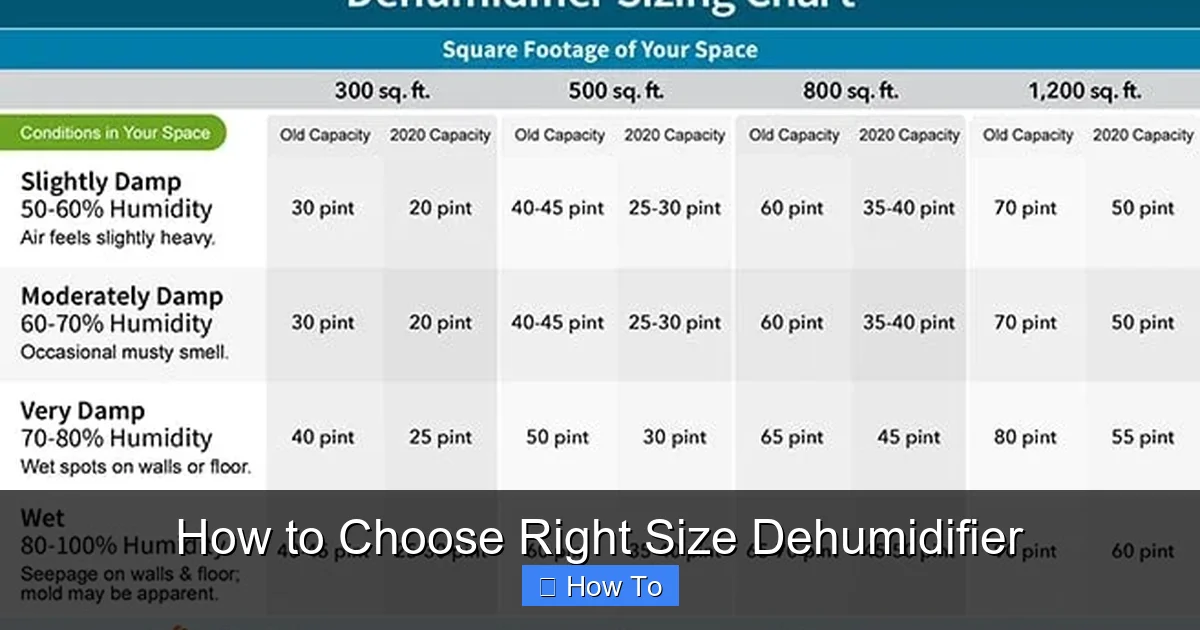
Choosing the right size dehumidifier ensures optimal moisture control, energy efficiency, and long-term performance. This guide walks you through room size, humidity levels, and capacity ratings to help you pick the best model for your needs.
Quick Answers to Common Questions
Tip/Question?
What’s the ideal humidity level for my home?
Keep indoor humidity between 30% and 50% for comfort and health. Use a hygrometer to monitor levels regularly.
Tip/Question?
Can I use one dehumidifier for my whole house?
Most residential dehumidifiers are designed for single rooms. For whole-house coverage, consider a whole-home dehumidifier integrated with your HVAC system.
Tip/Question?
Should I run my dehumidifier all the time?
It depends. Use it continuously in damp areas like basements. In other rooms, run it when humidity exceeds 50% or during humid seasons.
Tip/Question?
How often should I clean my dehumidifier?
Clean the filter monthly and empty the water tank regularly. Deep clean the coils and tank every 3–6 months.
Tip/Question?
Is a higher PPD always better?
Not necessarily. Match PPD to your room size and humidity level. An oversized unit can waste energy and over-dry the air.
How to Choose the Right Size Dehumidifier
Excess moisture in your home can lead to mold, musty odors, and structural damage. A dehumidifier helps maintain healthy indoor air quality by removing excess humidity. But with so many models and sizes available, how do you know which one is right for you? Choosing the right size dehumidifier isn’t just about picking the biggest one—it’s about matching the unit’s capacity to your specific space, humidity level, and lifestyle.
In this guide, you’ll learn how to choose the right size dehumidifier step by step. We’ll cover everything from measuring your room and testing humidity levels to understanding capacity ratings and energy efficiency. By the end, you’ll have the confidence to select a dehumidifier that works efficiently, saves energy, and keeps your home comfortable year-round.
Step 1: Measure Your Room’s Square Footage
The first step in choosing the right size dehumidifier is knowing how much space you need to cover. Most manufacturers list coverage area in square feet, so getting an accurate measurement is essential.
Visual guide about How to Choose Right Size Dehumidifier
Image source: buildbetterhouse.com
How to Calculate Square Footage
To find the square footage of a room, multiply the length by the width. For example, a room that is 12 feet long and 10 feet wide equals 120 square feet. If your room is irregularly shaped, divide it into rectangles, calculate each section, and add them together.
Don’t forget to include all connected areas that share airflow, such as open hallways or adjacent rooms. If your basement has an open floor plan, measure the entire space rather than individual sections.
Why Room Size Matters
A dehumidifier that’s too small won’t effectively remove moisture, leading to ongoing humidity problems. On the other hand, an oversized unit may cycle on and off too frequently, wasting energy and wearing out components faster. The goal is to find a balanced fit.
As a general rule:
- Small rooms (up to 500 sq. ft.): 20–30 pints per day (PPD)
- Medium rooms (500–1,500 sq. ft.): 30–50 PPD
- Large rooms (1,500–2,500 sq. ft.): 50–70 PPD
- Very large or open areas (2,500+ sq. ft.): 70+ PPD or multiple units
Keep in mind that these are starting points. Other factors like humidity level and room usage will influence your final choice.
Step 2: Test the Humidity Level
Room size gives you a baseline, but humidity level determines how hard your dehumidifier needs to work. A 500-square-foot basement in Florida will need a much stronger unit than the same size room in Arizona.
Use a Hygrometer to Measure Humidity
A hygrometer is a small, inexpensive device that measures relative humidity (RH). You can find digital hygrometers at hardware stores or online for under $20. Place it in the room for 24–48 hours, checking it at different times of day to get an average reading.
Ideal indoor humidity levels are between 30% and 50%. Anything above 60% is considered high and can promote mold and dust mites.
Interpret Your Results
Based on your hygrometer reading, categorize the humidity level:
- Normal (30–50%): Standard dehumidifier capacity is sufficient.
- Moderately damp (50–60%): Choose a mid-range or higher-capacity unit.
- Very damp (60–70%): Opt for a high-capacity model with strong moisture removal.
- Wet or flooded (70%+): You may need a commercial-grade dehumidifier or professional remediation.
For example, if your basement reads 65% humidity, a 50-pint dehumidifier would be more appropriate than a 30-pint model—even if the room is only 800 square feet.
Step 3: Understand Dehumidifier Capacity (Pints Per Day)
Dehumidifier capacity is measured in pints per day (PPD)—the amount of moisture the unit can remove in 24 hours under standard conditions (80°F and 60% RH). This number is your best guide to performance.
Match PPD to Your Needs
Manufacturers often provide a “coverage guide” based on room size and humidity. Here’s a simplified version:
- 20–30 PPD: Small, dry areas (e.g., closets, RVs, or bathrooms with ventilation)
- 30–50 PPD: Medium-sized, moderately damp rooms (e.g., living rooms, small basements)
- 50–70 PPD: Large, damp spaces (e.g., full basements, garages, or homes in humid climates)
- 70+ PPD: Very large or extremely wet areas (e.g., flood-damaged rooms, crawl spaces with standing water)
For instance, a 70-pint dehumidifier can remove up to 70 pints of water per day—ideal for a 1,500-square-foot basement in a rainy region.
Beware of Overstated Ratings
Some manufacturers test dehumidifiers under ideal lab conditions, which may not reflect real-world performance. Look for units tested to AHAM (Association of Home Appliance Manufacturers) standards, which simulate typical home environments. AHAM-rated models provide more accurate PPD numbers.
Also, note that higher PPD doesn’t always mean better. An oversized unit may short-cycle (turn on and off rapidly), reducing efficiency and increasing wear. It can also over-dry the air, making your home feel uncomfortably dry.
Step 4: Consider Room Usage and Conditions
Not all rooms are created equal when it comes to moisture. How you use a space affects how much humidity it generates.
High-Moisture Areas
Some rooms naturally produce more moisture and need stronger dehumidification:
- Basements: Often damp due to poor ventilation and ground moisture. Choose a unit with at least 50 PPD for a standard basement.
- Laundry rooms: Clothes dryers release significant moisture. A 30–50 PPD unit is recommended, especially if the dryer isn’t vented outside.
- Bathrooms: Steam from showers increases humidity. A small 20–30 PPD unit or a vented exhaust fan may suffice.
- Kitchens: Cooking and dishwashing add moisture. Consider a portable dehumidifier or ensure good ventilation.
- Crawl spaces: Enclosed and prone to dampness. Use a dedicated crawl space dehumidifier with a condensate pump for automatic drainage.
Climate and Seasonal Changes
Your local climate plays a big role. Homes in humid regions like the Southeast U.S., Gulf Coast, or Pacific Northwest need more powerful dehumidifiers year-round. In contrast, dry climates may only require seasonal use.
Also, consider seasonal changes. Humidity often spikes in summer due to heat and rain. If you only need dehumidification during certain months, a mid-sized unit may be sufficient. But if you live in a consistently humid area, invest in a higher-capacity model.
Step 5: Evaluate Energy Efficiency
A larger dehumidifier uses more electricity, so energy efficiency is crucial for long-term savings and environmental impact.
Look for ENERGY STAR Certification
ENERGY STAR-certified dehumidifiers are at least 10% more efficient than standard models. They use advanced compressors and fans to remove moisture with less energy. Over time, this can save you hundreds of dollars on utility bills.
Check the unit’s energy factor (liters of water removed per kilowatt-hour of electricity). Higher numbers mean better efficiency. For example, a model with an energy factor of 2.0 is more efficient than one with 1.5.
Consider Operating Costs
To estimate monthly costs, multiply the dehumidifier’s wattage by the number of hours used per day, then by your electricity rate. For example:
- A 500-watt dehumidifier running 8 hours a day = 4,000 watt-hours (4 kWh)
- At $0.12 per kWh, that’s $0.48 per day or about $14.40 per month
ENERGY STAR models may cost more upfront but pay for themselves in energy savings.
Step 6: Choose the Right Features
Beyond size and capacity, features can enhance convenience and performance.
Automatic Humidistat
A built-in humidistat lets you set your desired humidity level (e.g., 45%). The dehumidifier turns on and off automatically to maintain that level, preventing over-drying and saving energy.
Continuous Drainage Option
Most dehumidifiers have a water tank that needs emptying every 12–24 hours. A continuous drainage hose allows the unit to empty directly into a floor drain or sump pump, ideal for basements or 24/7 operation.
Auto Defrost
In cold environments (below 65°F), frost can build up on the coils, reducing efficiency. Auto-defrost models melt ice automatically, ensuring consistent performance in unheated spaces like garages or crawl spaces.
Portability and Noise Level
If you plan to move the dehumidifier between rooms, look for one with wheels and a handle. Noise level is also important—especially for bedrooms or living areas. Choose a model under 50 decibels for quiet operation.
Filter and Maintenance Alerts
Some models have washable filters and indicator lights that remind you when to clean them. This improves air quality and extends the unit’s lifespan.
Step 7: Avoid Common Sizing Mistakes
Even with the right information, it’s easy to make errors when choosing a dehumidifier. Here are common pitfalls to avoid:
Buying Based on Price Alone
A cheap, undersized unit may seem like a bargain, but it won’t solve your humidity problem and may cost more in repairs or replacements. Invest in quality and proper sizing.
Ignoring Humidity Sources
If your home has a water leak, poor ventilation, or foundation issues, a dehumidifier alone won’t fix the problem. Address the root cause first, then choose a unit to maintain healthy levels.
Overlooking Airflow
Dehumidifiers need good airflow to work efficiently. Don’t place them in tight corners or behind furniture. Leave at least 6–12 inches of clearance around the unit.
Assuming Bigger Is Always Better
An oversized dehumidifier can over-dry the air, leading to dry skin, irritated sinuses, and static electricity. It can also short-cycle, reducing efficiency and lifespan.
Troubleshooting: What If Your Dehumidifier Isn’t Working?
Even the right-sized dehumidifier can underperform if not used correctly. Here’s how to troubleshoot common issues:
Unit Isn’t Removing Enough Moisture
- Check the filter: A dirty filter restricts airflow. Clean or replace it monthly.
- Ensure proper placement: Move the unit away from walls and furniture.
- Verify humidity settings: Make sure the humidistat is set below the current humidity level.
- Inspect for frost: In cold rooms, frost on coils can block operation. Use a model with auto-defrost.
Water Tank Fills Too Quickly
- Use continuous drainage: Attach a hose to bypass the tank.
- Check for leaks: Inspect the room for water sources like cracks or condensation.
- Reduce moisture sources: Use exhaust fans in bathrooms and kitchens.
Unit Is Too Noisy
- Place on a stable surface: Vibrations can increase noise.
- Check for loose parts: Tighten screws or panels if needed.
- Choose a quieter model: Look for units with noise ratings under 50 dB.
Conclusion
Choosing the right size dehumidifier doesn’t have to be complicated. Start by measuring your room, testing humidity levels, and understanding capacity ratings. Factor in room usage, climate, and energy efficiency to find a model that fits your needs. Avoid common mistakes like oversizing or ignoring maintenance, and don’t forget to use features like automatic humidistats and continuous drainage for convenience.
A properly sized dehumidifier will keep your home comfortable, protect your belongings, and improve indoor air quality. Take the time to assess your space and needs—your future self will thank you when you’re breathing easier and saying goodbye to mold and musty smells.