
Choosing the right size dehumidifier ensures optimal moisture control, energy efficiency, and long-term performance. This guide walks you through room size, humidity levels, and key features to help you pick the perfect unit for your space.
Quick Answers to Common Questions
Tip/Question?
How often should I empty the dehumidifier bucket?
It depends on the model and humidity level, but most portable units need emptying every 12–24 hours. Use continuous drainage to avoid this chore.
Tip/Question?
Can I use a dehumidifier in winter?
Yes, but only if the space stays above 60°F. Below that, coils may freeze. Choose a model with an auto-defrost feature for cold areas.
Tip/Question?
Should I run the dehumidifier all the time?
Not necessarily. Use the auto-humidistat to maintain 40–50% humidity. Running it continuously in dry conditions can over-dry the air.
Tip/Question?
Will a dehumidifier help with allergies?
Yes. By reducing mold, dust mites, and mildew, a dehumidifier can significantly improve indoor air quality and allergy symptoms.
Tip/Question?
Can I place a dehumidifier in a closet?
Only if it’s well-ventilated and the unit has proper airflow. Most closets are too small and enclosed, which can cause overheating.
How to Choose the Correct Size Dehumidifier
Excess moisture in your home can lead to a host of problems—mold growth, musty odors, warped wood, and even health issues like allergies and asthma. A dehumidifier is a simple, effective solution, but only if you choose the right one. The key to success? Picking the correct size.
Many people make the mistake of buying a dehumidifier based solely on price or brand, only to find it’s either too weak to make a difference or so powerful it cycles on and off too quickly, wasting energy. This guide will walk you through everything you need to know to choose the correct size dehumidifier for your home, whether you’re tackling a damp basement, a humid bathroom, or a whole-house moisture issue.
By the end of this guide, you’ll understand how to measure your space, assess humidity levels, interpret dehumidifier capacity ratings, and select a model that delivers reliable, energy-efficient performance. Let’s dive in.
Step 1: Measure the Square Footage of the Area
The first step in choosing the right dehumidifier is knowing how much space it needs to cover. Dehumidifiers are rated by the amount of moisture they can remove per day (measured in pints), and that rating is based on standard room sizes. So, start by measuring the area where you plan to use the unit.
Visual guide about How to Choose the Correct Size Dehumidifier
Image source: i.pinimg.com
How to Calculate Square Footage
To find the square footage of a room, multiply the length by the width. For example, a basement that’s 20 feet long and 30 feet wide equals 600 square feet. If your space is irregularly shaped, break it into smaller rectangles, calculate each, and add them together.
Include All Affected Areas
If moisture is spreading across multiple connected rooms—like an open-concept basement and laundry room—include the total combined square footage. Don’t forget closets, crawl spaces, or utility areas that may also be damp.
Example: Basement Sizing
Let’s say your basement is 40 feet by 25 feet. That’s 1,000 square feet. According to most manufacturer guidelines, a 1,000-square-foot space with moderate humidity would typically require a dehumidifier rated for at least 30–40 pints per day. But we’ll get into capacity matching in the next step.
Pro Tip: Use a laser measuring tool or a tape measure app on your smartphone for quick, accurate readings. Always round up to the nearest 100 square feet to ensure you don’t underestimate.
Step 2: Assess the Humidity Level in Your Space
Not all damp spaces are created equal. A slightly musty closet doesn’t need the same dehumidifier as a flood-prone basement. The severity of moisture determines the capacity and power you’ll need.
Use a Hygrometer to Measure Humidity
A hygrometer is a small, inexpensive device that measures relative humidity (RH) in the air. Ideal indoor humidity levels are between 30% and 50%. Anything above 60% is considered high and can promote mold and dust mites.
Place the hygrometer in the center of the room, away from windows, vents, or direct sunlight, and let it sit for at least an hour. Take readings at different times of day—humidity can fluctuate based on weather, laundry, showers, or cooking.
Categorize Your Space by Moisture Level
Most dehumidifier manufacturers classify spaces into three main categories based on humidity and dampness:
- Damp: Feels damp and may have a musty smell. Humidity is typically 50–60%. Common in basements with minor seepage or poor ventilation.
- Wet: Water may pool after rain, or you see condensation on walls and windows. Humidity is 60–70%. Often found in poorly sealed crawl spaces or laundry rooms.
- Very Wet: Frequent standing water, flooding, or severe condensation. Humidity exceeds 70%. Common in flood-prone areas or homes with chronic leaks.
Example: Basement Assessment
Imagine your basement has a musty odor, and you notice damp spots on the walls after heavy rain. A hygrometer reading shows 65% humidity. This falls into the “wet” category, meaning you’ll need a dehumidifier with higher capacity than a unit designed for a mildly damp space.
Pro Tip: If you don’t have a hygrometer, look for visual signs: peeling paint, rust on metal, or black spots (mold). These are strong indicators of high humidity.
Step 3: Match Dehumidifier Capacity to Your Space
Dehumidifiers are rated by how many pints of moisture they can remove in 24 hours under standard conditions (80°F and 60% RH). This is known as the “pint rating.” But real-world performance depends on your specific environment.
Use a Sizing Chart as a Starting Point
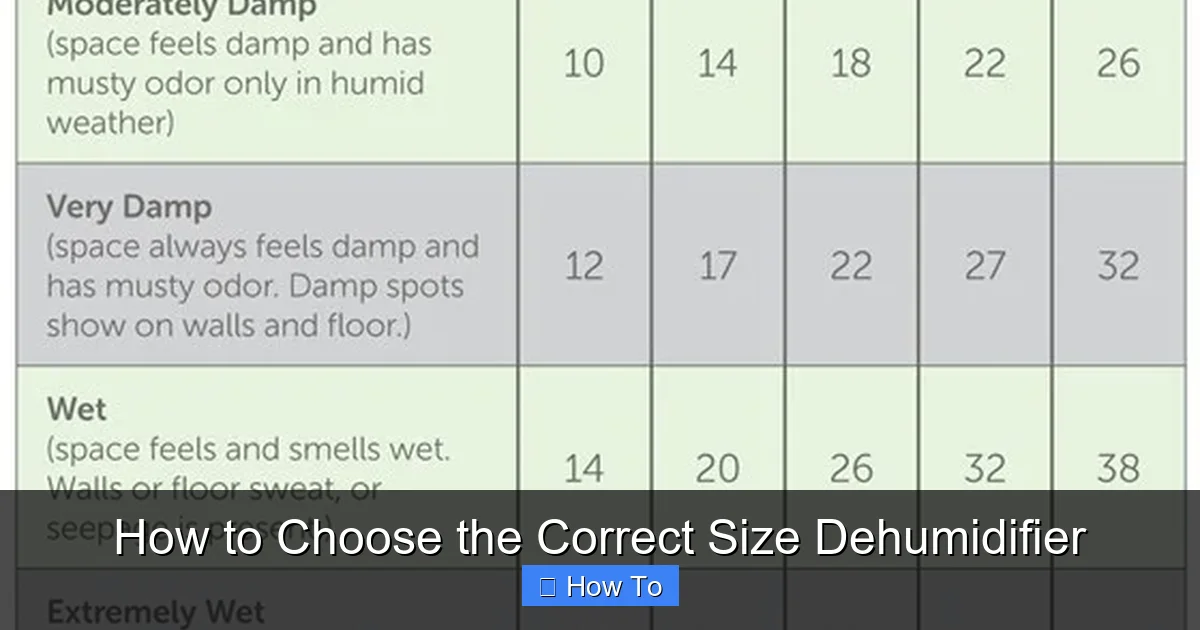
Most manufacturers provide a general sizing chart based on square footage and moisture level. Here’s a simplified version:
- Up to 500 sq. ft.: 10–20 pints (damp), 20–30 pints (wet), 30–50 pints (very wet)
- 500–1,000 sq. ft.: 20–30 pints (damp), 30–50 pints (wet), 50–70 pints (very wet)
- 1,000–1,500 sq. ft.: 30–40 pints (damp), 40–60 pints (wet), 60–90 pints (very wet)
- 1,500+ sq. ft.: 40–60 pints (damp), 60–90 pints (wet), 90+ pints (very wet)
Adjust for Real-World Conditions
These charts assume average conditions. If your space has any of the following, consider upgrading to a higher capacity:
- Poor ventilation (no windows or exhaust fans)
- Frequent water intrusion (leaky pipes, foundation cracks)
- High outdoor humidity (common in coastal or tropical climates)
- Heavy use (laundry drying indoors, frequent showers without ventilation)
Example: Choosing the Right Capacity
Let’s go back to the 1,000-square-foot basement with 65% humidity (wet category). According to the chart, you’d need a 50-pint dehumidifier. But if you live in a humid coastal area and your basement has a history of minor flooding, a 70-pint model would be a safer, more effective choice.
Pro Tip: Don’t go too high—oversized dehumidifiers can short-cycle (turn on and off too quickly), which reduces efficiency, increases wear, and may not run long enough to properly dehumidify.
Step 4: Consider Airflow and Ventilation
Even the best dehumidifier can’t work effectively if air isn’t circulating. Stagnant air traps moisture, making it harder for the unit to do its job.
Check for Obstructions
Ensure the dehumidifier has at least 6–12 inches of clearance on all sides, especially around the air intake and exhaust. Don’t place it against a wall or in a cramped corner.
Improve Air Circulation
If your space lacks airflow, consider adding a fan to help distribute dry air. In basements, a small oscillating fan can make a big difference. For whole-house dehumidification, a ducted system or HVAC-integrated unit may be necessary.
Ventilate High-Moisture Areas
Bathrooms, kitchens, and laundry rooms generate a lot of moisture. Use exhaust fans during and after showers or cooking. If possible, vent your dryer to the outside. These steps reduce the load on your dehumidifier.
Pro Tip: In tightly sealed homes, consider an energy recovery ventilator (ERV) or heat recovery ventilator (HRV) to balance humidity and air quality without wasting energy.
Step 5: Evaluate Key Features and Settings
Once you’ve narrowed down the size, look for features that enhance performance, convenience, and energy efficiency.
Auto-Humidistat
This built-in sensor monitors humidity and automatically turns the unit on or off to maintain your desired level (usually set between 40% and 50%). It prevents over-drying and saves energy.
Continuous Drainage Option
Instead of emptying a bucket every day, many dehumidifiers offer a hose connection for continuous drainage. This is ideal for basements or unattended spaces. Just attach a garden hose and direct it to a floor drain or sump pump.
Defrost Function
In cold environments (like unheated garages or crawl spaces), coils can freeze. A defrost feature automatically melts ice, ensuring the unit keeps running efficiently.
Energy Efficiency
Look for ENERGY STAR-certified models. These use up to 15% less energy than standard units and often qualify for utility rebates. Check the “Energy Factor” (liters of water removed per kilowatt-hour)—higher is better.
Portability and Noise
If you plan to move the dehumidifier between rooms, choose a model with wheels and a handle. For bedrooms or living areas, opt for a quieter unit (under 50 decibels).
Pro Tip: Some smart dehumidifiers connect to Wi-Fi and can be controlled via an app. You can monitor humidity levels, adjust settings, and receive alerts—even when you’re away from home.
Step 6: Decide Between Portable and Whole-House Units
Dehumidifiers come in two main types: portable and whole-house (or whole-home) systems.
Portable Dehumidifiers
These are standalone units you can move from room to room. They’re ideal for single areas like basements, bathrooms, or crawl spaces. Most have a bucket that needs emptying every 12–24 hours, though some offer continuous drainage.
Best for: Spot treatment, renters, or homes with isolated moisture problems.
Whole-House Dehumidifiers
These are larger, more powerful systems integrated into your HVAC ductwork. They treat the entire home and are typically installed by a professional. They’re more expensive upfront but offer consistent, whole-home humidity control.
Best for: Large homes, high humidity climates, or chronic moisture issues.
Hybrid Options
Some systems combine portable units with ducting kits, allowing you to dehumidify multiple rooms from one central location. These are a good middle ground for medium-sized homes.
Pro Tip: If you have central air conditioning, your AC removes some moisture—but not enough in very humid climates. A supplemental dehumidifier can improve comfort and reduce AC runtime.
Step 7: Read Reviews and Compare Brands
Not all dehumidifiers are created equal, even if they have the same pint rating. Performance, durability, and customer service vary by brand.
Check Independent Reviews
Look for reviews from trusted sources like Consumer Reports, Wirecutter, or HVAC professionals. Pay attention to real-world performance, noise levels, and reliability.
Compare Warranties
A good warranty (at least 2–5 years) indicates the manufacturer stands behind their product. Some brands offer extended coverage on compressors or sealed systems.
Consider Long-Term Costs
A cheaper unit may save money upfront but cost more in electricity and repairs over time. Factor in energy use, maintenance, and expected lifespan (typically 5–10 years).
Pro Tip: Brands like Frigidaire, hOmeLabs, GE, and AprilAire are known for reliable dehumidifiers. Avoid ultra-cheap models with poor reviews—they often fail within a year.
Troubleshooting Common Sizing Mistakes
Even with the best planning, things can go wrong. Here’s how to fix common issues:
Problem: Dehumidifier Runs Constantly But Doesn’t Reduce Humidity
Cause: The unit is too small for the space or humidity level.
Solution: Upgrade to a higher-capacity model or improve ventilation and reduce moisture sources.
Problem: Unit Cycles On and Off Too Quickly
Cause: The dehumidifier is oversized or the humidistat is set too low.
Solution: Choose a smaller unit or adjust the humidity setting to 50%. Ensure proper airflow around the unit.
Problem: Water Leaks or Spills
Cause: Full bucket, clogged drain hose, or improper leveling.
Solution: Empty the bucket regularly, clean the hose, and place the unit on a level surface. Use a drain hose if available.
Problem: Musty Smell Persists
Cause: Mold or mildew in the unit or surrounding area.
Solution: Clean the filter and water tank monthly. Wipe down walls and floors with a mold-killing solution. Run the dehumidifier continuously until humidity drops below 50%.
Conclusion
Choosing the correct size dehumidifier isn’t just about picking the biggest number on the box. It’s about understanding your space, assessing moisture levels, and matching those needs to the right capacity and features. A properly sized dehumidifier will keep your home comfortable, protect your belongings, and improve your health—without wasting energy or money.
Start by measuring your area and checking humidity with a hygrometer. Use a sizing chart to find the right pint rating, then adjust for real-world conditions like poor ventilation or frequent water intrusion. Don’t forget to look for smart features like auto-humidistats and continuous drainage, and consider whether a portable or whole-house system makes more sense for your home.
With this guide, you’re equipped to make an informed decision. Say goodbye to dampness, mold, and musty smells—and hello to a healthier, more comfortable living space.