
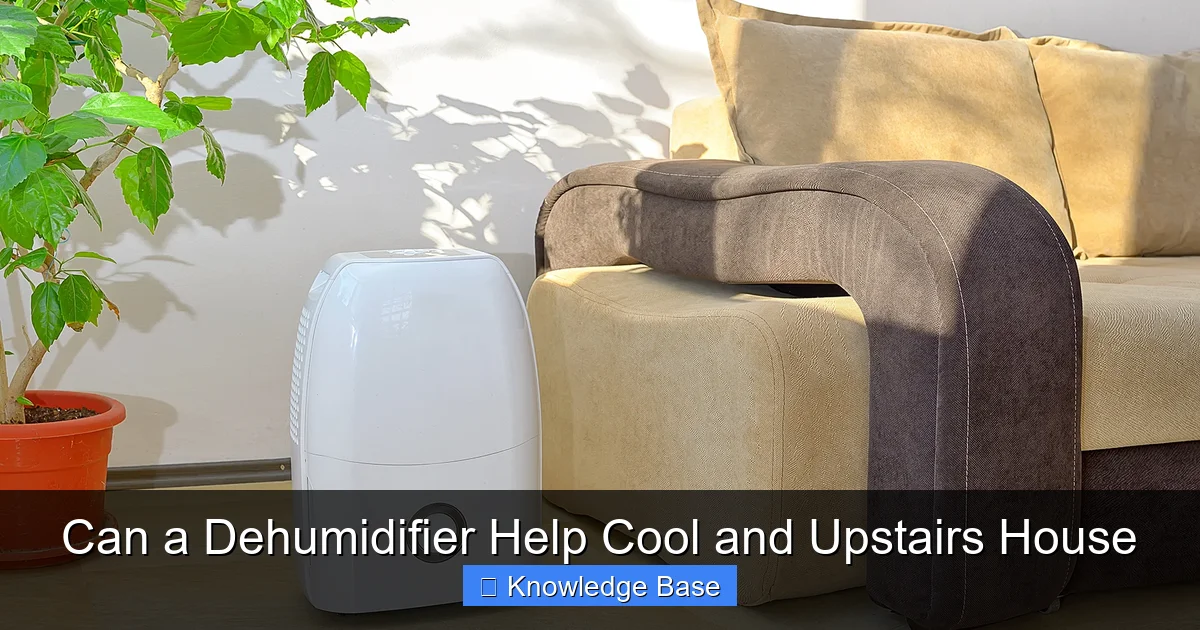
Yes, a dehumidifier can help cool an upstairs house—not by lowering air temperature directly, but by reducing humidity levels so the air feels cooler and more comfortable. This is especially helpful in hot, humid climates where upper floors often trap warm, moist air. While it won’t replace an air conditioner, it can improve comfort, reduce AC workload, and save energy when used strategically.
Key Takeaways
- Dehumidifiers reduce humidity, not temperature: They remove excess moisture from the air, which makes the room feel cooler and more comfortable, even if the thermostat reading stays the same.
- Upstairs areas are more prone to humidity: Warm air rises, carrying moisture with it, making upper floors feel stickier and hotter than lower levels.
- Improved comfort means less AC use: When the air feels less humid, you may be able to raise your thermostat setting slightly, reducing energy consumption.
- Whole-house vs. portable units: For best results in an upstairs house, consider a whole-house dehumidifier integrated with your HVAC system, though portable units can work in smaller spaces.
- Proper placement matters: Place dehumidifiers in central locations or near moisture sources like bathrooms or laundry areas for maximum effectiveness.
- Maintenance is key: Regular cleaning of filters and coils ensures efficient operation and prevents mold or bacteria growth.
- Combine with other cooling strategies: Use fans, window coverings, and insulation improvements alongside dehumidification for the best results.
Quick Answers to Common Questions
Does a dehumidifier actually lower the temperature?
No, a dehumidifier doesn’t lower the air temperature like an air conditioner. Instead, it removes moisture from the air, which makes the room feel cooler and more comfortable.
Where should I place a dehumidifier upstairs?
Place it in a central location, such as a hallway or large room, away from walls and furniture. This ensures proper airflow and maximum moisture removal.
Can a dehumidifier replace my air conditioner?
No, it can’t replace an AC in hot climates. But it can reduce the AC’s workload by removing excess moisture, improving efficiency and comfort.
How often should I empty the dehumidifier tank?
It depends on humidity levels and tank size. Most portable units need emptying every 12–24 hours. Use a hose for continuous drainage if possible.
Will a dehumidifier help with mold upstairs?
Yes, by reducing humidity below 60%, a dehumidifier helps prevent mold and mildew growth, especially in damp areas like bathrooms or basements.
📑 Table of Contents
- Can a Dehumidifier Help Cool an Upstairs House?
- How Dehumidifiers Work: The Science Behind the Comfort
- Why Upstairs Areas Are More Prone to Humidity
- How a Dehumidifier Improves Upstairs Comfort
- Choosing the Right Dehumidifier for Your Upstairs Space
- Combining Dehumidification with Other Cooling Strategies
- Potential Drawbacks and Considerations
- Conclusion: A Cooler, More Comfortable Upstairs Awaits
Can a Dehumidifier Help Cool an Upstairs House?
If you live in a multi-story home, especially in a warm or humid climate, you’ve probably noticed that the upstairs feels significantly hotter and stickier than the downstairs. Ceiling fans spin, windows are open, and the air conditioner runs nonstop—but the upper floor still feels like a sauna. You might be wondering: can a dehumidifier help cool an upstairs house?
The short answer is yes—but not in the way you might think. A dehumidifier doesn’t lower the actual air temperature like an air conditioner does. Instead, it removes excess moisture from the air, which changes how hot the space feels. This process, known as improving the “perceived temperature,” can make a room feel several degrees cooler without touching the thermostat.
In this article, we’ll explore how dehumidifiers work, why upstairs areas are more prone to humidity, and how using one can improve comfort, reduce energy bills, and even extend the life of your HVAC system. Whether you’re dealing with summer heat, seasonal humidity, or year-round moisture issues, understanding the role of humidity in indoor comfort is the first step toward a cooler, more enjoyable home.
How Dehumidifiers Work: The Science Behind the Comfort

Visual guide about Can a Dehumidifier Help Cool and Upstairs House
Image source: hvac-boss.com
To understand how a dehumidifier can help cool an upstairs house, it’s important to first grasp what humidity is and how it affects how we feel.
Humidity refers to the amount of water vapor in the air. When humidity is high—typically above 60%—the air feels heavy, sticky, and uncomfortable. This is because our bodies cool themselves by sweating, and when the air is already saturated with moisture, sweat doesn’t evaporate as easily. As a result, we feel hotter than the actual temperature suggests.
A dehumidifier tackles this problem by pulling in warm, moist air from the room and passing it over cold coils inside the unit. As the air cools, the moisture condenses into water droplets, which are collected in a tank or drained away. The drier air is then reheated slightly and blown back into the room.
This process doesn’t lower the air temperature significantly, but it drastically reduces the relative humidity. For example, if the room is 80°F with 70% humidity, it might feel like 87°F. But if the humidity drops to 50%, the same 80°F room can feel more like 77°F—a noticeable difference in comfort.
Types of Dehumidifiers
There are two main types of dehumidifiers: refrigerant (compressor-based) and desiccant.
Refrigerant dehumidifiers are the most common and work best in warm, humid environments—like an upstairs bedroom in the summer. They use a compressor and refrigerant gas to cool coils, causing moisture to condense. These units are energy-efficient and effective in typical home conditions.
Desiccant dehumidifiers, on the other hand, use a moisture-absorbing material (like silica gel) to pull water from the air. They work well in cooler or less humid environments and are often quieter, but they can be less efficient in high-humidity settings.
For most homeowners dealing with an upstairs humidity problem, a refrigerant dehumidifier is the best choice.
Why Upstairs Areas Are More Prone to Humidity

Visual guide about Can a Dehumidifier Help Cool and Upstairs House
Image source: homemadebklyn.com
If you’ve ever walked upstairs on a hot summer day and felt the air grow thicker and warmer, you’re not imagining things. Upper floors naturally accumulate more heat and moisture for several reasons.
First, warm air rises. Heat generated by appliances, sunlight through windows, and even body heat from occupants tends to collect near the ceiling and upper levels of a home. This warm air can hold more moisture, which means humidity levels increase as you go up.
Second, many homes have poor ventilation on upper floors. Bathrooms, laundry areas, and kitchens—common sources of moisture—are often located on the main or lower levels, but the steam and humidity they produce can travel upward through stairwells, HVAC ducts, or open doorways.
Third, insulation and attic design play a role. If your attic isn’t properly ventilated or insulated, heat can build up and radiate down into the upstairs living spaces. This trapped heat raises the temperature and increases the air’s capacity to hold moisture, leading to higher humidity levels.
Finally, air conditioning systems often struggle to cool upper floors evenly. Many HVAC systems are designed to cool the entire house from a central location, which can result in uneven temperature distribution. The upstairs may receive less cool air, allowing humidity to build up over time.
All these factors combine to make the upstairs the most challenging area to keep cool and dry—especially during humid months.
How a Dehumidifier Improves Upstairs Comfort
Now that we understand why upstairs areas are more humid, let’s look at how a dehumidifier can make a real difference in comfort.
When humidity levels drop, the air feels lighter and cooler. This allows your body to sweat and cool itself more efficiently, reducing that sticky, clammy feeling. Even if the thermostat still reads 78°F, you’ll feel more comfortable at that temperature when the humidity is under control.
This improved comfort has practical benefits. For one, you may be able to raise your thermostat setting by a few degrees without sacrificing comfort. For every degree you raise the thermostat, you can save up to 3–5% on cooling costs. Over time, this can add up to significant energy savings.
Additionally, lower humidity reduces the workload on your air conditioner. When the air is less humid, your AC doesn’t have to work as hard to remove moisture—a process that consumes a lot of energy. In fact, up to 60% of an air conditioner’s energy use goes toward dehumidification, not cooling. By using a dehumidifier to handle some of that moisture removal, your AC can focus more on temperature control, improving efficiency and reducing wear and tear.
Real-World Example: The Smith Family’s Upstairs Bedroom
Take the Smith family, for example. They live in a two-story home in Florida, where summer humidity regularly hits 80% or higher. Their upstairs master bedroom felt unbearable by mid-afternoon, even with the AC running constantly. The thermostat was set to 74°F, but it still felt like 80°F.
After researching solutions, they purchased a 50-pint portable dehumidifier and placed it in the hallway outside their bedroom. Within a week, they noticed a dramatic improvement. The air felt lighter, their sheets weren’t damp, and they were able to raise the thermostat to 76°F without discomfort. Their monthly energy bill dropped by about $25, and their AC ran less frequently.
This is a common outcome. By reducing humidity, the Smiths didn’t just feel cooler—they created a healthier, more energy-efficient environment.
Choosing the Right Dehumidifier for Your Upstairs Space
Not all dehumidifiers are created equal, and choosing the right one for your upstairs house depends on several factors, including room size, humidity levels, and your home’s layout.
Portable vs. Whole-House Dehumidifiers
Portable dehumidifiers are the most common and affordable option. They’re easy to move from room to room and typically cost between $150 and $400. These units are ideal for single rooms or small upstairs areas, like a bedroom or home office.
However, portable units have limitations. They require regular emptying of the water tank (unless you use a hose for continuous drainage), and they may not be powerful enough for large or multi-room spaces.
For whole-house coverage, especially in a large upstairs area, a whole-house dehumidifier is a better long-term solution. These units are installed directly into your HVAC system and can dehumidify the entire home, including upstairs. They’re more expensive—ranging from $1,500 to $3,000 installed—but they’re more efficient, require less maintenance, and provide consistent humidity control.
Capacity and Placement
Dehumidifiers are rated by how many pints of moisture they can remove in 24 hours. For most upstairs bedrooms or living areas, a 30- to 50-pint unit is sufficient. Larger spaces or extremely humid climates may require a 70-pint model.
Placement is also crucial. For best results, place the dehumidifier in a central location on the upper floor, such as a hallway or large open area. Avoid placing it in a corner or behind furniture, as this can restrict airflow. If you have multiple rooms with high humidity, consider using a portable unit that you can move as needed.
Energy Efficiency and Smart Features
Look for dehumidifiers with an Energy Star rating, which indicates they meet strict efficiency guidelines. These models use less electricity and can save you money over time.
Many modern dehumidifiers also come with smart features, such as humidity sensors, auto-shutoff when the tank is full, and programmable timers. Some even connect to Wi-Fi, allowing you to monitor and control humidity levels from your smartphone.
For example, the AprilAire E080 whole-house dehumidifier includes a built-in humidistat and can be integrated with smart thermostats for automated humidity control. Similarly, the hOmeLabs 50-Pint Portable Dehumidifier has a digital display, auto-restart after power outages, and a 24-hour timer.
Combining Dehumidification with Other Cooling Strategies
While a dehumidifier can make a big difference, it works best when combined with other cooling and moisture-control strategies.
Improve Air Circulation
Use ceiling fans or portable fans to improve air movement upstairs. Fans don’t lower the temperature, but they create a wind-chill effect that makes the air feel cooler. Place fans near windows to draw in cooler evening air or use them to push air from lower floors upward.
Seal Air Leaks and Improve Insulation
Check for gaps around windows, doors, and attic access points. Sealing these leaks prevents humid outdoor air from entering and cool indoor air from escaping. Adding insulation to the attic can also reduce heat transfer, keeping the upstairs cooler and drier.
Use Window Coverings
Close blinds, curtains, or shades during the day to block sunlight and reduce heat gain. Reflective window films or blackout curtains can be especially effective in south- and west-facing rooms.
Maintain Your HVAC System
Regular HVAC maintenance ensures your system is running efficiently. Replace air filters every 1–3 months, clean ducts if necessary, and have a professional inspect the system annually. A well-maintained AC removes moisture more effectively, reducing the need for supplemental dehumidification.
Monitor Humidity Levels
Use a hygrometer—a simple, inexpensive device—to monitor indoor humidity levels. Aim to keep humidity between 30% and 50% for optimal comfort and health. If levels consistently exceed 60%, it’s a sign that you may need a dehumidifier or better ventilation.
Potential Drawbacks and Considerations
While dehumidifiers offer many benefits, they’re not a magic solution. There are a few things to keep in mind.
First, dehumidifiers produce heat as a byproduct of operation. In small, enclosed spaces, this can slightly raise the room temperature. However, the cooling effect of reduced humidity usually outweighs this minor heat gain.
Second, portable units can be noisy. Look for models with a low decibel rating (under 50 dB) if noise is a concern, especially in bedrooms.
Third, dehumidifiers require regular maintenance. Clean the air filter monthly, empty the water tank as needed, and wipe down the coils to prevent mold growth. Neglecting maintenance can reduce efficiency and even pose health risks.
Finally, dehumidifiers are not a replacement for air conditioning in extremely hot climates. If temperatures regularly exceed 90°F, you’ll still need an AC to maintain a comfortable indoor environment. But a dehumidifier can complement your AC, making it more effective and efficient.
Conclusion: A Cooler, More Comfortable Upstairs Awaits
So, can a dehumidifier help cool an upstairs house? Absolutely—by reducing humidity, it makes the air feel cooler, improves comfort, and can even lower your energy bills. While it doesn’t replace an air conditioner, it’s a powerful tool for managing moisture, especially in warm, humid climates where upper floors tend to trap heat and humidity.
Whether you choose a portable unit for a single room or invest in a whole-house system for comprehensive coverage, the key is consistency and proper use. Combine dehumidification with good ventilation, insulation, and smart cooling habits, and you’ll create a healthier, more comfortable living environment upstairs.
Remember, comfort isn’t just about temperature—it’s about how the air feels. And when humidity is under control, even a warm room can feel refreshing. So don’t sweat the heat this summer. With the right dehumidifier, your upstairs house can be a cool, dry retreat—no matter the weather outside.
Frequently Asked Questions
How much humidity should be in an upstairs bedroom?
Ideal indoor humidity levels are between 30% and 50%. Levels above 60% can promote mold growth and make the air feel uncomfortably sticky.
Can I run a dehumidifier all the time?
Yes, but it’s more efficient to use a model with a built-in humidistat that turns it on and off automatically based on humidity levels.
Do dehumidifiers use a lot of electricity?
It depends on the model and usage. Energy Star-rated units are more efficient. On average, a 50-pint dehumidifier uses about 500–700 watts per hour.
Can a dehumidifier help with allergies?
Yes, by reducing humidity, it helps control dust mites, mold, and mildew—common allergens that thrive in moist environments.
Is a whole-house dehumidifier worth it?
If you have consistent humidity problems throughout your home, especially upstairs, a whole-house unit offers better coverage and efficiency than portable models.
What’s the difference between a dehumidifier and an air purifier?
A dehumidifier removes moisture from the air, while an air purifier filters out pollutants like dust, pollen, and smoke. They serve different purposes but can be used together.