

Dehumidifier CFM (cubic feet per minute) is calculated to ensure proper airflow for effective moisture removal. It helps match the unit’s capacity to room size, humidity levels, and air circulation needs, maximizing efficiency and comfort.
Key Takeaways
- CFM measures airflow: CFM stands for cubic feet per minute and indicates how much air a dehumidifier can move in one minute. Proper CFM ensures efficient moisture extraction.
- Room size matters: Larger spaces require higher CFM ratings to circulate air effectively and maintain consistent humidity control.
- Humidity levels affect CFM needs: High-humidity environments like basements or laundry rooms demand stronger airflow to remove moisture quickly.
- Energy efficiency depends on CFM: Units with optimal CFM use less energy by avoiding overwork or underperformance, saving on electricity bills.
- Proper CFM prevents mold and mildew: Adequate airflow reduces stagnant, damp air, lowering the risk of mold growth and improving indoor air quality.
- CFM impacts noise and comfort: Higher CFM may increase fan noise, so balancing airflow with quiet operation is key for home comfort.
- Manufacturers use CFM for design and testing: CFM calculations help engineers optimize fan size, coil design, and overall dehumidifier performance.
📑 Table of Contents
- Why Dehumidifier CFM Is Calculated: The Science Behind Airflow and Moisture Control
- What Is CFM and How Does It Relate to Dehumidifiers?
- The Role of Room Size and Air Changes Per Hour
- How Humidity Levels Influence CFM Requirements
- Energy Efficiency and the Importance of Proper CFM
- Noise, Comfort, and the Human Side of CFM
- How Manufacturers Calculate and Test Dehumidifier CFM
- Conclusion: Making CFM Work for You
Why Dehumidifier CFM Is Calculated: The Science Behind Airflow and Moisture Control
Have you ever walked into a damp basement and felt that sticky, heavy air clinging to your skin? Or noticed that your bathroom mirror fogs up every time you take a shower, no matter how long you leave the fan running? These are classic signs of excess humidity—and they’re not just uncomfortable. High indoor humidity can lead to mold, musty odors, damaged furniture, and even health issues like allergies and respiratory problems.
This is where dehumidifiers come in. These handy appliances pull moisture from the air, helping maintain a comfortable and healthy indoor environment. But not all dehumidifiers are created equal. One of the most important—but often overlooked—factors in choosing the right unit is its CFM rating. CFM stands for cubic feet per minute, and it measures how much air the dehumidifier can move in one minute. But why is dehumidifier CFM calculated in the first place? And how does it affect performance?
In this article, we’ll dive deep into the world of dehumidifier CFM. We’ll explore what CFM really means, why it’s calculated, how it impacts efficiency, and how you can use this knowledge to pick the perfect dehumidifier for your home. Whether you’re dealing with a damp crawl space, a humid living room, or a moisture-prone laundry area, understanding CFM will help you make smarter, more effective choices.
What Is CFM and How Does It Relate to Dehumidifiers?
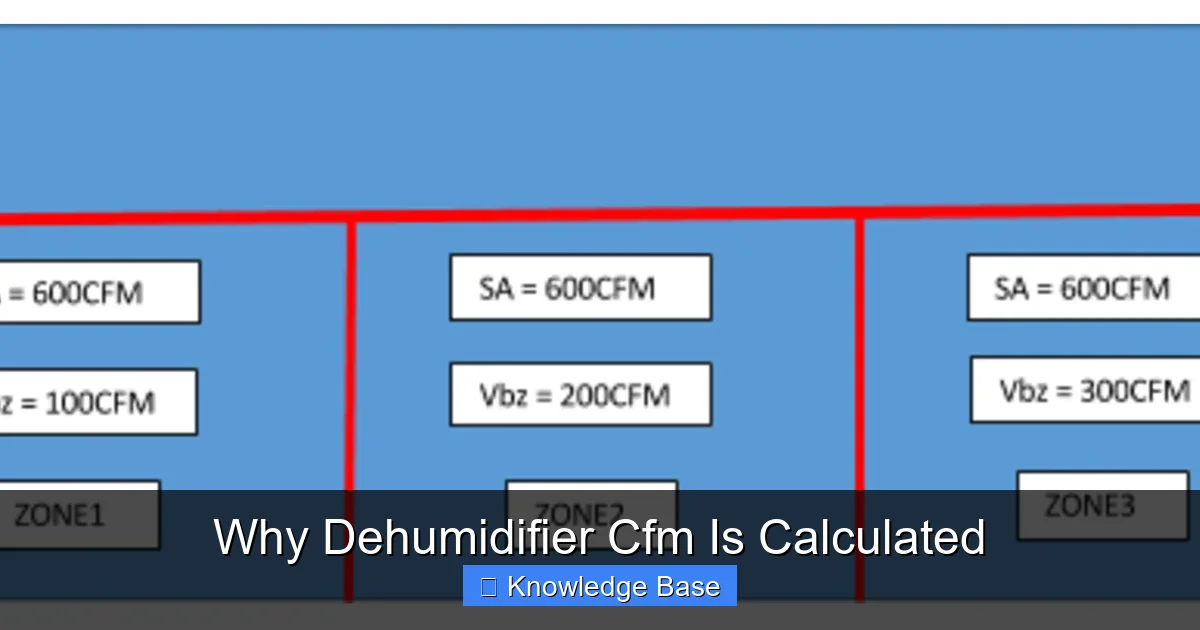
Visual guide about Why Dehumidifier Cfm Is Calculated
Image source: hvacbrain.com
Let’s start with the basics. CFM, or cubic feet per minute, is a standard unit of measurement used to describe airflow. Think of it as the “breathing power” of your dehumidifier. The higher the CFM, the more air the unit can circulate in a minute. For example, a dehumidifier with a CFM of 200 can move 200 cubic feet of air every 60 seconds.
But why does this matter for moisture removal? Because dehumidifiers don’t just suck in air and magically extract water. They work by pulling humid air across cold coils, where moisture condenses into water droplets that collect in a tank or drain away. For this process to work efficiently, the air must flow smoothly and consistently over the coils. If the airflow is too weak, the unit can’t process enough air to make a real difference. If it’s too strong, the air might rush past the coils too quickly, reducing condensation and leaving moisture behind.
That’s why dehumidifier CFM is calculated—to ensure the fan speed and duct design are perfectly matched to the unit’s moisture-removal capacity. Manufacturers calculate CFM based on several factors, including the size of the evaporator and condenser coils, the fan motor power, and the intended room size. This calculation helps them design a dehumidifier that balances airflow, efficiency, and noise levels.
For instance, a small bathroom dehumidifier might have a CFM of 100–150, which is plenty for a confined space with limited air volume. But a whole-house dehumidifier designed for a 2,000-square-foot home might need a CFM of 300 or higher to keep up with air circulation demands.
How CFM Affects Moisture Removal Efficiency
You might be wondering: “Can’t I just buy the dehumidifier with the highest CFM and call it a day?” Not so fast. While higher CFM means more airflow, it doesn’t always mean better performance. In fact, mismatched CFM can actually reduce efficiency.
Imagine a dehumidifier with a very high CFM but a small water tank. It might move air quickly, but if the coils can’t condense moisture fast enough, the unit will struggle to keep up. The result? Poor humidity control and frequent tank emptying. On the flip side, a low-CFM unit in a large, humid room will run constantly, overworking the compressor and driving up energy bills without delivering results.
The sweet spot is when CFM is calculated to match the dehumidifier’s pint-per-day (PPD) capacity—the amount of moisture it can remove in 24 hours. For example, a 50-pint dehumidifier designed for a 1,000-square-foot basement should have a CFM that allows it to cycle the room’s air 3 to 5 times per hour. This ensures consistent moisture removal without overloading the system.
Real-World Example: Choosing the Right CFM for Your Space
Let’s say you have a 500-square-foot basement with high humidity levels—maybe you’ve noticed condensation on the walls or a musty smell. You’re looking at two dehumidifiers:
– Model A: 30 pints/day, 150 CFM
– Model B: 50 pints/day, 250 CFM
At first glance, Model B seems better because it removes more moisture. But if your basement has poor air circulation—say, it’s sealed off from the rest of the house—Model A’s lower CFM might actually be more efficient. Why? Because it allows air to spend more time over the coils, increasing condensation. Model B’s higher CFM might move air too quickly, reducing contact time and lowering efficiency.
This is why dehumidifier CFM is calculated not just for power, but for balance. It’s about matching airflow to the specific conditions of your space.
The Role of Room Size and Air Changes Per Hour

Visual guide about Why Dehumidifier Cfm Is Calculated
Image source: hvac-boss.com
One of the main reasons dehumidifier CFM is calculated is to ensure the unit can handle the air volume of the room it’s placed in. This involves a concept called “air changes per hour” (ACH)—how many times the dehumidifier can cycle the entire volume of air in a room each hour.
For effective humidity control, most experts recommend 3 to 5 air changes per hour. To calculate the required CFM, you can use this simple formula:
Required CFM = (Room Volume in Cubic Feet) × (Air Changes Per Hour) ÷ 60
Let’s break that down. First, calculate the room volume by multiplying length × width × height. For a basement that’s 20 feet long, 25 feet wide, and 8 feet high:
20 × 25 × 8 = 4,000 cubic feet
If you want 4 air changes per hour:
4,000 × 4 = 16,000
16,000 ÷ 60 = 267 CFM
So, you’d need a dehumidifier with at least 267 CFM to effectively cycle the air four times per hour. A unit with 250 CFM would be close, but slightly underpowered. A 300 CFM model would be ideal.
Why Air Changes Matter for Humidity Control
You might think, “Why not just run the dehumidifier 24/7?” The truth is, even constant operation won’t help if the air isn’t being circulated properly. Stagnant air pockets can form in corners or behind furniture, trapping moisture and creating mold hotspots. By ensuring adequate air changes, you distribute dry air evenly throughout the space, preventing these problem areas.
This is especially important in enclosed spaces like crawl spaces, garages, or windowless bathrooms, where natural airflow is minimal. In these cases, a dehumidifier with a well-calculated CFM becomes essential for maintaining consistent humidity levels.
Adjusting CFM for Ceiling Height and Layout
It’s also worth noting that room layout affects CFM needs. A room with high ceilings (9 feet or more) has a larger air volume, requiring higher CFM. Similarly, open floor plans or rooms connected to other areas may need more airflow to prevent moisture from drifting in from adjacent spaces.
For example, a 10-foot-high living room with an open kitchen might need a dehumidifier with a higher CFM than a standard 8-foot room of the same floor area. Manufacturers often account for this in their CFM calculations, but it’s something to keep in mind when shopping.
How Humidity Levels Influence CFM Requirements
Not all rooms are created equal when it comes to humidity. A bathroom after a hot shower can spike to 80% relative humidity, while a dry attic might hover around 30%. These differences directly impact how dehumidifier CFM is calculated.
In high-humidity environments, the air holds more moisture, so the dehumidifier must work harder to extract it. This means it needs stronger airflow to bring enough humid air into contact with the cooling coils. If the CFM is too low, the unit will struggle to keep up, leading to prolonged run times and reduced efficiency.
High-Humidity Areas: Basements, Laundry Rooms, and Bathrooms
Basements are prime examples of high-humidity zones. They’re often below ground level, poorly ventilated, and prone to water seepage. A basement dehumidifier typically needs a higher CFM than one used in a living room or bedroom. For instance, a 70-pint basement dehumidifier might have a CFM of 300 or more to handle the dense, moist air.
Laundry rooms are another hotspot. Wet clothes release significant moisture into the air, especially if the dryer vent is blocked or inefficient. A dehumidifier in this space should have a CFM high enough to capture that moisture before it spreads to other areas.
Bathrooms are smaller but can experience extreme humidity spikes. A compact dehumidifier with a CFM of 100–150 is usually sufficient, but it should be sized to handle the room’s volume and usage patterns. For example, a family of four taking multiple showers a day will need more airflow than a single occupant.
Low-Humidity Environments: When Less CFM Is Better
Conversely, in dry climates or well-ventilated spaces, a lower CFM may be more appropriate. Overpowering a room with too much airflow can lead to excessive drying, which isn’t healthy either. Ideal indoor humidity levels are between 30% and 50%. Going below 30% can cause dry skin, irritated sinuses, and static electricity.
In these cases, a dehumidifier with a lower, well-calculated CFM can maintain balance without overcorrecting. Some advanced models even have variable fan speeds, allowing you to adjust CFM based on current humidity levels—offering the best of both worlds.
Energy Efficiency and the Importance of Proper CFM
One of the biggest benefits of calculating dehumidifier CFM correctly is energy efficiency. When airflow is optimized, the unit doesn’t have to work as hard to remove moisture. This reduces strain on the compressor and fan motor, leading to lower electricity consumption and longer lifespan.
How Mismatched CFM Wastes Energy
Let’s say you install a dehumidifier with a CFM that’s too low for your space. It will run continuously, trying to cycle the air but never quite catching up. This constant operation drives up your energy bill and increases wear and tear on the components.
On the other hand, a CFM that’s too high can cause short cycling—where the unit turns on and off frequently because it processes air too quickly. This not only wastes energy but can also reduce humidity control accuracy, as the sensor doesn’t have enough time to detect changes in moisture levels.
ENERGY STAR and CFM Optimization
ENERGY STAR-certified dehumidifiers are designed with efficiency in mind, including optimized CFM calculations. These units often feature smart sensors, variable-speed fans, and advanced coil designs that maximize moisture removal per watt of electricity used.
For example, a 50-pint ENERGY STAR dehumidifier might use 20% less energy than a standard model with the same capacity, thanks to better airflow management. Over time, this can save you hundreds of dollars on utility bills.
Tips for Maximizing Efficiency
To get the most out of your dehumidifier’s CFM:
– Place the unit in a central location with good air circulation.
– Keep doors and windows closed while it’s running.
– Clean the air filter regularly to maintain airflow.
– Use a hygrometer to monitor humidity and adjust settings accordingly.
– Consider a model with auto-humidistat and variable fan speeds for dynamic CFM control.
Noise, Comfort, and the Human Side of CFM
While CFM is a technical measurement, it has real-world impacts on comfort—especially noise. Higher CFM often means a louder fan, which can be disruptive in living spaces, bedrooms, or home offices.
Balancing Airflow and Quiet Operation
Manufacturers calculate CFM not just for performance, but also for user experience. A dehumidifier that’s too loud can become a nuisance, leading people to turn it off—defeating the purpose. That’s why many modern units use multi-speed fans or sound-dampening materials to reduce noise while maintaining adequate airflow.
For example, a dehumidifier with a CFM of 200 might operate at 50 decibels on low speed (about the sound of a quiet conversation) and 60 decibels on high (like a normal conversation). This allows you to run it quietly at night or during the day, adjusting CFM as needed.
Choosing the Right CFM for Your Lifestyle
If you’re sensitive to noise, look for models with a “quiet mode” or low-CFM settings. These are ideal for bedrooms or nurseries. For basements or garages, where noise is less of a concern, higher CFM is acceptable and often necessary.
Some units also feature timers or smart controls, so you can run high-CFM cycles during the day and switch to low-CFM at night—keeping your home comfortable without sacrificing sleep.
How Manufacturers Calculate and Test Dehumidifier CFM
Behind every dehumidifier’s CFM rating is a rigorous process of engineering, testing, and calibration. Manufacturers don’t just guess the airflow—they calculate it based on physics, thermodynamics, and real-world conditions.
The Engineering Behind CFM Calculation
To determine CFM, engineers consider several factors:
– Fan size and motor power
– Duct design and internal resistance
– Coil surface area and temperature
– Expected room size and humidity load
They use computational fluid dynamics (CFD) software to simulate airflow patterns and identify potential bottlenecks. Then, they build prototypes and test them in controlled environments, measuring how much air moves per minute under various conditions.
Standardized Testing and Certification
In the U.S., dehumidifiers are tested according to AHAM (Association of Home Appliance Manufacturers) standards. These tests measure not only CFM but also moisture removal rate, energy factor, and noise levels. The results are used to assign official ratings, ensuring consumers can compare models fairly.
For example, a dehumidifier labeled “50 pints, 250 CFM” has been tested and verified to meet those specifications under standard conditions (80°F, 60% relative humidity). This transparency helps you trust the numbers and make informed decisions.
Why You Should Trust CFM Ratings
While some cheaper models may exaggerate CFM or PPD ratings, reputable brands adhere to strict testing protocols. Look for certifications like AHAM, ENERGY STAR, or ETL to ensure the CFM is accurate and reliable.
Conclusion: Making CFM Work for You
So, why is dehumidifier CFM calculated? Because it’s the key to effective, efficient, and comfortable moisture control. From ensuring proper air circulation to matching unit capacity with room size, CFM plays a vital role in how well your dehumidifier performs.
By understanding CFM, you can avoid common pitfalls like underpowered units, wasted energy, and noisy operation. Instead, you’ll choose a dehumidifier that’s perfectly suited to your space—whether it’s a damp basement, a humid bathroom, or a whole-house system.
Remember, the goal isn’t just to remove moisture—it’s to create a healthier, more comfortable living environment. And with the right CFM, your dehumidifier can do exactly that.
Frequently Asked Questions
What does CFM mean in a dehumidifier?
CFM stands for cubic feet per minute and measures how much air a dehumidifier can move in one minute. It’s a key indicator of airflow strength and affects how efficiently the unit removes moisture.
How do I calculate the right CFM for my dehumidifier?
Use the formula: CFM = (Room Volume in Cubic Feet × Air Changes Per Hour) ÷ 60. Aim for 3–5 air changes per hour for effective humidity control.
Can a dehumidifier have too high a CFM?
Yes. If CFM is too high, air may pass over the coils too quickly, reducing condensation and efficiency. It can also increase noise and energy use.
Does higher CFM always mean better performance?
Not necessarily. Performance depends on the balance between CFM, moisture removal capacity (pints/day), and room conditions. A well-matched CFM is more important than a high number.
How does CFM affect energy efficiency?
Proper CFM ensures the dehumidifier doesn’t overwork or underperform, reducing energy consumption. Mismatched CFM can lead to constant running or short cycling, wasting electricity.
Should I prioritize CFM or pint capacity when buying a dehumidifier?
Both matter, but they work together. Choose a unit where CFM and pint capacity are balanced for your room size and humidity level. Check manufacturer specs and certifications for accuracy.