

Dehumidifiers use refrigerant to cool coils, condensing moisture from humid air. This process efficiently extracts water, improving indoor air quality and comfort.
Have you ever walked into a damp basement and noticed that sticky, heavy feeling in the air? Or maybe you’ve seen water droplets forming on windows during humid summer months? That’s excess moisture at work—and it’s not just uncomfortable. High humidity can lead to mold growth, musty smells, damaged furniture, and even health issues like allergies or asthma. That’s where dehumidifiers come in. These handy appliances pull moisture from the air, making your home feel fresher and healthier.
But have you ever wondered how they actually work? Specifically, why do dehumidifiers have refrigerant? If you’ve looked inside a dehumidifier or read the specs, you might have seen terms like “R-410A” or “R-32”—these are types of refrigerants. And while they sound technical, they play a surprisingly simple yet crucial role in the dehumidification process. In this article, we’ll break down exactly why refrigerant is a key ingredient in most dehumidifiers, how it works, and what it means for your home’s comfort and air quality.
Understanding this helps you make smarter choices when buying or maintaining a dehumidifier. Whether you’re dealing with a damp crawl space, a humid bathroom, or just want to improve your indoor climate, knowing how refrigerant functions gives you the power to choose the right unit and keep it running smoothly.
Key Takeaways
- Refrigerant enables cooling: It cools the dehumidifier’s coils, allowing moisture in the air to condense into water droplets.
- Essential for refrigeration-based models: Most home dehumidifiers rely on refrigerant systems to function effectively.
- Improves air quality: By removing excess humidity, refrigerant-based dehumidifiers prevent mold, dust mites, and musty odors.
- Energy-efficient operation: Modern refrigerants help dehumidifiers run efficiently, reducing electricity use and costs.
- Requires proper maintenance: Regular cleaning and refrigerant checks ensure long-term performance and safety.
- Environmentally evolving: Newer refrigerants are being developed to reduce environmental impact and meet regulations.
📑 Table of Contents
- What Is Refrigerant and How Does It Work?
- Why Do Dehumidifiers Need Refrigerant?
- The Science Behind Moisture Removal
- Types of Dehumidifiers and Their Use of Refrigerant
- Environmental Impact and Refrigerant Safety
- Maintenance Tips for Refrigerant-Based Dehumidifiers
- Choosing the Right Dehumidifier for Your Needs
- Conclusion
What Is Refrigerant and How Does It Work?
At its core, refrigerant is a special chemical compound that changes state—from liquid to gas and back again—as it absorbs and releases heat. This unique property makes it ideal for use in cooling systems, including air conditioners, refrigerators, and yes, dehumidifiers. Think of refrigerant as the “blood” of the cooling cycle. It flows through a closed loop of coils and components, picking up heat in one area and releasing it in another.
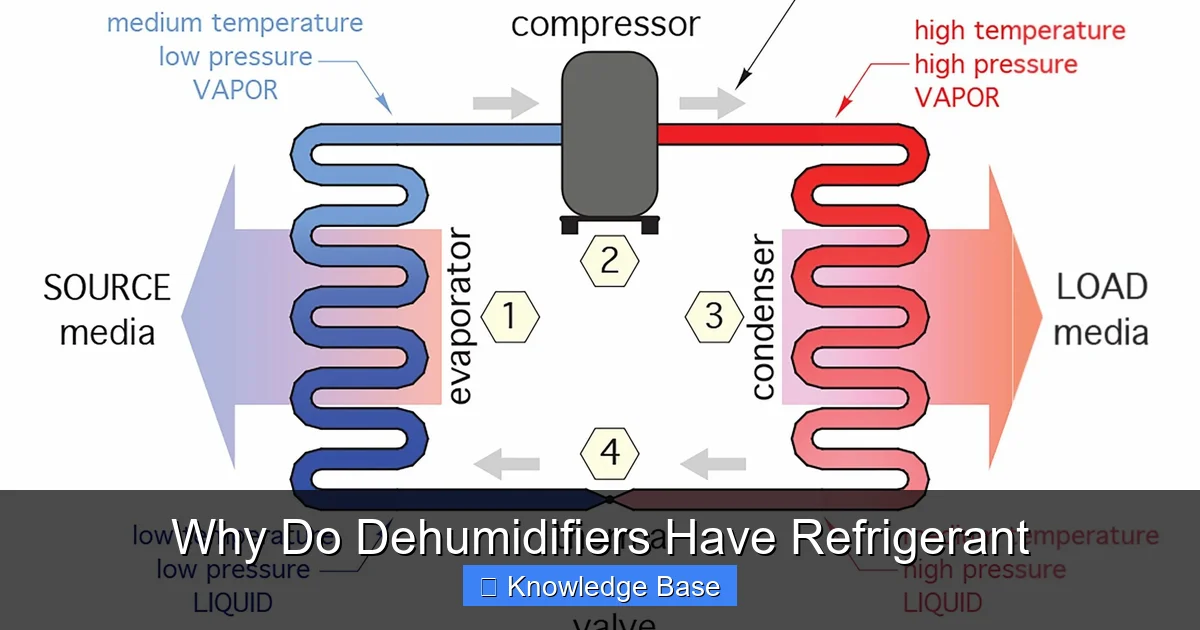
In a dehumidifier, the refrigerant’s job is to cool down metal coils so that warm, moist air passing over them loses its ability to hold water vapor. When the air cools, the moisture condenses into liquid water—just like how dew forms on grass in the morning. This water is then collected in a tank or drained away, while the now-drier air is reheated slightly and released back into the room.
The process starts when the dehumidifier’s fan pulls humid air from the room into the unit. This air first passes over a cold evaporator coil, which is cooled by the refrigerant. As the air cools, its relative humidity rises until it reaches the dew point—the temperature at which water vapor turns into liquid. The condensed water drips into a collection bucket. Then, the air moves over a warm condenser coil (also heated by the refrigerant cycle), where it’s warmed back up to room temperature before being expelled. The result? Drier, more comfortable air.
This cycle repeats continuously, gradually reducing the overall humidity level in the space. The refrigerant itself doesn’t get used up—it’s recycled over and over within the sealed system. That’s why proper sealing and maintenance are so important. A leak in the refrigerant line can reduce efficiency or even stop the dehumidifier from working altogether.
Why Do Dehumidifiers Need Refrigerant?
Visual guide about Why Do Dehumidifiers Have Refrigerant
Image source: opentextbc.ca
So, why can’t a dehumidifier just use a fan and a sponge to soak up moisture? Well, some do—those are called desiccant dehumidifiers, and they use moisture-absorbing materials like silica gel. But the majority of household dehumidifiers are refrigerant-based because they’re highly effective, energy-efficient, and well-suited for typical indoor humidity levels.
Refrigerant is essential because it enables the dehumidifier to cool the air quickly and efficiently. Without it, there would be no way to lower the temperature of the coils enough to cause condensation. And without condensation, there’s no way to extract water from the air in large quantities. In short, refrigerant is the engine behind the moisture-removal process.
Imagine trying to dry a wet towel by waving it in the air. It might work slowly, but it’s not very efficient. Now imagine using a fan to blow cool air over the towel—it dries much faster. A refrigerant-based dehumidifier does something similar, but instead of just blowing air, it actively cools the surface where moisture collects. This makes the process far more effective, especially in moderately humid environments like basements, laundry rooms, or bathrooms.
Another reason refrigerant is so widely used is its compatibility with compact, self-contained units. Unlike large industrial systems, home dehumidifiers need to be small, quiet, and easy to operate. Refrigerant-based systems meet these needs perfectly. They don’t require external water lines or complex setups—just plug them in, set the humidity level, and let them run.
Plus, modern refrigerants are designed to be stable, non-toxic, and efficient. They can transfer large amounts of heat with minimal energy input, which keeps operating costs low. This efficiency is especially important because dehumidifiers often run for hours each day, especially during humid seasons.
The Science Behind Moisture Removal
To truly understand why dehumidifiers have refrigerant, it helps to dig a little deeper into the science of humidity and condensation. Air contains water vapor—invisible moisture that’s always present to some degree. The amount of vapor the air can hold depends on its temperature: warmer air holds more moisture, while cooler air holds less.
This is where the concept of relative humidity comes in. It’s the percentage of moisture in the air compared to the maximum it could hold at that temperature. For example, if the air is at 50% relative humidity, it’s holding half the moisture it could at that temperature. When warm, humid air cools down, its relative humidity increases. If it cools enough, it reaches 100%—the dew point—and excess moisture condenses into liquid water.
Refrigerant-based dehumidifiers exploit this principle. By using refrigerant to chill the evaporator coils below the dew point of the incoming air, they force moisture to condense. This is the same process that creates fog on a cold window or dew on a soda can taken from the fridge.
Let’s walk through a real-world example. Say your basement has an air temperature of 75°F (24°C) and a relative humidity of 70%. That means the air is quite moist. When this air enters the dehumidifier, it passes over coils cooled to around 50°F (10°C) by the refrigerant. At that temperature, the air can’t hold as much moisture, so water droplets form on the coils and drip into the collection tank. The air, now drier, is warmed back up and released.
This cycle is highly effective because it targets the root cause of high humidity: warm air holding too much moisture. By cooling the air temporarily, the dehumidifier “tricks” it into releasing that moisture, then restores it to a comfortable temperature. The refrigerant is the key that makes this cooling possible.
Types of Dehumidifiers and Their Use of Refrigerant
Not all dehumidifiers are the same, and while most use refrigerant, there are different types designed for different needs. The two main categories are refrigerant (or compressor-based) dehumidifiers and desiccant dehumidifiers.
Refrigerant dehumidifiers are the most common in homes. They use a compressor, refrigerant, and a series of coils to cool and condense moisture. These units work best in temperatures above 60°F (15°C) and are ideal for basements, garages, and living areas. They’re efficient, affordable, and capable of removing large amounts of moisture—often 30 to 70 pints per day, depending on the model.
Desiccant dehumidifiers, on the other hand, use a moisture-absorbing material (like silica gel) to pull water from the air. They don’t rely on refrigerant or cooling coils. Instead, they use a rotating wheel coated with desiccant that soaks up moisture as air passes through. These units are better suited for colder environments, like unheated garages or crawl spaces, where refrigerant systems lose efficiency.
So why do most people choose refrigerant models? Because they’re more energy-efficient in typical indoor conditions and can handle higher humidity levels. They’re also quieter and more compact than many desiccant units. Plus, they’re often less expensive to buy and maintain.
That said, refrigerant dehumidifiers do have limitations. In very cold spaces, the evaporator coils can frost over, reducing efficiency or even shutting down the unit. Many modern models include automatic defrost features to prevent this, but it’s still something to consider if you’re using the dehumidifier in a chilly area.
Another factor is noise. The compressor in a refrigerant dehumidifier can produce a low hum, which might be noticeable in quiet spaces like bedrooms. However, newer models are designed to be much quieter, with sound levels as low as 40 decibels—about the same as a whisper.
Environmental Impact and Refrigerant Safety
As we rely more on appliances that use refrigerant, it’s important to consider their environmental impact. Older refrigerants, like R-22 (also known as Freon), were found to contribute to ozone depletion and were phased out under international agreements like the Montreal Protocol. Today, most dehumidifiers use newer, more eco-friendly refrigerants such as R-410A or R-32.
These modern refrigerants don’t harm the ozone layer, but they are potent greenhouse gases if released into the atmosphere. That’s why proper handling, installation, and disposal are critical. Never attempt to open or repair a refrigerant line yourself—always consult a certified technician.
Manufacturers are also working to develop even greener alternatives. For example, some newer models use R-290 (propane) or R-600a (isobutane), which have very low global warming potential (GWP). These natural refrigerants are highly efficient and environmentally friendly, though they require special safety measures due to their flammability.
When shopping for a dehumidifier, look for Energy Star-certified models. These units meet strict efficiency guidelines set by the U.S. Environmental Protection Agency and often use advanced refrigerants and smart controls to minimize energy use and environmental impact.
It’s also worth noting that refrigerant leaks are rare in well-maintained units. The system is sealed, and the refrigerant is contained within. Regular maintenance—like cleaning the coils and checking for damage—can help prevent issues and extend the life of your dehumidifier.
Maintenance Tips for Refrigerant-Based Dehumidifiers
To keep your refrigerant dehumidifier running smoothly, regular maintenance is key. Here are some practical tips to ensure optimal performance and longevity:
First, clean or replace the air filter every 1–2 months, especially during heavy use. A clogged filter restricts airflow, reducing efficiency and forcing the compressor to work harder. Most filters are washable—just rinse them under warm water and let them dry completely before reinstalling.
Next, empty the water collection tank regularly. Most units have a float switch that shuts off the dehumidifier when the tank is full, but it’s still good practice to check it daily during humid weather. If you don’t want to empty it manually, consider a model with a built-in pump or a continuous drain hose.
Keep the coils clean. Over time, dust and debris can build up on the evaporator and condenser coils, insulating them and reducing heat transfer. Use a soft brush or vacuum with a brush attachment to gently clean the coils every few months. Avoid using water or harsh chemicals.
Check for frost buildup in cold environments. If you notice ice forming on the coils, the unit may be operating below its recommended temperature range. Move it to a warmer area or use a model with an auto-defrost feature.
Finally, have your dehumidifier serviced by a professional every few years. A technician can check refrigerant levels, inspect seals, and ensure all components are working correctly. This helps prevent leaks and keeps the system running efficiently.
Choosing the Right Dehumidifier for Your Needs
When shopping for a dehumidifier, consider the size of the space, the humidity level, and the typical temperature. A unit that’s too small won’t effectively reduce moisture, while one that’s too large may cycle on and off too frequently, wasting energy.
Look for a model with a built-in humidistat, which lets you set your desired humidity level (ideally between 30% and 50%). Some advanced units even connect to smart home systems, allowing you to monitor and control humidity from your phone.
Pay attention to the pint rating—this indicates how much moisture the unit can remove in 24 hours. For example, a 30-pint dehumidifier is suitable for a 1,000-square-foot basement with moderate humidity, while a 70-pint model is better for larger or very damp spaces.
Also, consider noise level, energy efficiency, and ease of maintenance. A quiet, Energy Star-rated model with a washable filter and automatic shut-off will save you money and hassle in the long run.
And of course, make sure it uses a modern, eco-friendly refrigerant. This not only reduces environmental impact but also ensures compliance with current regulations.
Conclusion
So, why do dehumidifiers have refrigerant? Because it’s the heart of the moisture-removal process. By cooling the coils and causing water vapor to condense, refrigerant enables dehumidifiers to efficiently extract excess humidity from the air. This improves comfort, protects your home from mold and damage, and supports better indoor air quality.
Refrigerant-based dehumidifiers are the go-to choice for most homes because they’re effective, energy-efficient, and easy to use. While they do require some maintenance and consideration of environmental impact, modern models are designed to be safe, reliable, and eco-friendly.
Whether you’re tackling a damp basement, a humid bathroom, or just want to breathe easier, understanding how refrigerant works helps you make informed decisions. Choose the right unit, maintain it properly, and enjoy the benefits of a drier, healthier home.
Frequently Asked Questions
Why do dehumidifiers use refrigerant instead of just fans?
Dehumidifiers use refrigerant because fans alone can’t cool air enough to remove moisture. Refrigerant enables the coils to reach temperatures below the dew point, causing water vapor to condense and be collected.
Can a dehumidifier work without refrigerant?
No, refrigerant-based dehumidifiers cannot function without refrigerant. It’s essential for cooling the coils. However, desiccant dehumidifiers don’t use refrigerant and rely on moisture-absorbing materials instead.
Is refrigerant in dehumidifiers dangerous?
Modern refrigerants are generally safe when contained in a sealed system. However, leaks can be harmful to the environment. Always have repairs done by a certified technician.
How often should I check the refrigerant level?
You don’t need to check refrigerant levels yourself. The system is sealed, and only a professional should handle refrigerant. If the unit isn’t removing moisture, it may need servicing.
Do all dehumidifiers use the same type of refrigerant?
No, different models use different refrigerants. Older units may use R-22, while newer ones use R-410A, R-32, or eco-friendly alternatives like R-290. Always check the product specifications.
Can I use a refrigerant dehumidifier in a cold basement?
Yes, but performance drops below 60°F. Look for models with auto-defrost or consider a desiccant dehumidifier for colder spaces.