
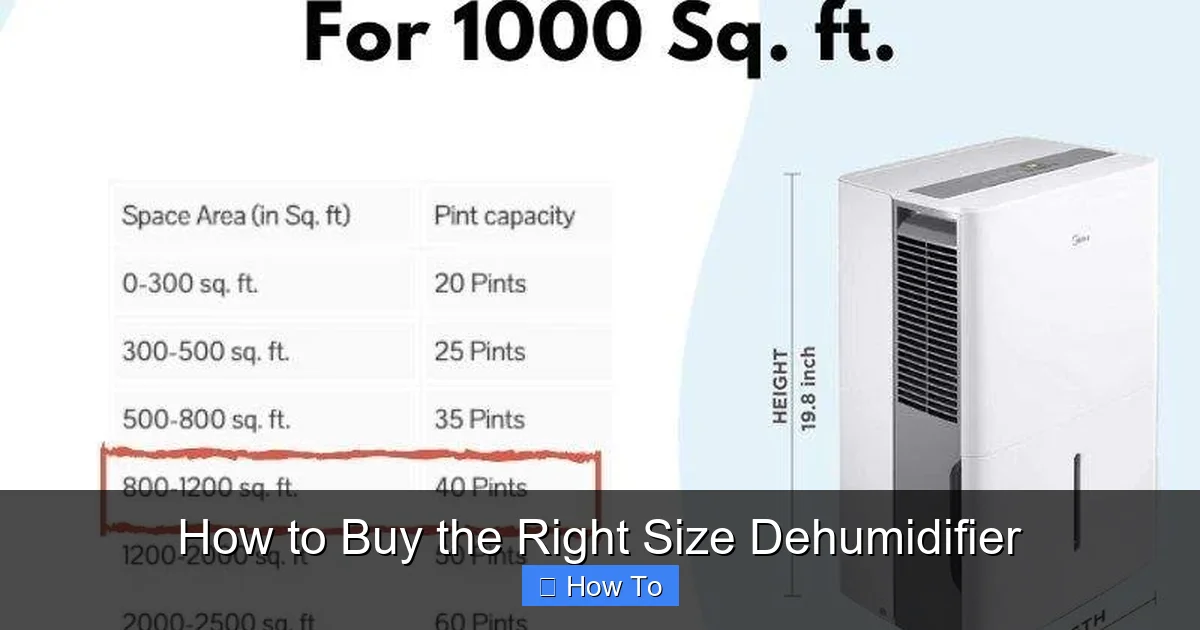
Choosing the right size dehumidifier is crucial for comfort, air quality, and energy efficiency. This guide walks you through room size, humidity levels, and capacity ratings to help you pick the perfect unit. Avoid common mistakes and get lasting results with expert advice.
Quick Answers to Common Questions
Tip/Question?
What’s the fastest way to check if my room is too humid?
Use a hygrometer. These small devices measure relative humidity and cost less than $20. Aim for 30–50% for comfort and health.
Tip/Question?
Can I use one dehumidifier for my whole house?
Yes, but only if you install a whole-house model connected to your HVAC system. Portable units are best for single rooms or basements.
Tip/Question?
How often should I empty the water tank?
It depends on humidity and capacity. In very damp areas, you may need to empty it daily. Use continuous drainage to avoid this.
Tip/Question?
Is a bigger dehumidifier always better?
No. Oversized units cycle too quickly, wasting energy and not removing moisture evenly. Match the size to your room and humidity level.
Tip/Question?
Do dehumidifiers use a lot of electricity?
They can, but ENERGY STAR models are much more efficient. Look for high energy factor ratings to save on operating costs.
How to Buy the Right Size Dehumidifier
If you’ve ever walked into a basement that smells like wet socks or noticed condensation on your windows, you know how uncomfortable high humidity can be. Excess moisture doesn’t just feel sticky—it can lead to mold, mildew, dust mites, and even structural damage over time. That’s where a dehumidifier comes in. But here’s the catch: not all dehumidifiers are created equal. Buying the wrong size can leave you with a unit that’s either too weak to make a difference or too powerful, wasting energy and money.
So how do you pick the right one? It’s not just about square footage. You also need to consider humidity levels, room conditions, and even how often you’ll use it. This guide will walk you through every step to help you buy the right size dehumidifier—whether you’re tackling a damp crawl space, a humid bedroom, or a full basement.
By the end of this guide, you’ll know exactly what to look for, how to measure your space, and how to match your needs to the perfect dehumidifier. Let’s get started.
Step 1: Understand What a Dehumidifier Does
Visual guide about How to Buy the Right Size Dehumidifier
Image source: i3.ytimg.com
Before you shop, it helps to know how dehumidifiers work. These appliances pull in moist air, remove the water vapor, and release drier air back into the room. They’re especially useful in areas with poor ventilation or high moisture levels—like basements, bathrooms, laundry rooms, and garages.
Dehumidifiers come in different sizes and types, but most home units are refrigerant-based, meaning they use a cooling coil to condense moisture from the air. Some larger or industrial models use desiccants, but for most households, refrigerant models are the go-to choice.
The key thing to remember is that dehumidifiers are rated by how many pints of moisture they can remove in 24 hours. This is called the “pint capacity.” A 30-pint dehumidifier can remove up to 30 pints of water per day, while a 70-pint model handles much more. But bigger isn’t always better—you need the right size for your space.
Step 2: Measure Your Room Size
The first step in choosing the right dehumidifier is measuring the area you want to treat. Most manufacturers recommend sizing based on square footage, but it’s not the whole story.
Calculate Square Footage
Start by measuring the length and width of the room in feet. Multiply them to get the square footage. For example, a basement that’s 20 feet by 30 feet equals 600 square feet.
- Room: 15 ft x 12 ft = 180 sq ft
- Basement: 25 ft x 40 ft = 1,000 sq ft
- Garage: 20 ft x 20 ft = 400 sq ft
Consider Ceiling Height
While most guides focus on square footage, ceiling height also matters. A room with 8-foot ceilings holds less air than one with 10-foot ceilings. If your ceilings are higher than average, you may need a slightly larger unit. For standard 8-foot ceilings, square footage is usually sufficient. But for vaulted ceilings or open spaces, consider the total volume (length x width x height) when making your decision.
Account for Open Floor Plans
If your space is open-concept—like a combined living room and dining area—treat it as one large room. Don’t divide it into smaller sections unless there are physical barriers like walls or doors that block airflow.
Step 3: Assess the Humidity Level
Room size is important, but humidity level is just as critical. A small, very damp basement might need a larger dehumidifier than a big, slightly damp garage. That’s why you need to evaluate how wet your space really is.
Use a Hygrometer
The best way to measure humidity is with a hygrometer—a small, inexpensive device that reads relative humidity (RH). You can find digital hygrometers at hardware stores or online for under $20.
Ideal indoor humidity levels are between 30% and 50%. If your reading is:
- Below 30%: Air is too dry. You may not need a dehumidifier.
- 30–50%: Comfortable range. Monitor for changes.
- 50–60%: Slightly damp. Consider a small dehumidifier.
- 60–70%: Very damp. A mid-size unit is likely needed.
- Above 70%: Wet or very wet. You’ll need a high-capacity dehumidifier.
Check the humidity at different times of day and in different seasons. Basements, for example, can be much wetter in the summer.
Look for Visual and Olfactory Clues
If you don’t have a hygrometer yet, use these signs to estimate humidity:
- Slightly damp: Musty smell, occasional condensation on windows, damp spots after rain.
- Very damp: Persistent musty odor, visible mold in corners, damp carpet or walls.
- Wet: Standing water, flooding after storms, mold growth, warped wood.
These observations help you choose the right capacity, even before you buy a hygrometer.
Step 4: Match Capacity to Your Needs
Now that you know your room size and humidity level, it’s time to pick the right pint capacity. Most dehumidifiers are labeled as 20-pint, 30-pint, 50-pint, or 70-pint models. Here’s a general guide:
Capacity Guide by Room Size and Humidity
| Room Size | Humidity Level | Recommended Capacity |
|---|---|---|
| Up to 500 sq ft | Slightly damp | 20–30 pints |
| Up to 500 sq ft | Very damp | 30–50 pints |
| Up to 500 sq ft | Wet | 50–70 pints |
| 500–1,000 sq ft | Slightly damp | 30–50 pints |
| 500–1,000 sq ft | Very damp | 50–70 pints |
| 500–1,000 sq ft | Wet | 70+ pints |
| 1,000+ sq ft | Any level | 70+ pints or multiple units |
For example:
- A 400 sq ft basement that’s very damp needs a 50-pint dehumidifier.
- A 1,200 sq ft crawl space that’s wet may require a 70-pint unit or two smaller ones.
- A 200 sq ft bathroom with occasional condensation can use a 20-pint model.
Don’t Overbuy
It’s tempting to go big, but oversized dehumidifiers can cycle on and off too quickly, which reduces efficiency and may not remove moisture evenly. They also cost more upfront and use more energy. Stick to the recommended range for your space.
Step 5: Consider Special Conditions
Some rooms have unique challenges that affect dehumidifier performance. Here’s how to adjust your choice:
Basements and Crawl Spaces
These areas are often cool and poorly ventilated, which can slow moisture removal. Look for a dehumidifier rated for “low-temperature operation” (down to 41°F or 5°C). Many standard units shut off below 65°F, so a basement-specific model is worth the investment.
Also, consider a unit with a built-in pump or continuous drainage option. Basements rarely have nearby drains, and emptying a tank daily is a hassle.
Garages and Workshops
Garages are typically uninsulated and exposed to outdoor humidity. They may need a larger unit, especially in humid climates. Choose a rugged model with a washable filter and durable casing.
Laundry Rooms
These spaces generate a lot of moisture from washing machines and dryers. A 30–50-pint dehumidifier is usually sufficient, but make sure it’s placed near the moisture source. Some models even have a “laundry mode” for extra drying power.
Whole-House Dehumidifiers
If you want to control humidity throughout your entire home, consider a whole-house dehumidifier. These are installed in your HVAC system and can handle 70+ pints per day. They’re more expensive but ideal for large homes or high-humidity regions.
Step 6: Check Energy Efficiency
Dehumidifiers run for hours each day, so energy use adds up. Look for models with the ENERGY STAR label. These units use 15–30% less energy than standard models, saving you money on electricity.
Look at the Energy Factor
The energy factor (EF) measures how efficiently a dehumidifier removes moisture. It’s listed in liters per kilowatt-hour (L/kWh) or pints per kilowatt-hour (pints/kWh). Higher numbers mean better efficiency.
For example:
- A 50-pint ENERGY STAR model might have an EF of 1.8 pints/kWh.
- A non-certified model might only reach 1.2 pints/kWh.
Over a year, that difference can save you $20–$50 in energy costs.
Estimate Annual Operating Cost
To calculate how much a dehumidifier will cost to run:
- Find the wattage (usually listed on the label or manual).
- Multiply by hours used per day, then by days per year.
- Divide by 1,000 to get kilowatt-hours (kWh).
- Multiply by your electricity rate (average is $0.13/kWh).
Example: A 300-watt dehumidifier running 8 hours/day for 120 days:
- 300W x 8 hrs = 2,400 Wh = 2.4 kWh/day
- 2.4 kWh x 120 days = 288 kWh/year
- 288 kWh x $0.13 = $37.44/year
ENERGY STAR models can cut this cost significantly.
Step 7: Evaluate Features and Convenience
Beyond size and efficiency, features can make a big difference in usability.
Auto-Humidistat
This feature lets you set your desired humidity level (e.g., 45%). The dehumidifier turns on and off automatically to maintain it. It’s more efficient than running continuously.
Continuous Drainage
Instead of emptying a tank, you can attach a hose to drain water directly into a floor drain, sink, or sump pump. This is essential for basements and 24/7 operation.
Built-In Pump
Some models include a pump that can push water upward—perfect for basements without floor drains. Look for this if you need to drain into a utility sink or window.
Washable Filter
A reusable filter saves money and reduces waste. Just rinse it monthly to keep airflow strong.
Noise Level
Dehumidifiers can be noisy, especially in bedrooms or living areas. Look for models under 50 decibels (dB) for quiet operation. Check the product specs or customer reviews.
Portability and Wheels
If you plan to move the unit between rooms, choose one with handles and caster wheels. Larger models (50+ pints) are heavier, so mobility matters.
Step 8: Read Reviews and Compare Brands
Once you’ve narrowed your options, read customer reviews on retailer websites like Amazon, Home Depot, or Lowe’s. Look for comments about:
- Actual performance vs. advertised capacity
- Noise levels
- Ease of maintenance
- Durability over time
Popular and reliable brands include:
- Frigidaire
- hOmeLabs
- Keepsafe
- Eva-Dry
- AprilAire (for whole-house systems)
Avoid ultra-cheap models—they often lack durability and efficiency.
Step 9: Make the Purchase
When you’re ready to buy, compare prices across retailers. Look for sales, especially in spring and summer when humidity rises. Check return policies in case the unit doesn’t perform as expected.
Consider buying from a store with in-person support, like Home Depot or Lowe’s, so you can get help if needed.
Troubleshooting Common Issues
Even the right-sized dehumidifier can have problems. Here’s how to fix common issues:
Unit Isn’t Removing Enough Moisture
- Check the filter—clean or replace it.
- Ensure the room is sealed (close doors and windows).
- Verify the humidity setting—lower it if needed.
- Make sure the coil isn’t frozen (common in cold basements).
Water Tank Fills Too Fast
- The room may be wetter than estimated—consider a larger unit.
- Check for leaks or poor drainage.
- Use continuous drainage if available.
Unit Is Too Loud
- Place it on a flat, stable surface.
- Ensure it’s not vibrating against a wall.
- Consider a quieter model for living spaces.
Frost on the Coils
- This happens in cold environments. Use a low-temperature model.
- Some units have auto-defrost—check the features.
Conclusion
Buying the right size dehumidifier doesn’t have to be overwhelming. By measuring your space, checking humidity levels, and matching capacity to your needs, you can find a unit that keeps your home comfortable and healthy. Don’t forget to consider energy efficiency, special features, and long-term maintenance.
A well-chosen dehumidifier reduces allergens, prevents mold, and protects your home’s structure. It’s an investment in comfort and air quality. Take your time, do the research, and choose wisely. Your future self—and your basement—will thank you.