
Choosing the correct dehumidifier capacity for your room size ensures efficient moisture removal, energy savings, and better air quality. This guide walks you through measuring your space, understanding humidity levels, and matching capacity to needs so you can pick the perfect unit with confidence.
Quick Answers to Common Questions
Should I buy a dehumidifier based on room size alone?
No—room size is important, but you also need to consider humidity level, usage, and climate. A small bathroom with high steam needs more dehumidification than a large, dry garage.
Can I use one dehumidifier for multiple rooms?
Only if the rooms are open to each other. For separate rooms, you’ll need individual units or a whole-house system.
Is a higher PPD always better?
Not necessarily. An oversized unit can short-cycle and waste energy. Match PPD to your room size and moisture level for best results.
Do I need a dehumidifier in winter?
Usually not, unless you have a cold, damp basement. Most portable units don’t work well below 65°F.
How often should I clean my dehumidifier?
Clean the tank weekly and the air filter every 1–2 months to prevent mold and maintain efficiency.
How to Choose Dehumidifier Capacity Room Size: A Complete Guide
If you’ve ever walked into a damp basement and felt that musty smell hit you like a wall, you know how uncomfortable and unhealthy excess moisture can be. High humidity doesn’t just make a room feel sticky—it can lead to mold growth, dust mites, wood rot, and even respiratory issues. That’s where a dehumidifier comes in. But here’s the catch: not all dehumidifiers are created equal. Choosing the right one starts with understanding how to match dehumidifier capacity to room size.
In this guide, we’ll walk you through everything you need to know to pick the perfect dehumidifier for your space. You’ll learn how to measure your room, assess humidity levels, interpret capacity ratings, and avoid common mistakes. Whether you’re dealing with a small bathroom or a large basement, this step-by-step guide will help you make a smart, informed decision.
By the end, you’ll know exactly what size dehumidifier you need—and why getting it right matters for your comfort, health, and wallet.
Step 1: Measure Your Room Size Accurately
Visual guide about How to Choose Dehumidifier Capacity Room Size
Image source: humidityfixers.com
The first step in choosing the right dehumidifier is knowing exactly how much space you’re working with. Most people think “room size” just means square footage, but it’s a bit more nuanced.
Calculate Square Footage
Start by measuring the length and width of the room in feet. Multiply these two numbers to get the square footage.
For example:
– A room that’s 12 feet by 15 feet = 180 square feet.
– A basement that’s 20 feet by 30 feet = 600 square feet.
If your room isn’t a perfect rectangle, break it into smaller rectangles, calculate each, and add them together.
Consider Ceiling Height
While most dehumidifier guides focus on square footage, ceiling height matters too—especially in basements or vaulted spaces. A room with 8-foot ceilings holds less air than one with 10-foot ceilings, even if the floor area is the same.
To estimate air volume, multiply square footage by ceiling height:
– 180 sq ft × 8 ft = 1,440 cubic feet
– 600 sq ft × 10 ft = 6,000 cubic feet
Larger volumes mean more air to dehumidify, so you may need a higher-capacity unit.
Account for Openings and Adjacent Spaces
If your room connects to other areas—like an open-concept basement or a laundry room with no door—you’ll need to include those spaces in your calculation. Air flows freely between open areas, so moisture from one room affects another.
Tip: If the connected space is less than half the size of the main room, add 25% to your total square footage. If it’s larger, treat it as a separate zone or choose a unit rated for the combined area.
Step 2: Assess the Humidity Level in Your Room
Room size is only half the equation. The other half is how damp the space actually is. A small bathroom with constant steam from showers needs a different dehumidifier than a large, dry garage.
Use a Hygrometer to Measure Humidity
A hygrometer is a small, inexpensive device that measures relative humidity (RH). You can find digital models for under $20 at hardware stores or online.
Ideal indoor humidity levels are between 30% and 50%. Here’s how to interpret your readings:
– 30–50%: Normal. You may not need a dehumidifier unless you’re in a humid climate.
– 50–60%: Mild dampness. A small to medium dehumidifier may help.
– 60–70%: Moderate humidity. Mold and mildew risk increases. A medium to large unit is recommended.
– 70%+: Severe dampness. You likely have visible condensation, musty odors, or mold. A high-capacity dehumidifier is essential.
Check humidity at different times of day—especially after showers, laundry, or rainy weather—to get an accurate picture.
Look for Visual and Sensory Clues
Even without a hygrometer, you can assess moisture levels:
– Condensation on windows or walls: Sign of high humidity.
– Musty or earthy smell: Often indicates mold or mildew growth.
– Warped wood, peeling paint, or rust: Long-term moisture damage.
– Feeling clammy or sticky: Your body senses excess moisture.
If you notice any of these, your room likely needs aggressive dehumidification.
Step 3: Understand Dehumidifier Capacity Ratings
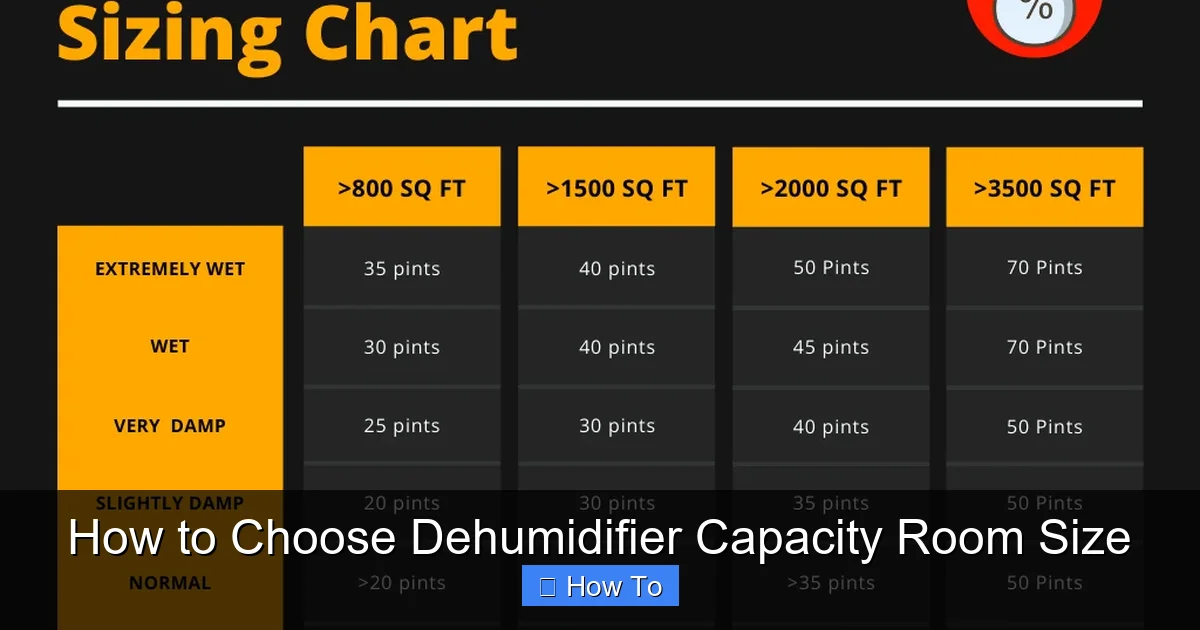
Dehumidifier capacity is measured in pints per day (PPD)—the amount of moisture the unit can remove in 24 hours under standard conditions (80°F and 60% RH). But don’t just go by the number alone. You need to match PPD to both room size and humidity level.
Standard Capacity Guidelines
Here’s a general rule of thumb based on room size and moisture level:
| Room Size (sq ft) | Mild Dampness (50–60% RH) | Moderate Dampness (60–70% RH) | Severe Dampness (70%+ RH) |
|——————-|—————————-|——————————-|—————————-|
| Up to 500 | 20–30 PPD | 30–50 PPD | 50–70 PPD |
| 500–1,000 | 30–50 PPD | 50–70 PPD | 70–90 PPD |
| 1,000–1,500 | 50–70 PPD | 70–90 PPD | 90+ PPD |
| 1,500+ | 70+ PPD | 90+ PPD | 100+ PPD or multiple units |
Note: These are estimates. Always check manufacturer recommendations.
Why PPD Isn’t the Whole Story
Manufacturers test dehumidifiers in controlled labs, but real-world conditions vary. A unit rated for 50 PPD might only remove 30 pints in a cold basement or a very humid climate.
Also, some brands inflate ratings. Look for AHAM (Association of Home Appliance Manufacturers) certified ratings—they’re more reliable.
Energy Efficiency Matters Too
Check the Energy Factor (EF)—measured in liters of water removed per kilowatt-hour (L/kWh). Higher EF means better efficiency.
For example:
– EF of 1.5 = 1.5 liters per kWh
– EF of 2.0 = 2.0 liters per kWh (more efficient)
ENERGY STAR-certified models typically have EF ratings of 1.75 or higher.
Step 4: Match Capacity to Room Type and Usage
Not all rooms are created equal. A dehumidifier for a basement won’t work the same as one for a bathroom. Consider how the space is used.
Basements
Basements are often cool, dark, and prone to dampness. They’re common spots for mold and musty smells.
– Size: Typically 500–1,500+ sq ft
– Humidity: Often moderate to severe
– Recommended Capacity: 50–90+ PPD
– Features to Look For: Continuous drain option, auto-restart after power outage, low-temperature operation (some units shut off below 65°F)
Tip: If your basement is unfinished and poorly insulated, go one size up in capacity.
Bathrooms
Bathrooms generate steam from showers and baths. Even small ones can get very humid.
– Size: Usually under 100 sq ft
– Humidity: Spikes to 70–80% after showers
– Recommended Capacity: 20–30 PPD (or a small, portable unit)
– Features to Look For: Timer, auto-humidistat, quiet operation
Note: Many people use exhaust fans instead. But if ventilation is poor, a dehumidifier helps.
Laundry Rooms
Wet clothes and dryers add moisture. Laundry rooms often lack windows or ventilation.
– Size: 50–150 sq ft
– Humidity: Moderate to high
– Recommended Capacity: 30–50 PPD
– Features to Look For: Continuous drain (to avoid emptying the tank), durable build
Tip: Run the dehumidifier while doing laundry for best results.
Whole-House Dehumidifiers
For large homes or severe humidity issues, consider a whole-house dehumidifier. These integrate with your HVAC system and cover 1,500–5,000+ sq ft.
– Capacity: 70–120+ PPD
– Best For: Homes in humid climates, crawl spaces, or homes with central air
– Pros: Consistent humidity control, no tank to empty
– Cons: Higher cost, professional installation required
Step 5: Avoid Common Sizing Mistakes
Even with the right data, it’s easy to make errors when choosing a dehumidifier. Here are the most common pitfalls—and how to avoid them.
Oversizing the Unit
It might seem smart to buy the biggest dehumidifier available, but oversized units can cause problems:
– Short cycling: The unit turns on and off too quickly, reducing efficiency and lifespan.
– Insufficient dehumidification: It cools the air too fast without removing enough moisture.
– Higher upfront cost: You pay more for capacity you don’t need.
Solution: Stick to the recommended PPD for your room size and humidity level.
Undersizing the Unit
A dehumidifier that’s too small will run constantly, struggle to keep up, and wear out faster.
Signs your unit is too small:
– Tank fills up in hours
– Humidity stays above 60%
– Musty smell persists
Solution: If you’re on the border between sizes, go up—not down.
Ignoring Drainage Options
Most dehumidifiers have a water tank you must empty manually. But in damp areas, the tank can fill in less than a day.
Look for models with:
– Continuous drain hose: Connects to a floor drain or sump pump
– Auto-shutoff: Stops when the tank is full
– Pump feature: Pushes water upward to a sink or window (great for basements)
Tip: If you can’t use a drain, choose a model with a large tank (10+ pints) and alert system.
Forgetting About Noise Levels
Dehumidifiers can be noisy—especially in bedrooms or living areas.
Check the decibel (dB) rating:
– Under 50 dB: Quiet (like a whisper)
– 50–60 dB: Moderate (like a conversation)
– 60+ dB: Loud (may disturb sleep)
Look for “quiet mode” or “low-noise” features if noise is a concern.
Step 6: Consider Climate and Seasonal Factors
Your local climate plays a big role in dehumidifier performance.
Humid vs. Dry Climates
– Humid climates (e.g., Florida, Gulf Coast): High outdoor humidity means more moisture enters your home. You may need a larger unit or run it year-round.
– Dry climates (e.g., Arizona, Nevada): Low outdoor humidity reduces the load. A smaller unit may suffice, or you might only need it during rainy seasons.
Seasonal Changes
Humidity levels fluctuate with the seasons:
– Spring/Summer: Higher humidity—peak dehumidifier use
– Fall/Winter: Lower humidity—may not need it at all
Tip: Choose a unit with a humidistat so it only runs when needed.
Cold Weather Operation
Most portable dehumidifiers stop working below 65°F. If your basement or garage gets cold, look for a low-temperature dehumidifier (rated down to 41°F or lower).
These use special coils and refrigerants to keep working in cold spaces.
Step 7: Read Reviews and Compare Models
Once you know your ideal capacity, it’s time to shop. But don’t just pick the first model you see.
Check Real-World Performance
Manufacturer specs are helpful, but user reviews tell the real story. Look for comments about:
– Actual moisture removal
– Noise levels
– Tank size and ease of emptying
– Durability and reliability
Sites like Amazon, Home Depot, and Consumer Reports offer detailed feedback.
Compare Features
Beyond capacity, consider:
– Humidistat: Lets you set a target humidity level
– Timer: Schedule on/off times
– Air filter: Removes dust and allergens
– Portability: Wheels and handles for easy moving
– Warranty: At least 1–2 years is standard
Look for ENERGY STAR Certification
ENERGY STAR dehumidifiers are 10–20% more efficient than standard models. They save energy and reduce utility bills over time.
Troubleshooting Common Issues
Even with the right size, problems can occur. Here’s how to fix them.
Unit Isn’t Removing Enough Moisture
Possible causes:
– Too small for the space: Upgrade to a higher-capacity model
– Dirty air filter: Clean or replace every 1–2 months
– Frost on coils: Common in cold rooms—use a low-temp model or defrost manually
– Blocked airflow: Keep 6–12 inches of space around the unit
Tank Fills Too Quickly
– Use a continuous drain hose if possible
– Empty the tank regularly (set a reminder)
– Check for leaks in the drain system
Unit Is Too Noisy
– Place on a flat, stable surface to reduce vibration
– Clean the fan and coils to prevent rattling
– Move to a less sensitive area if noise persists
Musty Smell Returns
– Clean the water tank weekly with vinegar or mild bleach
– Replace the air filter if it’s dirty
– Run the unit longer until humidity stabilizes
Conclusion
Choosing the right dehumidifier capacity for your room size isn’t just about picking a big number—it’s about matching the unit to your specific needs. By measuring your space, assessing humidity, understanding PPD ratings, and considering usage patterns, you can find a dehumidifier that works efficiently and lasts for years.
Remember: a properly sized dehumidifier improves air quality, protects your home from mold and damage, and saves energy. Don’t rush the decision. Take the time to measure, test, and compare.
With this guide, you’re equipped to make the best choice for your home. Say goodbye to dampness, musty smells, and sticky air—and hello to a healthier, more comfortable living space.