
Choosing the right dehumidifier size for your room ensures comfort, energy efficiency, and better air quality. This guide walks you through room size, humidity levels, and dehumidifier capacity so you can pick the best model for your needs.
Quick Answers to Common Questions
Tip/Question?
How do I know if my room is too humid without a hygrometer?
Look for condensation on windows, a musty smell, or mold growth. These are clear signs of high humidity.
Tip/Question?
Can I use one dehumidifier for multiple rooms?
Yes, if the rooms are connected and open. Place the unit in a central location and use fans to help circulate air.
Tip/Question?
Should I run my dehumidifier all the time?
Only if humidity is consistently high. Use an auto-humidistat to maintain 30–50% RH and save energy.
Tip/Question?
Is a larger dehumidifier always better?
No. An oversized unit may short-cycle, waste energy, and fail to dehumidify properly.
Tip/Question?
Do dehumidifiers use a lot of electricity?
It depends on the model and usage. ENERGY STAR® units are more efficient and cost less to run.
How to Choose Dehumidifier Size Room: A Complete Step-by-Step Guide
High humidity can make your home feel sticky, promote mold growth, and damage furniture, walls, and electronics. A dehumidifier helps control moisture levels, improving comfort and air quality. But with so many models and sizes available, how do you know which one is right for your space?
This guide will show you exactly how to choose dehumidifier size room by walking you through room measurement, humidity assessment, capacity matching, and smart shopping tips. Whether you’re dealing with a damp basement, a humid bathroom, or a musty bedroom, you’ll learn how to pick the perfect dehumidifier for your needs—without overspending or underperforming.
Step 1: Measure Your Room Size
The first step in choosing the right dehumidifier is knowing the size of the space you want to treat. Dehumidifiers are rated by how much moisture they can remove in a 24-hour period, measured in pints per day (PPD). But that number only matters if it matches your room’s square footage.
Calculate Square Footage
To find your room’s square footage, multiply the length by the width. For example, a room that’s 12 feet by 15 feet equals 180 square feet.
- Rectangular rooms: Length × Width = Square Feet
- Irregular rooms: Divide the space into rectangles, calculate each, then add them together.
- Basements and crawl spaces: Include the entire usable area, even if partially finished.
Tip: Use a laser measuring tool or a tape measure for accuracy. Don’t guess—small errors can lead to choosing the wrong size.
Account for Ceiling Height
Most dehumidifier sizing charts assume an 8-foot ceiling. If your ceilings are higher (9 or 10 feet), you may need a more powerful unit. Higher ceilings mean more air volume, which can hold more moisture.
For example, a 10-foot ceiling increases air volume by 25% compared to an 8-foot ceiling. In such cases, consider stepping up one size category when selecting your dehumidifier.
Step 2: Assess the Humidity Level
Room size alone isn’t enough—you also need to know how damp the space is. A small bathroom with a steamy shower needs a different dehumidifier than a large, dry basement.
Use a Hygrometer
A hygrometer is a small, inexpensive device that measures relative humidity (RH). You can find digital hygrometers for under $20 at hardware stores or online.
Place the hygrometer in the room for 24 hours, checking it at different times (morning, afternoon, night). Ideal indoor humidity is between 30% and 50%. Here’s how to interpret your readings:
- 30–50% RH: Comfortable and dry. A small dehumidifier may not be needed unless you have specific moisture issues.
- 50–60% RH: Slightly damp. You may notice condensation on windows or a musty smell. A dehumidifier is recommended.
- 60–70% RH: Very damp. Mold and mildew are likely. A mid- to large-sized dehumidifier is necessary.
- 70%+ RH: Wet or flooded conditions. You’ll need a high-capacity unit, possibly with a pump for continuous drainage.
Look for Visual and Sensory Clues
If you don’t have a hygrometer yet, use these signs to estimate humidity levels:
- Slightly damp: Occasional condensation on windows, faint musty odor, clothes take longer to dry.
- Very damp: Persistent dampness, visible mold in corners, warped wood, or peeling paint.
- Wet: Standing water, flooding, or a strong mildew smell. This may require professional remediation plus a heavy-duty dehumidifier.
Step 3: Match Dehumidifier Capacity to Room Size and Conditions
Now that you know your room size and humidity level, it’s time to match them to the right dehumidifier capacity. Most manufacturers provide sizing charts based on square footage and moisture conditions.
Understand Pint-Per-Day (PPD) Ratings
Dehumidifiers are labeled by how many pints of moisture they can remove in 24 hours. Common sizes include:
- 20–30 PPD: Small rooms (up to 500 sq ft), slightly damp conditions.
- 30–50 PPD: Medium rooms (500–1,500 sq ft), moderately damp.
- 50–70 PPD: Large rooms (1,500–2,500 sq ft), very damp or wet.
- 70+ PPD: Extra-large or commercial spaces, severe moisture issues.
Note: These are general guidelines. Always check the manufacturer’s recommendations for your specific model.
Use a Sizing Chart
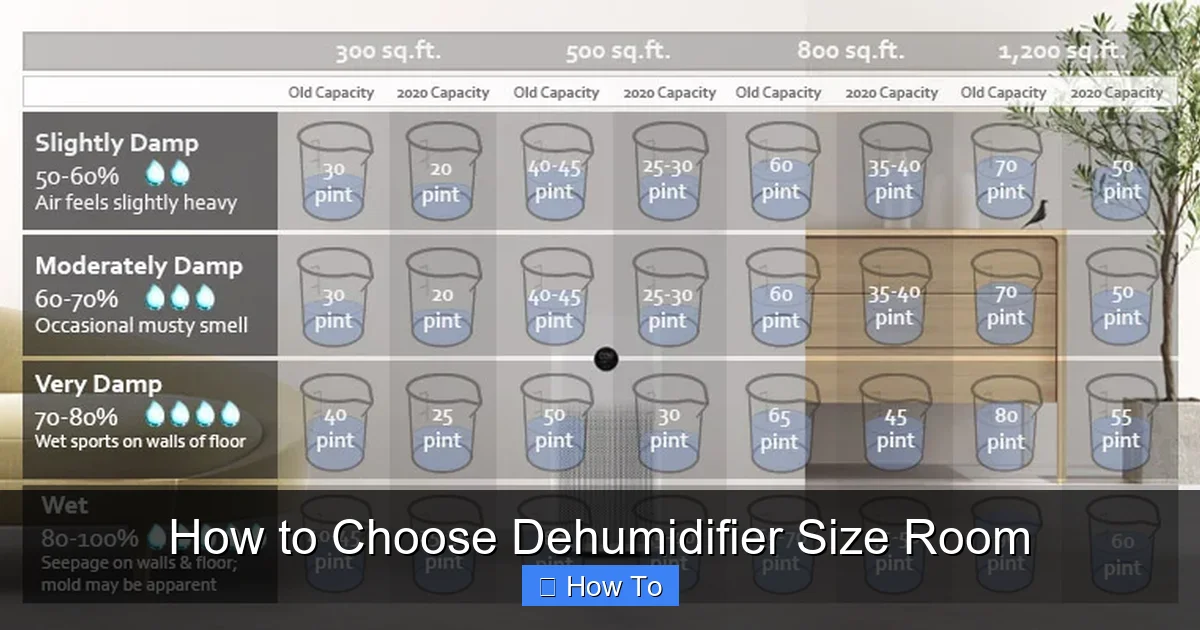
Here’s a simplified chart to help you choose:
| Room Size (sq ft) | Humidity Level | Recommended PPD |
|---|---|---|
| Up to 500 | Slightly damp | 20–30 |
| 500–1,000 | Slightly damp | 30–40 |
| 500–1,000 | Very damp | 40–50 |
| 1,000–1,500 | Very damp | 50–60 |
| 1,500–2,500 | Wet | 60–70+ |
Example: A 1,200 sq ft basement with a musty smell and 65% humidity would need a 50–60 PPD dehumidifier.
Adjust for Special Conditions
Some environments need extra consideration:
- Basements: Often cooler and damper. Choose a unit rated for low temperatures (below 65°F).
- Bathrooms and laundry rooms: High steam output. A smaller, portable unit may work, but ensure it’s moisture-resistant.
- Open floor plans: Calculate the total square footage, but consider airflow. You may need a more powerful unit.
- Poor insulation or drafty windows: These let in humid air. A larger dehumidifier may be needed to compensate.
Step 4: Consider Airflow and Ventilation
Even the best dehumidifier won’t work well if air can’t circulate. Stagnant air traps moisture, reducing efficiency.
Check for Obstructions
Make sure furniture, curtains, or storage aren’t blocking vents. Leave at least 6–12 inches of space around the unit for proper airflow.
Use Fans to Improve Circulation
A ceiling fan or box fan can help distribute dry air and pull moist air toward the dehumidifier. This is especially helpful in large or irregularly shaped rooms.
Seal Air Leaks
Drafty windows, gaps under doors, or cracks in walls let humid outdoor air in. Use weatherstripping or caulk to seal leaks. This reduces the workload on your dehumidifier and improves efficiency.
Step 5: Choose the Right Features
Once you’ve narrowed down the size, look for features that match your lifestyle and needs.
Auto-Humidistat
This built-in sensor monitors humidity and turns the unit on/off to maintain your desired level. Look for models with adjustable settings (e.g., 30%, 40%, 50%).
Continuous Drainage Option
Instead of emptying a bucket every day, connect a hose for continuous drainage. Ideal for basements or unattended spaces. Some models include built-in pumps to push water uphill.
Timer and Auto-Restart
A timer lets you run the dehumidifier during off-peak hours. Auto-restart resumes operation after a power outage—great for storm-prone areas.
Energy Efficiency
Look for ENERGY STAR® certified models. They use 15–30% less energy than standard units. Check the energy factor (liters per kilowatt-hour)—higher is better.
Noise Level
Dehumidifiers can be noisy. Check the decibel (dB) rating. Under 50 dB is quiet; over 60 dB may be disruptive in bedrooms or living rooms.
Portability and Design
Wheels and handles make it easy to move the unit. Compact designs fit better in small spaces. Some models are stackable or wall-mountable.
Step 6: Avoid Common Mistakes
Even with the right size, poor usage can reduce effectiveness. Here’s what to avoid:
Oversizing the Unit
A dehumidifier that’s too large for your room may “short-cycle”—turning on and off frequently. This wastes energy, wears out the compressor, and doesn’t allow enough run time to properly dehumidify.
Example: A 70 PPD unit in a 400 sq ft slightly damp room will cycle too quickly. A 30 PPD model is more efficient and cost-effective.
Undersizing the Unit
Conversely, a unit that’s too small will run constantly, struggle to keep up, and may overheat. It won’t solve your moisture problem and could increase your electricity bill.
Ignoring Maintenance
Dirty filters and coils reduce efficiency. Clean the air filter monthly and check the coil for frost (in cold environments). Empty the water bucket regularly if not using continuous drainage.
Placing the Unit Incorrectly
Don’t put the dehumidifier in a corner or behind furniture. Place it in the center of the room or near the source of moisture (e.g., near a washing machine or shower).
Troubleshooting Common Issues
Even with the right size, you might run into problems. Here’s how to fix them:
Unit Runs But Doesn’t Remove Moisture
- Check the filter—clean or replace if dirty.
- Ensure the room is sealed (close windows and doors).
- Verify the humidity setting isn’t too low.
- Make sure the coil isn’t frozen (common in cold basements).
Water Bucket Fills Too Fast
- The room may be wetter than estimated—consider a larger unit.
- Check for leaks or flooding that need repair.
- Use continuous drainage to avoid frequent emptying.
Unit Is Too Noisy
- Place it on a flat, stable surface to reduce vibration.
- Ensure nothing is touching the unit or blocking vents.
- Consider a quieter model if noise is a concern.
Ice Builds Up on Coils
- This happens in cold environments (below 65°F).
- Use a dehumidifier rated for low temperatures.
- Move the unit to a warmer area if possible.
Final Tips for Smart Shopping
Before you buy, compare models and read reviews. Look for:
- Warranty (at least 1–2 years).
- Customer support and service availability.
- Real-world performance reports (not just manufacturer claims).
- Compatibility with smart home systems (Wi-Fi, Alexa, etc.).
Buy from reputable retailers and check return policies in case the unit doesn’t meet your needs.
Conclusion
Choosing the right dehumidifier size for your room doesn’t have to be complicated. By measuring your space, assessing humidity, matching capacity, and considering features, you can find a model that keeps your home comfortable and healthy.
Remember: the best dehumidifier is the right size for your room and conditions. Don’t guess—use this guide to make an informed decision. With the right unit, you’ll enjoy fresher air, less mold, and lower energy bills for years to come.