

A dehumidifier alone cannot get a box to zero humidity. While it can significantly reduce moisture levels, achieving absolute zero humidity requires specialized equipment and controlled conditions beyond standard home units.
Have you ever opened a storage box only to find your prized collectibles warped, electronics corroded, or documents moldy? Moisture is sneaky—it creeps into even the most seemingly secure containers. That’s why many people turn to dehumidifiers, hoping these handy devices can create a completely dry environment. But here’s the big question: *Can a dehumidifier get a box to zero humidity?*
The short answer? Not quite. While dehumidifiers are excellent tools for reducing indoor moisture and protecting belongings, they have physical and mechanical limits. Achieving “zero humidity”—meaning absolutely no water vapor in the air—isn’t just difficult; it’s practically impossible with consumer-grade dehumidifiers. But that doesn’t mean you’re out of options. Understanding how dehumidifiers work, what “zero humidity” really means, and how to combine technologies can help you get as close as possible to that ideal dry environment.
In this guide, we’ll break down the science behind humidity, explore the capabilities and limitations of dehumidifiers, and show you practical ways to minimize moisture in sealed boxes—whether you’re storing vintage cameras, rare books, musical instruments, or sensitive electronics.
Key Takeaways
- Zero humidity is scientifically unattainable with standard dehumidifiers: Even the best residential units can only reach around 30–40% relative humidity (RH), not 0%.
- Dehumidifiers work by condensing moisture: They pull humid air in, cool it to extract water, then release drier air—but they can’t remove every last molecule of water vapor.
- Sealed environments matter: The tighter the box’s seal, the more effective a dehumidifier will be at lowering humidity over time.
- Desiccants are better for ultra-low humidity: Silica gel or molecular sieves can absorb residual moisture that dehumidifiers miss.
- Temperature affects performance: Colder air holds less moisture, so cooling the box slightly can help reduce RH—but freezing isn’t necessary.
- Practical applications don’t need zero humidity: Most storage, electronics, or preservation needs are met at 10–20% RH—far above absolute dryness.
- Combining methods yields best results: Use a dehumidifier first, then add desiccants or vacuum sealing for near-zero humidity goals.
Quick Answers to Common Questions
Can a dehumidifier remove all moisture from a sealed box?
No, a standard dehumidifier cannot remove all moisture. It can reduce relative humidity to around 30–40%, but achieving zero humidity requires additional methods like desiccants or vacuum sealing.
What’s the lowest humidity a home dehumidifier can reach?
Most residential dehumidifiers bottom out at 30–40% relative humidity under ideal conditions. Desiccant models may reach 20–30%, but not lower without regeneration.
Do I need zero humidity to protect my electronics?
No. Keeping humidity between 10–20% is sufficient to prevent corrosion and damage. Zero humidity is unnecessary and unattainable in practice.
Can I put a dehumidifier inside a storage box?
It’s possible with small, portable units, but not recommended for large compressor models. Ensure proper ventilation, drainage, and monitoring to avoid overheating or inefficiency.
What’s better for a sealed box: a dehumidifier or silica gel?
Use both. A dehumidifier reduces bulk moisture, while silica gel captures residual vapor. Together, they achieve much lower humidity than either alone.
📑 Table of Contents
- Understanding Humidity: What Does “Zero” Really Mean?
- How Dehumidifiers Work: The Science Behind Moisture Removal
- Can You Modify a Dehumidifier for a Sealed Box?
- Better Solutions for Achieving Ultra-Low Humidity
- Real-World Applications: When Does Zero Humidity Matter?
- Myths and Misconceptions About Dehumidifiers and Humidity
- Conclusion: Aim for Practical Dryness, Not Perfection
Understanding Humidity: What Does “Zero” Really Mean?
Before diving into dehumidifiers, it’s essential to understand what humidity is and why “zero humidity” is more of a theoretical concept than a practical reality.
Humidity refers to the amount of water vapor present in the air. It’s typically measured as **relative humidity (RH)**, which compares the current moisture level to the maximum amount the air can hold at a given temperature. For example, 50% RH means the air holds half the moisture it could at that temperature.
Now, “zero humidity” would mean 0% RH—no water vapor at all. But here’s the catch: even in the driest deserts on Earth, RH rarely drops below 10–20%. And inside a sealed box? You’re fighting not just ambient air, but also moisture released from materials like wood, paper, fabric, or even plastic over time. These materials are hygroscopic—they absorb and release moisture based on their surroundings.
So, while you might aim for “bone dry,” true zero humidity is unattainable in everyday conditions. Even laboratory-grade vacuum chambers struggle to eliminate every trace of water vapor without extreme measures like cryogenic cooling or chemical drying agents.
Why Zero Humidity Is a Myth (Even in Labs)
Scientists and engineers working with ultra-sensitive equipment—like semiconductor manufacturing or space simulation chambers—do strive for extremely low humidity levels. But they use highly specialized systems involving vacuum pumps, liquid nitrogen cooling, and molecular sieves. These setups cost thousands of dollars and require constant monitoring.
For the average person storing items in a plastic bin or wooden crate, such extremes are unnecessary—and unfeasible. What matters more is reaching a humidity level that prevents damage. For most applications, keeping RH below 30% is sufficient to stop mold, rust, and warping. Going lower helps, but diminishing returns kick in quickly.
How Dehumidifiers Work: The Science Behind Moisture Removal
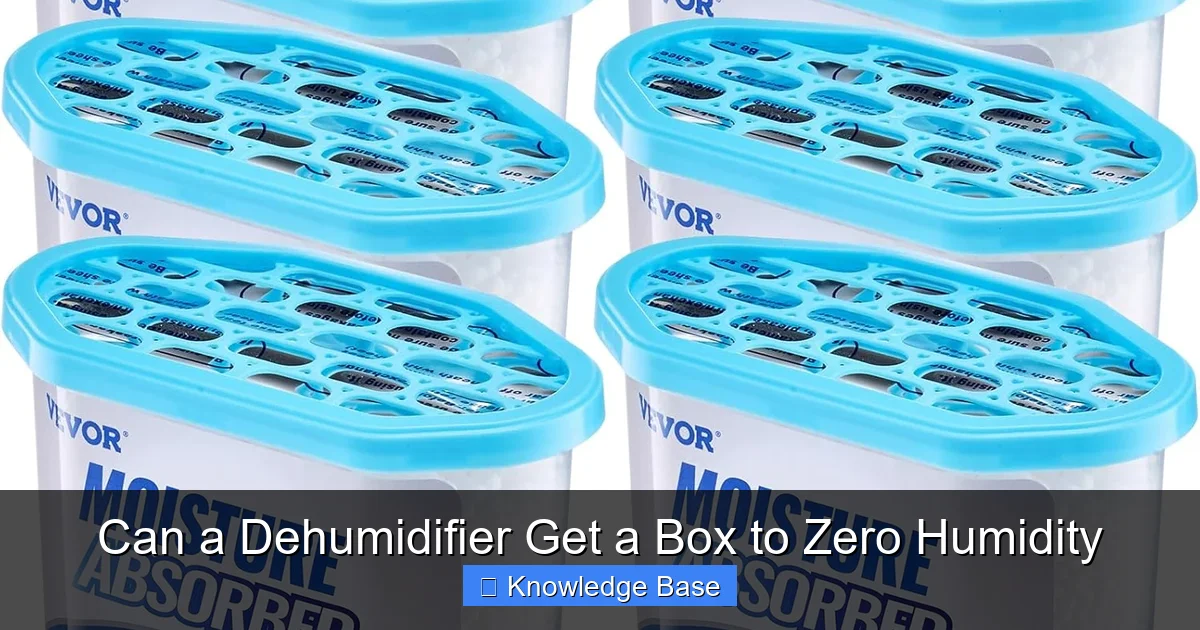
Visual guide about Can a Dehumidifier Get a Box to Zero Humidity
Image source: m.media-amazon.com
To understand why dehumidifiers can’t reach zero humidity, let’s look at how they actually remove moisture.
Most home dehumidifiers use a **refrigerant-based system**. Here’s a simplified breakdown:
1. A fan pulls humid air from the room (or box) into the unit.
2. The air passes over cold evaporator coils, causing water vapor to condense into liquid droplets.
3. The collected water drips into a reservoir or drains out.
4. The now-drier air passes over warm condenser coils to reheat it slightly.
5. The dry air is blown back into the space.
This process is highly effective at reducing humidity in open or semi-open spaces like basements or closets. But when you place a dehumidifier inside a sealed box, several limitations arise.
Limitations of Refrigerant Dehumidifiers in Enclosed Spaces
First, dehumidifiers need airflow to function. If the box is completely sealed, the unit will quickly recirculate the same air, hitting a plateau where it can’t extract more moisture because the air is already as dry as the machine can make it.
Second, refrigerant dehumidifiers struggle in cold environments. Their coils must stay above freezing to work efficiently. In a small, sealed box that’s cooled by the dehumidifier itself, performance drops sharply once internal temperatures fall below about 65°F (18°C).
Third, there’s a physical limit to how dry the air can get. Most consumer dehumidifiers bottom out around **30–40% RH** under ideal conditions. That’s because the cooling coils can only lower the air temperature to a certain point before condensation stops—even if more moisture is present.
Desiccant vs. Compressor Dehumidifiers: Which Is Better for Boxes?
Not all dehumidifiers are created equal. There are two main types:
– **Compressor (refrigerant) dehumidifiers**: Common in homes, best for warm, humid environments.
– **Desiccant dehumidifiers**: Use moisture-absorbing materials (like silica gel) and work better in cooler or tighter spaces.
For small, sealed boxes, **desiccant dehumidifiers** often perform better. They don’t rely on cooling coils, so they function well in cold or confined areas. Some portable desiccant units are small enough to fit inside storage containers and can reduce RH to around **20–30%**.
However, even desiccant units have limits. Once the desiccant material becomes saturated, it stops absorbing moisture unless regenerated (usually by heating). And like compressor models, they can’t achieve true zero humidity.
Can You Modify a Dehumidifier for a Sealed Box?

Visual guide about Can a Dehumidifier Get a Box to Zero Humidity
Image source: m.media-amazon.com
Some DIY enthusiasts try to adapt dehumidifiers for use in sealed containers—perhaps by cutting vents, adding tubing, or placing the unit inside a modified bin. While creative, these approaches come with challenges.
Practical Challenges of In-Box Dehumidification
Placing a full-sized dehumidifier inside a box is rarely practical. Most units are too large, require drainage, and generate heat—which can raise internal temperatures and counteract drying efforts.
Smaller, portable dehumidifiers (like closet or wardrobe models) are more feasible. These often use desiccants and recharge via USB or wall power. But again, they’re designed for open spaces, not fully sealed environments.
If you attempt a custom setup, ensure:
– The box has minimal air exchange (use weatherstripping or gaskets).
– The dehumidifier has a way to drain or collect water (a small tray or absorbent pad).
– You monitor humidity with a digital hygrometer to avoid over-drying, which can damage certain materials.
Alternative: External Dehumidification with Air Exchange
A smarter approach might be to dehumidify the air *before* it enters the box. For example:
– Use a small air pump to circulate air from the box through an external dehumidifier.
– Or, pre-dry the air with a desiccant cartridge before sealing the box.
This method avoids placing electronics inside the container and allows better control over the drying process.
Better Solutions for Achieving Ultra-Low Humidity
Since dehumidifiers alone can’t reach zero humidity, combining them with other methods is the key to success.
1. Use Desiccants Alongside Dehumidifiers
Desiccants like silica gel, activated alumina, or molecular sieves are excellent at capturing residual moisture. You can place desiccant packs inside the box after running a dehumidifier. For long-term storage, use **indicating silica gel** (which changes color when saturated) and recharge it in the oven periodically.
Tip: Calculate how much desiccant you need. A general rule is 1–2 grams of silica gel per liter of volume for moderate drying, or up to 5 grams for very low humidity goals.
2. Vacuum Sealing for Maximum Dryness
Vacuum sealing removes air—and thus moisture—from the container before sealing. While it won’t eliminate moisture *within* materials (like wood or paper), it drastically reduces ambient humidity.
Combine vacuum sealing with desiccants for best results. Some vacuum sealers even have built-in desiccant compartments.
3. Nitrogen or Inert Gas Purging
In industrial settings, containers are often flushed with dry nitrogen gas to displace humid air. While overkill for most home users, small nitrogen cartridges (used for wine preservation) can be adapted for tiny enclosures.
4. Climate-Controlled Storage
If you’re serious about preservation, consider storing your box in a climate-controlled room with low ambient humidity (below 30% RH). This reduces the starting moisture load and makes dehumidification inside the box far more effective.
Real-World Applications: When Does Zero Humidity Matter?
Let’s be honest: most people don’t need zero humidity. But certain applications demand extremely dry conditions.
Electronics and Circuit Boards
Moisture causes corrosion and short circuits. For long-term storage of vintage computers or camera gear, aim for **10–20% RH**. Desiccants and sealed cases work well here.
Archival Documents and Photographs
Paper and film degrade in high humidity. The Library of Congress recommends **30–50% RH** for archives—but for rare or fragile items, going lower (20–30%) slows deterioration.
Musical Instruments (Woodwinds, Violins)
Wood expands and contracts with humidity changes. Stable, low humidity (35–45%) is ideal—but going too low can cause cracking. Balance is key.
Firearms and Metal Collectibles
Rust is the enemy. Keep RH below **40%**, and use vapor-phase corrosion inhibitors (VpCI) along with desiccants for metal protection.
In all these cases, a dehumidifier gets you partway there—but finishing the job requires additional steps.
Myths and Misconceptions About Dehumidifiers and Humidity
Let’s clear up some common misunderstandings.
Myth: “If I run a dehumidifier long enough, it’ll dry everything out.”
Reality: Dehumidifiers reach equilibrium—the point where the air is as dry as the machine can make it. Beyond that, no amount of runtime helps. That’s why supplemental drying is needed.
Myth: “Freezing a box removes all moisture.”
Reality: Freezing slows moisture movement but doesn’t eliminate it. In fact, frost can form, and when thawed, it releases water. Freezing is not a drying method.
Myth: “All dehumidifiers work the same in small spaces.”
Reality: Size, type, and environment matter greatly. A basement dehumidifier won’t work well in a shoebox. Match the tool to the task.
Conclusion: Aim for Practical Dryness, Not Perfection
So, can a dehumidifier get a box to zero humidity? The honest answer is no—not on its own, and not with current consumer technology. But that doesn’t mean you can’t create a remarkably dry environment that protects your valuables for years.
The key is understanding your goal. If you’re storing items that degrade in moisture, focus on achieving a stable, low-humidity environment—not an impossible zero. Use a dehumidifier to do the heavy lifting, then add desiccants, vacuum sealing, or inert gases to push humidity as low as practically needed.
Remember: perfection isn’t the target. Protection is. And with the right combination of tools and techniques, you can keep your boxes—and their contents—safe, dry, and damage-free.
Frequently Asked Questions
What is relative humidity, and why does it matter?
Relative humidity (RH) measures how much water vapor is in the air compared to the maximum it can hold at a given temperature. It matters because high RH causes mold, rust, and warping, while very low RH can dry out materials.
How do I measure humidity inside a sealed box?
Use a digital hygrometer—a small device that fits inside the box and displays real-time humidity levels. Place it away from direct contact with desiccants for accurate readings.
Can humidity damage occur at low levels?
Yes, but only if too low. Extremely dry air (below 20% RH) can crack wood, shrink leather, or brittle paper. Most items prefer 30–50% RH, with sensitive gear needing 10–30%.
How often should I recharge silica gel in a storage box?
Check indicating silica gel every 3–6 months. When it turns from blue to pink, it’s saturated. Recharge by heating in an oven at 250°F (120°C) for 2–3 hours.
Are there dehumidifiers made specifically for small enclosures?
Yes. Look for “mini dehumidifiers” or “closet dehumidifiers” that use desiccant technology. They’re compact, quiet, and designed for confined spaces.
Does temperature affect how well a dehumidifier works in a box?
Absolutely. Cooler air holds less moisture, but refrigerant dehumidifiers lose efficiency below 65°F (18°C). Desiccant models perform better in cold or small spaces.