
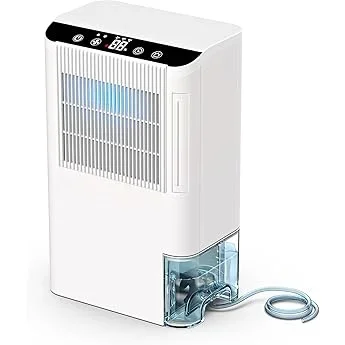
Dealing with excess moisture in your home isn’t just about comfort—it’s about protecting your health, your belongings, and the structural integrity of your living space. Whether you’re battling musty odors in a basement, preventing mold growth in a humid climate, or simply trying to breathe easier in a stuffy bedroom, a reliable dehumidifier can make all the difference. For homes around 800 square feet—a common size for apartments, condos, small houses, or single-room applications—choosing the right unit requires careful consideration. The market is flooded with options, from budget-friendly models that barely keep up to high-performance machines packed with smart features. Without expert guidance, it’s easy to overspend, undershoot your needs, or end up with a noisy, inefficient appliance that gathers dust in the corner.
This comprehensive buying guide is designed to cut through the noise and help you make an informed decision. We’ll walk you through every critical factor—from performance specs and energy efficiency to build quality, smart features, and long-term reliability. You’ll learn how to match a dehumidifier’s capacity to your specific space, understand what features truly matter (and which are just marketing fluff), avoid common purchasing pitfalls, and find the best value within your budget. Whether you’re a first-time buyer or upgrading from an older model, this guide equips you with the knowledge to choose a dehumidifier that delivers consistent results, lasts for years, and fits seamlessly into your lifestyle.
The dehumidifier market has evolved significantly in recent years. Advances in compressor technology, improved filtration systems, and the rise of smart home integration have transformed these once-basic appliances into sophisticated climate control tools. Brands like Frigidaire, hOmeLabs, GE, Midea, and Tosot now offer models tailored to different room sizes, humidity levels, and user preferences. For an 800 sq ft space—whether it’s a single open-concept living area, a basement, or a multi-room apartment—the ideal dehumidifier typically falls in the 20–30 pint range, depending on humidity severity. But capacity is just one piece of the puzzle. This guide will help you navigate the full spectrum of considerations to find the perfect match for your needs.

What to Look for When Buying a Dehumidifier
1. Capacity (Pint Rating)
The most fundamental specification when selecting a dehumidifier is its capacity, measured in pints per day (PPD). This tells you how much moisture the unit can remove from the air in a 24-hour period under standard testing conditions (typically 60% relative humidity at 80°F). For an 800 sq ft space, a 20–30 pint dehumidifier is generally sufficient, but the exact requirement depends on your environment.
In moderately damp areas—like a well-ventilated basement or a home in a temperate climate—a 20-pint model may suffice. However, if you live in a humid region (such as the Southeast U.S.), experience frequent rain, or have a chronically damp space (like a crawlspace or poorly insulated room), a 30-pint or even 50-pint unit might be necessary. Overestimating capacity isn’t always better; oversized units can cycle on and off too frequently, reducing efficiency and lifespan. Conversely, an undersized dehumidifier will run constantly, struggle to maintain target humidity, and wear out faster.
Look for models that specify coverage area alongside pint rating. For example, a “30-pint dehumidifier for up to 1,500 sq ft” may seem excessive, but it’s designed for high-humidity conditions. Always cross-reference the manufacturer’s recommended room size with your actual square footage and humidity level.
2. Energy Efficiency & Operating Costs
Dehumidifiers are among the most energy-intensive appliances in a home, especially if run continuously. Running a standard 30-pint unit for 12 hours a day can add $30–$50 per month to your electricity bill, depending on local rates. Therefore, energy efficiency is a critical factor—not just for environmental reasons, but for long-term cost savings.
Look for units with the ENERGY STAR certification, which indicates they meet strict efficiency guidelines set by the U.S. Environmental Protection Agency. ENERGY STAR-certified dehumidifiers use 15–30% less energy than standard models, translating to significant savings over time. Pay attention to the Energy Factor (EF), measured in liters of water removed per kilowatt-hour (L/kWh). A higher EF means greater efficiency. For example, a model with an EF of 1.8 is more efficient than one with 1.2.
Also consider the wattage. Most residential dehumidifiers draw between 300–700 watts. Lower wattage doesn’t always mean less power—some efficient models use advanced compressors and fan systems to deliver high performance with lower energy consumption. Check the product label or manual for annual energy consumption estimates (usually in kWh/year) to compare long-term costs.
3. Humidity Control & Sensors
Precise humidity control is essential for maintaining a healthy indoor environment. Ideal indoor relative humidity (RH) should be between 30% and 50%. Levels above 60% encourage mold, dust mites, and mildew, while levels below 30% can cause dry skin, respiratory irritation, and static electricity.
Look for dehumidifiers with built-in hygrometers (humidity sensors) and adjustable humidity settings. Most quality models allow you to set a target RH level (e.g., 45%) and will automatically turn on or off to maintain it. This “auto-humidistat” feature prevents over-drying and saves energy. Some advanced units even offer digital displays showing real-time humidity levels, so you can monitor conditions at a glance.
Avoid models that only have manual timers or lack humidity feedback. Without automatic control, you’ll need to constantly monitor and adjust the unit, which defeats the purpose of having a smart appliance. For added convenience, consider models with continuous drainage options (via hose) so you don’t have to empty the tank manually.
4. Tank Size & Drainage Options
The water collection tank is a practical consideration that affects convenience and maintenance frequency. Most portable dehumidifiers come with built-in tanks ranging from 7 to 16 liters (about 1.8 to 4.2 gallons). For an 800 sq ft space, a 10–14 liter tank is typically adequate, but this depends on humidity levels and runtime.
In high-humidity environments, a small tank may need emptying every 6–12 hours, which can be inconvenient. Larger tanks reduce this hassle but add bulk to the unit. Look for models with easy-carry handles, spill-proof designs, and audible or visual full-tank alerts. Some units even have auto-shutoff when the tank is full, preventing overflows.
For continuous operation, consider models with a built-in pump or gravity drainage. A gravity drain hose (usually 5/8″ or 3/4″ diameter) can be routed to a floor drain, sink, or sump pump, eliminating the need to empty the tank. Pumped models are more expensive but ideal for basements or areas without nearby drains. Ensure the unit supports both tank and hose drainage for flexibility.
5. Noise Level
Dehumidifiers use compressors and fans, which generate noise—typically between 45 and 65 decibels (dB). For context, 45 dB is similar to a quiet library, while 65 dB is like normal conversation. In living spaces, bedrooms, or home offices, noise can be a major concern, especially if the unit runs overnight or during quiet hours.
Look for models with noise ratings below 55 dB for quiet operation. Some manufacturers list “low-noise” or “sleep mode” features that reduce fan speed and compressor cycling. However, be cautious—some ultra-quiet models sacrifice performance for silence. Read user reviews to verify real-world noise levels, as manufacturer specs can be optimistic.
Placement also affects perceived noise. Units placed on carpet or soft surfaces may vibrate more, increasing noise. Consider using anti-vibration pads or placing the dehumidifier on a stable, level surface away from walls or furniture that can amplify sound.
6. Build Quality & Durability
A dehumidifier is a long-term investment, so build quality matters. Look for units with sturdy plastic or metal casings, reinforced handles, and well-sealed components. Cheaper models often use thin, brittle plastics that crack or warp over time, especially in humid environments.
Internally, check the quality of the compressor and coils. Rotary compressors are generally more durable and efficient than reciprocating ones. Copper coils resist corrosion better than aluminum, which is important in damp areas. Sealed components and anti-corrosion coatings extend the unit’s lifespan.
Also consider the filter. A washable, reusable filter is more cost-effective and eco-friendly than disposable ones. Look for models with easy-access filter doors and indicators that remind you when to clean it. Some units include HEPA or activated carbon filters for improved air quality, though these may require more frequent maintenance.
7. Smart Features & Connectivity
Modern dehumidifiers increasingly offer smart features that enhance convenience and control. Wi-Fi connectivity allows you to monitor and adjust settings via smartphone apps (e.g., Frigidaire Smart Appliances, GE SmartHQ). You can check humidity levels, set schedules, receive alerts, and even integrate with smart home systems like Amazon Alexa or Google Assistant.
Other useful features include programmable timers (e.g., run for 2, 4, or 8 hours), auto-restart after power outages, and remote sensors that can be placed in another room to monitor humidity. Some premium models offer air quality monitoring, displaying levels of PM2.5, VOCs, or allergens.
While smart features add convenience, they also increase cost and complexity. If you don’t use apps or voice control, these may not be worth the extra expense. Focus on core functionality first—capacity, efficiency, and reliability—then consider smart upgrades if they align with your lifestyle.
8. Portability & Design
Even if you plan to keep your dehumidifier in one place, portability is still important for setup, cleaning, and occasional relocation. Look for models with recessed handles, smooth-rolling casters, and a compact footprint. Weight matters too—most 20–30 pint units weigh 30–50 pounds. Lighter models are easier to move, but may sacrifice durability.
Design also affects usability. A front-loading water tank is easier to access than a top-loading one. Control panels should be intuitive, with clear labels and responsive buttons. LED displays are helpful but can be hard to read in bright light. Some models offer hidden control panels or touchscreens for a sleek look.
Consider the unit’s dimensions, especially if space is limited. Measure the area where you plan to place it, including clearance for airflow (typically 6–12 inches on all sides). A well-designed dehumidifier should blend into your space without dominating it.
Different Types of Dehumidifiers

For an 800 sq ft space, compressor dehumidifiers are the most practical choice. They offer the best balance of performance, efficiency, and affordability. Desiccant models are better suited for cold environments where refrigerant units lose effectiveness below 65°F. Thermo-electric units are too weak for whole-room dehumidification but work well for small, enclosed spaces. Whole-house systems are overkill unless you’re integrating with central HVAC. Mini units lack the capacity for 800 sq ft and are best used as supplements.
Common Buying Mistakes to Avoid
❌ Mistake: Buying Based Solely on Price
Why it’s bad: The cheapest dehumidifier often lacks essential features like humidity control, auto-shutoff, or efficient drainage. It may also use outdated technology, consume more energy, and fail prematurely. A $100 unit that lasts one year is more expensive long-term than a $250 model that lasts five.
What to do instead: Focus on value, not just upfront cost. Consider total cost of ownership, including energy use, maintenance, and lifespan. Invest in a mid-range model with proven reliability and essential features.
❌ Mistake: Ignoring Humidity Levels
Why it’s bad: Buying a 20-pint dehumidifier for a swampy basement in Florida will result in constant running, poor performance, and rapid wear. Conversely, a 50-pint unit in a dry climate will cycle too often, wasting energy and reducing efficiency.
What to do instead: Assess your environment. Use a hygrometer to measure indoor humidity. If it’s consistently above 60%, opt for a higher-capacity unit. Match the dehumidifier’s specs to your actual conditions, not just square footage.
❌ Mistake: Overlooking Drainage Needs
Why it’s bad: If you forget to empty the tank daily, the unit will shut off when full, leaving your space humid. This is especially problematic in high-moisture areas or if you’re away from home.
What to do instead: Choose a model with continuous drainage (hose or pump) if you can’t empty the tank regularly. Even if you plan to use the tank, having a drain option adds flexibility for humid days or vacations.
❌ Mistake: Neglecting Noise Levels
Why it’s bad: A loud dehumidifier can disrupt sleep, work, or relaxation—especially in open-plan living areas or bedrooms. High noise levels often indicate poor build quality or inefficient fan design.
What to do instead: Check decibel ratings and read user reviews about noise. Opt for models under 55 dB for quiet spaces. Consider placement—corner units may amplify sound, while central placement can distribute noise more evenly.
❌ Mistake: Skipping the Warranty
Why it’s bad: Dehumidifiers have mechanical components (compressors, fans) that can fail. Without a warranty, repair costs can exceed the unit’s value. Some brands offer only 1-year coverage, which is insufficient for a long-term appliance.
What to do instead: Choose brands with at least a 2–5 year warranty. Register your product after purchase to activate coverage. Consider extended warranties if available, especially for premium models.
❌ Mistake: Buying Without Reading Reviews
Why it’s bad: Manufacturer specs can be misleading. Real-world performance often differs due to room conditions, usage patterns, or quality control issues. A model with great specs may have poor reliability or customer service.
What to do instead: Read verified customer reviews on Amazon, Home Depot, or Consumer Reports. Look for consistent feedback on performance, noise, durability, and support. Pay attention to recent reviews to ensure the product hasn’t changed.
❌ Mistake: Forgetting About Airflow and Placement
Why it’s bad: Dehumidifiers need proper airflow to work efficiently. Placing one in a corner, behind furniture, or in a closet restricts intake and exhaust, reducing performance and increasing wear.
What to do instead: Place the unit in a central location with at least 6–12 inches of clearance on all sides. Avoid blocking vents. In large or open spaces, consider multiple smaller units or a whole-house system.
Budget Guidelines: How Much Should You Spend?
Dehumidifiers vary widely in price, but for an 800 sq ft space, you can expect to spend between $150 and $400 for a quality unit. Here’s a breakdown of what to expect at each price tier:
- Entry-Level ($100–$180): These models are basic but functional. Expect 20–30 pint capacity, manual controls, small tanks, and limited features. Brands like Tosot or Midea offer reliable options in this range. Ideal for occasional use or low-humidity areas. Downsides include higher noise, shorter lifespan, and lack of smart features.
- Mid-Range ($180–$300): The sweet spot for most buyers. These units offer better efficiency, larger tanks, auto-humidistats, continuous drainage, and quieter operation. Models from Frigidaire, hOmeLabs, and GE dominate this category. ENERGY STAR certification is common. Expect 3–5 year lifespans with proper maintenance.
- Premium ($300–$450): For those who want top performance and convenience. These dehumidifiers include smart connectivity, advanced filtration, pump drainage, and sleek designs. Brands like AprilAire and Friedrich offer high-end options. Ideal for humid climates, basements, or users who value automation and air quality.
- Luxury ($450+): Whole-house systems or commercial-grade units. These are overkill for 800 sq ft unless integrated with HVAC. They offer massive capacity, centralized control, and professional installation. Best for large homes or severe moisture problems.

Expert Tips for Getting the Best Deal
- Buy During Off-Season: Dehumidifiers are in highest demand during summer. Prices drop in fall and winter. Shop between October and March for discounts, clearance sales, and promotions.
- Compare Retailers: Check Amazon, Home Depot, Lowe’s, Best Buy, and Costco. Online retailers often have better prices and reviews, but in-store pickup can save shipping costs. Use price-matching policies when available.
- Look for Bundles: Some retailers offer dehumidifier + air purifier bundles or include free accessories like hoses or filters. These can add value without increasing the base price.
- Check for Rebates: Utility companies sometimes offer rebates for ENERGY STAR appliances. Visit your provider’s website or the ENERGY STAR rebate finder to see if you qualify.
- Read the Fine Print on Warranties: Some warranties require professional installation or registration within 30 days. Understand what’s covered (parts, labor, compressor) and what voids the warranty (e.g., using non-approved filters).
- Test Before Committing: If buying in-store, inspect the unit for build quality, noise, and ease of use. Check tank removal, control layout, and wheel functionality. Online, rely on detailed reviews and video demonstrations.
- Consider Refurbished Models: Certified refurbished dehumidifiers from reputable sellers (e.g., Amazon Renewed, manufacturer outlets) can save 20–40% and often come with warranties. Ensure they’re tested and cleaned.
- Don’t Forget Return Policies: Choose retailers with generous return windows (30–90 days). If the unit doesn’t perform as expected, you’ll want the option to exchange or return it without hassle.

Frequently Asked Questions
Q: How do I know if I need a dehumidifier for my 800 sq ft space?
A: Signs include persistent musty odors, condensation on windows, peeling paint or wallpaper, mold growth, or a clammy feeling in the air. Use a hygrometer to measure humidity—if it’s consistently above 50–60%, a dehumidifier is recommended.
Q: Can one dehumidifier cover multiple rooms?
A: Yes, if the rooms are connected and open to each other (e.g., living room and kitchen). For separate, enclosed rooms, you may need multiple units or a whole-house system. Airflow and layout matter more than square footage.
Q: How often should I clean my dehumidifier?
A: Clean the water tank weekly and the air filter every 2–4 weeks, depending on usage. Wipe down the exterior and coils monthly. Regular maintenance prevents mold, bacteria, and performance loss.
Q: Is it safe to run a dehumidifier 24/7?
A: Yes, especially if humidity levels are high. Most modern units are designed for continuous operation. Use auto-humidistat settings to avoid over-drying. Ensure proper drainage to prevent overflows.
Q: Do dehumidifiers cool the air?
A: No, they don’t cool like air conditioners. However, removing moisture can make the air feel cooler and more comfortable by improving evaporation from the skin.
Q: Can I use a dehumidifier in winter?
A: Compressor models lose efficiency below 65°F and may freeze. Desiccant dehumidifiers work better in cold temperatures. Use only in heated spaces or choose a cold-climate model.
Q: What’s the difference between a 30-pint and 50-pint dehumidifier?
A: A 50-pint unit removes more moisture per day and is better for very damp or large spaces. For 800 sq ft, a 30-pint model is usually sufficient unless humidity is extreme.
Q: Do I need a dehumidifier if I have air conditioning?
A: Yes, if your AC doesn’t adequately control humidity. Central AC removes some moisture, but in humid climates or poorly insulated homes, a dehumidifier may still be necessary.
Q: How long do dehumidifiers typically last?
A: With proper maintenance, most last 5–10 years. Compressor life is the limiting factor. Regular cleaning and avoiding overuse can extend lifespan.
Q: Are smart dehumidifiers worth the extra cost?
A: If you value remote monitoring, scheduling, and integration with smart home systems, yes. For basic use, a non-smart model with manual controls may be sufficient and more reliable.
Our Final Recommendations
- Best for Budget-Conscious Buyers: Tosot 30 Pint Dehumidifier – Reliable performance, 30-pint capacity, ENERGY STAR certified, and priced under $200. Great for moderate humidity and small to mid-sized spaces.
- Best Overall Value: Frigidaire FFAD3033W1 30-Pint Dehumidifier – Excellent balance of efficiency, features, and durability. Includes auto-humidistat, continuous drainage, and a large 13.9-liter tank. Priced around $250.
- Best Premium Option: hOmeLabs 30 Pint Smart Dehumidifier – Wi-Fi enabled, app control, sleek design, and quiet operation. Ideal for tech-savvy users who want convenience and performance. Around $320.
- Best for Beginners: GE ADEL30LZ 30-Pint Dehumidifier – Simple controls, reliable performance, and strong customer support. Easy to set up and use, with clear indicators and a sturdy build.
- Best for Advanced Users: AprilAire E080 Pro 80-Pint Crawl Space Dehumidifier – Overkill for 800 sq ft unless used in a basement or crawlspace. High capacity, pump drainage, and professional-grade durability. Best for severe moisture issues.
Conclusion: Making the Right Choice
Choosing the best dehumidifier for an 800 sq ft space isn’t just about picking the biggest or cheapest model—it’s about matching the right capacity, efficiency, and features to your specific needs. Consider your climate, humidity levels, room layout, and lifestyle. Prioritize energy efficiency, reliable humidity control, and convenient drainage. Avoid common pitfalls like overspending on unnecessary features or undersizing for your environment.
A quality dehumidifier does more than remove moisture—it improves air quality, protects your home from mold and damage, and creates a more comfortable living space. With the insights from this guide, you’re equipped to make a confident, informed decision. Take your time, compare models, read reviews, and invest in a unit that will serve you well for years to come. Your home—and your health—will thank you.