
Understanding how to calculate energy consumption of dehumidifier helps you manage electricity usage and reduce costs. This guide walks you through easy steps, formulas, and practical examples to estimate and monitor your dehumidifier’s energy use effectively.
Quick Answers to Common Questions
Tip/Question?
How do I find my dehumidifier’s wattage if it’s not labeled?
Check the user manual or manufacturer’s website. If unavailable, use the voltage and amperage: Watts = Volts × Amps.
Tip/Question?
Can I use a dehumidifier in winter?
Yes, but only if the temperature stays above 65°F. Most units won’t work efficiently in cold spaces.
Tip/Question?
Does a larger dehumidifier always use more energy?
Not necessarily. A more efficient large unit may use less energy overall by running fewer hours.
Tip/Question?
How often should I clean my dehumidifier?
Clean the filter monthly and coils annually. Dirty components increase energy use and reduce performance.
Tip/Question?
Is it worth buying an ENERGY STAR dehumidifier?
Yes. ENERGY STAR models are 10–20% more efficient and can save $100+ in electricity over their lifetime.
How to Calculate Energy Consumption of Dehumidifier
If you’ve ever wondered how much your dehumidifier is costing you each month, you’re not alone. These handy appliances keep your home comfortable by reducing excess moisture, but they can also be energy hogs if not used wisely. Learning how to calculate energy consumption of dehumidifier is the first step toward smarter usage and lower electricity bills.
In this comprehensive guide, you’ll discover exactly how to measure your dehumidifier’s energy use—no engineering degree required. We’ll walk you through simple formulas, real-world examples, and practical tools you can use today. Whether you’re running a small unit in your basement or a heavy-duty model in a large space, this guide will help you understand your energy footprint and make informed decisions.
By the end, you’ll know how to estimate daily, monthly, and annual energy consumption, compare different models, and even reduce your usage without sacrificing comfort. Let’s dive in.
Why Calculating Dehumidifier Energy Use Matters
Dehumidifiers work by pulling in moist air, cooling it to remove water, and then reheating it before releasing it back into the room. This process requires electricity, and depending on the size, efficiency, and usage, it can add up quickly on your utility bill.
Many people assume dehumidifiers are low-energy devices, but that’s not always true. A standard 50-pint dehumidifier can use between 500 and 700 watts per hour. If it runs for 8 hours a day, that’s over 4 kWh daily—equivalent to running a microwave or a few incandescent light bulbs.
Understanding how to calculate energy consumption of dehumidifier helps you:
- Estimate monthly electricity costs
- Compare different models before buying
- Identify energy-saving opportunities
- Avoid surprise spikes on your utility bill
Plus, with rising energy prices and growing environmental awareness, managing appliance efficiency is more important than ever. Even small changes—like adjusting the humidity setting or using a timer—can lead to meaningful savings over time.
Step 1: Find Your Dehumidifier’s Power Rating
The first step in calculating energy consumption is knowing how much power your dehumidifier uses. This is measured in watts (W) and is usually listed on the appliance’s label, in the user manual, or on the manufacturer’s website.
Where to Look for Wattage
Check these common locations:
- The back or bottom of the unit (look for a sticker or metal plate)
- The power cord or plug area
- The user manual or specification sheet
- The manufacturer’s website (search by model number)
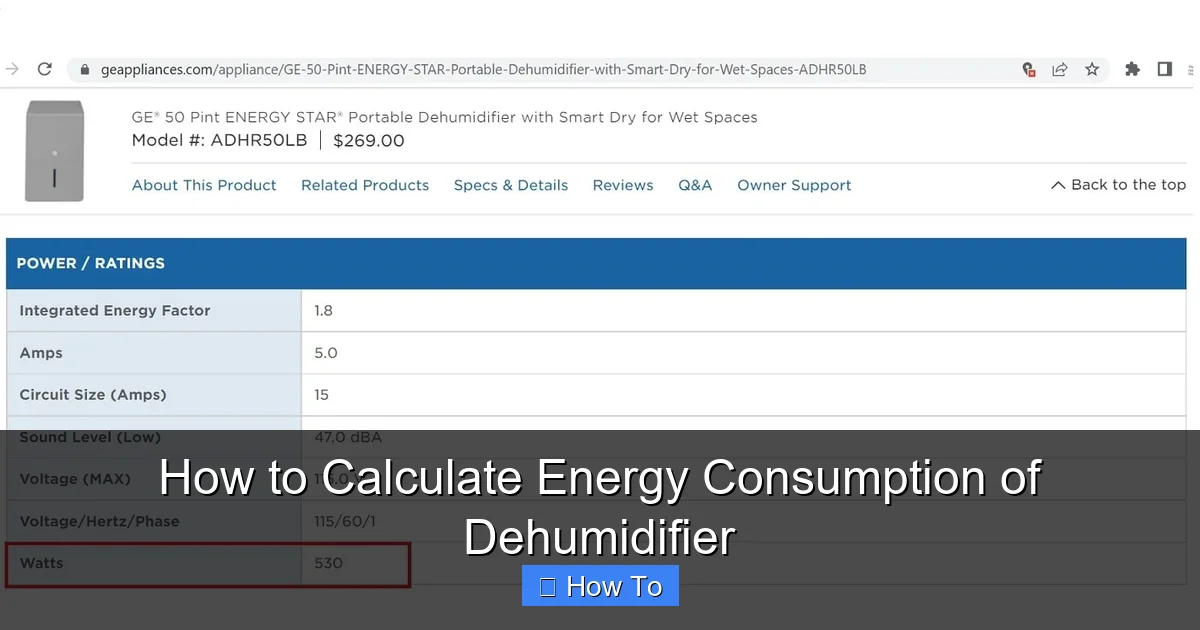
If you can’t find the wattage, look for the voltage (V) and amperage (A). You can calculate watts using this formula:
Watts = Volts × Amps
Visual guide about How to Calculate Energy Consumption of Dehumidifier
Image source: letsavelectricity.com
For example, if your dehumidifier runs on 120 volts and draws 5 amps:
120 V × 5 A = 600 watts
Most residential dehumidifiers range from 300 to 800 watts, with larger units (70+ pints) using more power.
Understanding Energy Efficiency Ratings
While wattage tells you power draw, it doesn’t tell the whole story. A more efficient dehumidifier removes more moisture per kilowatt-hour (kWh) of electricity used.
Look for the Energy Factor (EF), measured in liters per kilowatt-hour (L/kWh). The higher the EF, the more efficient the unit. ENERGY STAR-certified dehumidifiers typically have an EF of 1.5 or higher, meaning they remove at least 1.5 liters of water per kWh.
For example:
- A unit with EF = 1.2 uses more energy to remove the same amount of moisture
- A unit with EF = 1.8 is significantly more efficient
When comparing models, prioritize both wattage and EF to get the full picture of energy use.
Step 2: Estimate Daily Runtime
Dehumidifiers don’t run continuously. Most have built-in humidistats that turn the unit on when humidity rises above a set level and off when it drops below. This cycling behavior means actual runtime varies based on:
- Indoor humidity levels
- Outdoor climate
- Room size and ventilation
- Unit capacity and efficiency
How to Estimate Average Daily Use
Start by observing your dehumidifier over a few days. Note how often it turns on and off. You can also use these general guidelines:
- Low humidity (below 50%): 2–4 hours per day
- Moderate humidity (50–60%): 4–6 hours per day
- High humidity (above 60%): 6–10 hours per day
- Very damp areas (basements, crawl spaces): 8–12 hours per day
For example, if your basement feels damp and the unit runs about 8 hours a day, use 8 hours in your calculation.
Using a Timer or Smart Plug
To get more accurate data, plug your dehumidifier into a smart plug or timer with usage tracking. These devices log how long the appliance runs each day and can even send reports to your phone.
Popular options include:
- TP-Link Kasa Smart Plug
- Belkin WeMo Insight Switch
- Sonoff Basic R3
These tools eliminate guesswork and help you fine-tune usage for maximum efficiency.
Step 3: Use the Energy Consumption Formula
Now that you know the wattage and estimated runtime, it’s time to calculate energy consumption. The standard formula is:
Energy (kWh) = (Watts × Hours Used) ÷ 1,000
Let’s break it down with an example.
Example Calculation
Suppose you have a 600-watt dehumidifier that runs 8 hours per day.
Step 1: Multiply watts by hours
600 W × 8 hours = 4,800 watt-hours
Step 2: Convert to kilowatt-hours (kWh)
4,800 ÷ 1,000 = 4.8 kWh per day
So, your dehumidifier uses 4.8 kWh of electricity each day.
Monthly and Annual Estimates
To find monthly usage:
4.8 kWh/day × 30 days = 144 kWh/month
For annual usage:
4.8 kWh/day × 365 days = 1,752 kWh/year
That’s a significant amount of energy—equivalent to running a refrigerator for several months.
Step 4: Calculate Electricity Costs
Knowing your kWh usage is helpful, but seeing the dollar amount makes it real. To calculate cost, multiply your energy consumption by your local electricity rate.
Find Your Electricity Rate
Check your utility bill for the cost per kWh. Rates vary widely by region:
- National average (U.S.): ~$0.15 per kWh
- California: ~$0.25–$0.30 per kWh
- Midwest: ~$0.10–$0.12 per kWh
If your bill shows “$0.145 per kWh,” round to $0.15 for simplicity.
Cost Calculation Example
Using the earlier example (4.8 kWh/day) and a rate of $0.15/kWh:
Daily cost:
4.8 kWh × $0.15 = $0.72 per day
Monthly cost:
$0.72 × 30 = $21.60
Annual cost:
$0.72 × 365 = $262.80
That’s over $260 per year just for dehumidification. In high-rate areas, this could exceed $400.
Adjusting for Real-World Usage
Remember, this is an estimate. Actual costs may be lower if:
- You use a more efficient model
- You run the unit fewer hours
- You live in a dry climate
Conversely, costs could be higher in humid regions or if the unit runs constantly.
Step 5: Use an Energy Monitor for Accuracy
While formulas give you a good estimate, the most accurate way to measure energy use is with a plug-in energy monitor.
How Energy Monitors Work
These devices plug into the wall, and your dehumidifier plugs into them. They measure real-time power draw, total kWh used, and even cost based on your electricity rate.
Popular models include:
- Kill A Watt P3 P4460
- Etekcity Voltson ESW01-EU
- Zuli Smart Plug (with app integration)
Benefits of Using a Monitor
- See exact wattage and runtime
- Track usage over days or weeks
- Identify energy spikes or malfunctions
- Compare different settings or models
For example, you might discover your dehumidifier uses 650 watts instead of the labeled 600 watts, or that it runs 10 hours a day instead of 8. This data helps you make smarter decisions.
How to Use It
1. Plug the monitor into the wall outlet.
2. Plug your dehumidifier into the monitor.
3. Set your local electricity rate (if supported).
4. Let it run for a few days.
5. Check the display or app for total kWh and cost.
This method removes all guesswork and gives you precise numbers.
Step 6: Compare Different Dehumidifier Models
If you’re shopping for a new dehumidifier, knowing how to calculate energy consumption helps you choose the most efficient option.
What to Compare
When evaluating models, look at:
- Wattage (lower is better)
- Energy Factor (EF) – higher is better
- Capacity (pints per day) – match to your space
- ENERGY STAR certification
Example Comparison
Let’s compare two 50-pint dehumidifiers:
Model A:
- Wattage: 500 W
- EF: 1.3 L/kWh
- Daily runtime: 8 hours
- Daily kWh: (500 × 8) ÷ 1,000 = 4.0 kWh
Model B:
- Wattage: 650 W
- EF: 1.6 L/kWh
- Daily runtime: 6 hours (more efficient, so runs less)
- Daily kWh: (650 × 6) ÷ 1,000 = 3.9 kWh
Even though Model B uses more watts, its higher efficiency means it runs fewer hours and uses slightly less energy overall. Over a year, that small difference could save you $10–$20.
ENERGY STAR Advantage
ENERGY STAR-certified dehumidifiers are at least 10% more efficient than standard models. Some are up to 20% more efficient. Look for the blue label when shopping.
According to ENERGY STAR, a certified 50-pint unit can save about $100 in electricity over its lifetime compared to a non-certified model.
Tips to Reduce Dehumidifier Energy Use
Once you know how to calculate energy consumption of dehumidifier, you can take steps to lower it.
1. Set the Right Humidity Level
The ideal indoor humidity is between 30% and 50%. Setting your dehumidifier to 45% instead of 30% can significantly reduce runtime.
Each 5% reduction in target humidity can increase energy use by 10–20%. So, aim for the highest comfortable level.
2. Use Auto Mode
Most modern dehumidifiers have an “auto” or “smart” mode that adjusts based on current humidity. This prevents over-drying and saves energy.
Avoid “continuous” mode unless absolutely necessary.
3. Maintain Your Unit
A dirty filter or clogged coils force the dehumidifier to work harder, increasing energy use.
- Clean the air filter monthly
- Check and clean the coils annually
- Empty the water tank regularly
A well-maintained unit runs more efficiently and lasts longer.
4. Improve Home Ventilation
Reduce moisture at the source:
- Use exhaust fans in bathrooms and kitchens
- Fix leaks and seal basement cracks
- Vent dryers to the outside
- Use a dehumidifier only where needed
Less moisture means less work for your dehumidifier.
5. Choose the Right Size
An oversized unit cycles on and off frequently, wasting energy. An undersized unit runs constantly and may not keep up.
Match capacity to your space:
- Small (30–50 pints): 500–1,500 sq ft
- Medium (50–70 pints): 1,500–2,500 sq ft
- Large (70+ pints): 2,500+ sq ft or very damp areas
Use manufacturer sizing guides for best results.
Troubleshooting Common Issues
Even with accurate calculations, you might encounter problems. Here’s how to address them.
Dehumidifier Runs Constantly
Possible causes:
- Humidity setting too low
- Dirty filter or coils
- Undersized unit
- High outdoor humidity
Solution: Raise the humidity setting, clean the unit, or consider a larger model.
High Energy Bills Despite Low Usage
Check for:
- Faulty humidistat (not turning off)
- Leaky ductwork or windows
- Incorrect wattage assumption
Solution: Use an energy monitor to verify actual usage. Replace the humidistat if needed.
Unit Uses More Power Than Expected
Older models or those with worn compressors may draw more current.
Solution: Compare with manufacturer specs. If significantly higher, consider repair or replacement.
Conclusion
Learning how to calculate energy consumption of dehumidifier is a powerful tool for managing home energy use. By understanding wattage, runtime, and efficiency, you can estimate costs, compare models, and make smarter choices.
Start by checking your unit’s power rating, estimating daily use, and applying the kWh formula. For the most accurate results, use a plug-in energy monitor. Then, take steps to reduce consumption—like adjusting settings, maintaining the unit, and improving ventilation.
With these strategies, you can enjoy a comfortable, dry home without overspending on electricity. Whether you’re using a small basement unit or a whole-house system, every kilowatt-hour saved adds up over time.
Remember: small changes lead to big savings. So grab your calculator, check your dehumidifier, and start saving today.