

Understanding how to calculate gas energy consumption of a dehumidifier helps you manage energy use and cut utility bills. This guide walks you through the process using simple formulas, real-world examples, and practical tips to ensure accurate results.
Quick Answers to Common Questions
Tip/Question?
How do I find my dehumidifier’s gas input rating?
Check the manufacturer’s label on the unit, the user manual, or the product page online. Look for “BTU/hr” or “Gas Input.”
Tip/Question?
Can I use a smart plug to track runtime?
Smart plugs work for electric units, but gas dehumidifiers often have separate controls. Use a manual timer or gas meter instead.
Tip/Question?
Why is my calculated consumption different from the meter reading?
Other gas appliances may have been running, or your unit’s efficiency may be lower than expected. Isolate the dehumidifier during testing.
Tip/Question?
Is it safe to run a gas dehumidifier continuously?
Yes, if properly maintained and ventilated. But monitor for gas leaks, yellow flames, or unusual smells—turn it off immediately if detected.
Tip/Question?
Should I switch to an electric dehumidifier?
Compare running costs using local electricity and gas rates. Electric units are often cheaper in mild climates, while gas excels in large, humid spaces.
How to Calculate Gas Energy Consumption of Dehumidifier
If you’re using a gas-powered dehumidifier—especially in industrial, agricultural, or large-scale residential settings—you might be wondering how much gas it’s actually consuming. Whether you’re trying to reduce energy costs, improve efficiency, or simply understand your appliance’s impact, knowing how to calculate gas energy consumption of a dehumidifier is essential.
This comprehensive guide will walk you through every step of the process. You’ll learn how to gather the right data, apply the correct formulas, interpret your results, and even troubleshoot common issues. By the end, you’ll have a clear picture of your dehumidifier’s gas usage and practical ways to optimize it.
Let’s dive in.
Understanding Gas-Powered Dehumidifiers
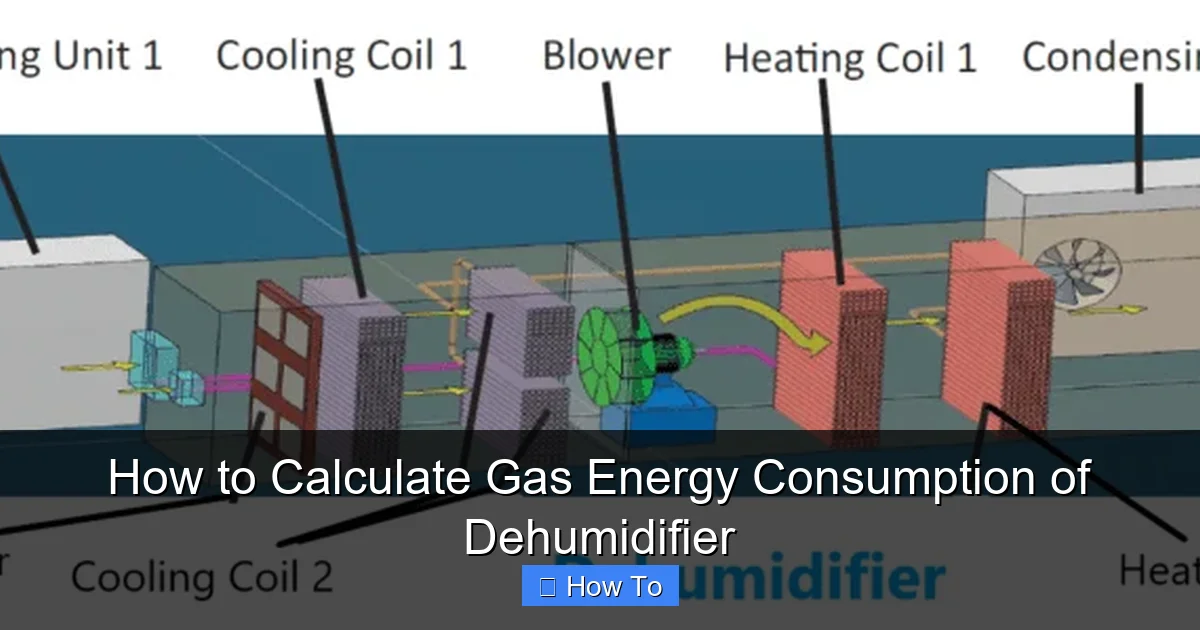
Visual guide about How to Calculate Gas Energy Consumption of Dehumidifier
Image source: flairpharma.com
Before we get into calculations, it’s important to understand what we mean by a “gas-powered dehumidifier.” Unlike standard electric dehumidifiers that plug into a wall outlet, gas-powered models use natural gas, propane, or another fuel source to generate heat, which helps remove moisture from the air.
These units are often used in large spaces like warehouses, greenhouses, barns, or basements where high humidity levels can damage goods or create mold. They’re especially common in climates with high moisture or during rainy seasons.
Gas dehumidifiers typically work by heating incoming air, passing it over a desiccant or cooling coil, and then releasing dry air back into the space. The heating element is powered by gas, which is why tracking gas consumption is crucial for cost and efficiency management.
Why Calculate Gas Energy Consumption?
You might be asking, “Why bother calculating gas usage?” The answer is simple: control and savings.
Cost Management: Gas isn’t free. If your dehumidifier runs 12 hours a day, even a small inefficiency can add up to significant expenses over time.
Energy Efficiency: Knowing your consumption helps you identify if your unit is running efficiently or if it’s time for maintenance or replacement.
Environmental Impact: Reducing unnecessary gas use lowers your carbon footprint, which is good for both your wallet and the planet.
Budget Planning: If you’re running multiple units or managing a facility, accurate consumption data helps with forecasting and budgeting.
Step 1: Identify Your Dehumidifier’s Gas Input Rating
The first step in calculating gas energy consumption is knowing how much gas your dehumidifier uses per hour. This is usually listed as the “input rating” and measured in BTUs (British Thermal Units) per hour.
Where to Find the Input Rating
Check the following places:
- Manufacturer’s label: Usually on the back or side of the unit. Look for “Input,” “Gas Input,” or “BTU/hr.”
- User manual: If you’ve lost the label, the manual often lists technical specs.
- Online product page: Search your model number on the manufacturer’s website.
For example, a typical gas dehumidifier might have an input rating of 30,000 BTU/hr. This means it consumes 30,000 BTUs of gas energy every hour it runs.
Example
Let’s say your dehumidifier has a gas input of 25,000 BTU/hr. That’s your starting point.
Step 2: Determine Operating Time
Next, you need to know how long the dehumidifier runs each day. This varies based on humidity levels, room size, and settings.
How to Track Runtime
- Use a timer: Manually track start and stop times over several days.
- Install a smart gas meter: Some advanced systems log usage automatically.
- Check built-in logs: High-end models may have digital displays showing runtime.
- Estimate based on cycles: If your unit cycles on and off, multiply average cycle time by number of cycles per day.
Let’s assume your dehumidifier runs for 8 hours a day.
Step 3: Calculate Daily Gas Consumption in BTUs
Now that you have the input rating and runtime, you can calculate daily gas consumption.
Use this formula:
Daily Gas Consumption (BTU) = Gas Input (BTU/hr) × Operating Hours (hr)
Example Calculation
Using our earlier numbers:
- Gas Input: 25,000 BTU/hr
- Operating Hours: 8 hr/day
Daily Consumption = 25,000 × 8 = 200,000 BTU/day
So, your dehumidifier uses 200,000 BTUs of gas energy each day.
Step 4: Convert BTUs to Cubic Feet or Therms (Optional)
Gas utilities often bill in therms or cubic feet (CCF), so you may want to convert BTUs to match your bill.
Conversion Factors
- 1 therm = 100,000 BTU
- 1 CCF (hundred cubic feet) = 100,000 BTU (approximate; varies by gas type)
Convert to Therms
Daily Consumption in Therms = Total BTU ÷ 100,000
Using our example:
200,000 ÷ 100,000 = 2 therms/day
Convert to CCF
Daily Consumption in CCF = Total BTU ÷ 100,000
Same result: 2 CCF/day
Now you can compare this to your gas bill to see how much it’s costing.
Step 5: Calculate Monthly and Annual Consumption
To understand long-term usage, scale up your daily numbers.
Monthly Consumption
Multiply daily consumption by 30 (average days per month).
Example:
2 therms/day × 30 = 60 therms/month
Annual Consumption
Multiply monthly by 12.
60 × 12 = 720 therms/year
That’s a significant amount of gas—especially if you’re paying $1.20 per therm. Your annual cost would be:
720 × $1.20 = $864 per year
Step 6: Factor in Efficiency and Real-World Conditions
Not all gas energy is used efficiently. Some is lost as heat, exhaust, or through incomplete combustion. Your actual consumption may be higher than calculated.
Dehumidifier Efficiency Ratings
Look for the Energy Factor (EF) or Moisture Removal Efficiency in the manual. This tells you how much moisture (in pints) the unit removes per kilowatt-hour (kWh) of energy—but for gas units, it’s often given in BTUs per pint.
A higher EF means better efficiency.
Adjust for Real Conditions
- High humidity: The unit works harder, increasing gas use.
- Cold environments: Gas burners may cycle more frequently.
- Dirty filters or coils: Reduces airflow, forcing the system to run longer.
- Improper sizing: An oversized unit short-cycles; an undersized one runs constantly.
To account for this, consider adding a 10–20% buffer to your calculated consumption.
Step 7: Verify with Gas Meter Readings
The best way to confirm your calculations is to monitor your gas meter.
How to Do It
- Turn off all other gas appliances (water heater, furnace, stove).
- Record the gas meter reading.
- Run the dehumidifier for 24 hours.
- Record the meter reading again.
- Subtract the two readings to get actual gas used.
Compare this to your calculated value. If there’s a big difference, recheck your input rating or runtime.
Example
- Initial meter: 1,250.4 CCF
- After 24 hours: 1,252.3 CCF
- Gas used: 1.9 CCF
Your calculation predicted 2 CCF—very close! This confirms your method is accurate.
Step 8: Calculate Cost of Gas Consumption
Now that you know how much gas your dehumidifier uses, you can calculate the cost.
Formula
Cost = Gas Used (therms or CCF) × Price per Unit
Check your gas bill for the current rate. Rates vary by region and supplier.
Example
- Daily gas use: 2 therms
- Price: $1.15 per therm
Daily Cost = 2 × $1.15 = $2.30/day
Monthly Cost = $2.30 × 30 = $69/month
Annual Cost = $69 × 12 = $828/year
That’s over $800 a year just for dehumidification—worth optimizing!
Step 9: Optimize Gas Usage
Once you know your consumption, you can take steps to reduce it.
Tips to Lower Gas Consumption
- Use a hygrometer: Only run the dehumidifier when humidity is above 50–60%.
- Set a timer: Run it during off-peak hours or only when needed.
- Maintain the unit: Clean filters, check burners, and ensure proper ventilation.
- Improve insulation: Reduce moisture infiltration to lessen the load.
- Use exhaust fans: In bathrooms and kitchens to reduce overall humidity.
- Consider zoning: Use smaller units in specific areas instead of one large unit.
Upgrade to a More Efficient Model
If your unit is over 10 years old, newer models may use 20–30% less gas for the same output. Look for ENERGY STAR-rated gas dehumidifiers or high-EF models.
Troubleshooting Common Issues
Even with accurate calculations, you might run into problems. Here’s how to fix them.
Inaccurate Gas Meter Readings
- Cause: Other gas appliances were running.
- Solution: Isolate the dehumidifier by turning off all other gas devices during testing.
Higher-Than-Expected Consumption
- Cause: Dirty burner, clogged air filter, or faulty thermostat.
- Solution: Schedule maintenance or replace parts.
Unit Not Removing Moisture Efficiently
- Cause: Undersized unit or poor airflow.
- Solution: Check sizing charts or add a booster fan.
Gas Smell or Yellow Flame
- Cause: Incomplete combustion—dangerous!
- Solution: Turn off the unit immediately and call a technician.
Alternative: Electric vs. Gas Dehumidifiers
You might be wondering if switching to an electric dehumidifier makes sense.
Pros of Electric Dehumidifiers
- Lower upfront cost
- No gas line required
- Quieter operation
- Often more efficient in moderate climates
Pros of Gas Dehumidifiers
- Better for large spaces
- Faster drying in high-humidity environments
- Can operate in colder temperatures
Which Is More Efficient?
It depends. In areas with cheap electricity, electric models may cost less to run. In places with low gas prices or high cooling demands, gas units can be more economical.
Use our calculation method to compare both options based on your local rates.
Conclusion
Calculating gas energy consumption of a dehumidifier doesn’t have to be complicated. By following these steps—identifying the input rating, tracking runtime, applying formulas, and verifying with meter readings—you can gain full control over your energy use.
Not only will this help you save money, but it also promotes smarter, more sustainable operation. Whether you’re managing a single unit at home or a fleet in a commercial setting, understanding your gas consumption is the first step toward efficiency.
Remember: small changes—like cleaning filters or adjusting timers—can lead to big savings over time. And if your calculations show high usage, it might be time to upgrade or rethink your dehumidification strategy.
With the knowledge from this guide, you’re now equipped to make informed decisions and keep your space dry without draining your budget.