

Air conditioners are less efficient than dehumidifiers because they cool air while removing moisture, using more energy for dual functions. Dehumidifiers focus solely on humidity control, making them more effective and energy-efficient in humid climates. Understanding this difference helps you choose the right appliance for comfort and savings.
Key Takeaways
- Air conditioners cool and dehumidify simultaneously, which increases energy consumption and reduces efficiency compared to dedicated dehumidifiers.
- Dehumidifiers remove moisture more effectively in humid environments because they are designed specifically for that purpose.
- Running an air conditioner for dehumidification alone is wasteful, as it cools the air unnecessarily, using extra electricity.
- Dehumidifiers can improve AC efficiency by reducing the humidity load, allowing the AC to focus on cooling.
- Energy efficiency ratings differ significantly—dehumidifiers typically use less power per pint of water removed than ACs.
- Climate plays a major role—in hot, humid areas, combining a dehumidifier with a smaller AC can save energy and boost comfort.
- Maintenance impacts performance—clean filters and coils in both units ensure optimal efficiency and longevity.
📑 Table of Contents
- Understanding the Core Functions: Cooling vs. Dehumidifying
- How Air Conditioners Work: A Closer Look
- How Dehumidifiers Work: Focused Moisture Removal
- Energy Efficiency: Comparing the Numbers
- Climate and Usage: When Efficiency Matters Most
- Comfort and Health: The Hidden Benefits of Dehumidifiers
- Maintenance and Longevity: Keeping Systems Efficient
- Cost-Benefit Analysis: Is a Dehumidifier Worth It?
- Future Trends: Smarter, More Efficient Systems
- Conclusion: Making the Right Choice for Your Home
Understanding the Core Functions: Cooling vs. Dehumidifying
When it comes to indoor comfort, most people think of air conditioners as the go-to solution. They cool the air, make hot days bearable, and often come with a side benefit: they reduce humidity. But here’s the catch—while air conditioners do remove moisture, they’re not built for that job alone. That’s where dehumidifiers come in, and that’s also why air conditioners are less efficient than dehumidifiers when it comes to managing humidity.
Let’s break it down. An air conditioner’s primary job is to cool the air. It pulls warm air from your home, passes it over cold evaporator coils, and blows the cooled air back into the room. As the warm air touches those cold coils, moisture in the air condenses—just like water droplets on a cold drink can. That water drips into a drain pan and is removed. So yes, ACs do dehumidify, but it’s a byproduct of cooling, not the main event.
A dehumidifier, on the other hand, is built from the ground up to remove moisture. It pulls in humid air, passes it over cold coils to condense the water, collects the water in a tank or drains it away, and then reheats the air slightly before blowing it back into the room. The result? The air feels drier and more comfortable, without a big drop in temperature.
This fundamental difference in design and purpose is the first clue to why air conditioners are less efficient than dehumidifiers in humid conditions. The AC is doing two jobs at once—cooling and dehumidifying—and that extra workload costs more energy. The dehumidifier focuses only on moisture, making it a leaner, more efficient machine for that specific task.
How Air Conditioners Work: A Closer Look
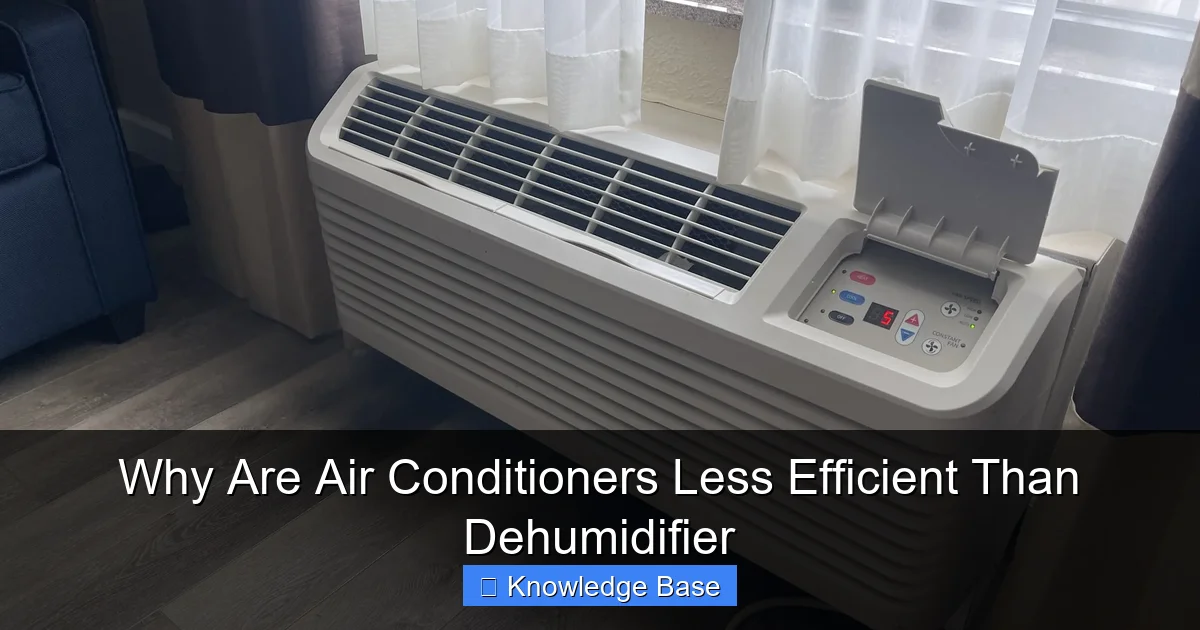
Visual guide about Why Are Air Conditioners Less Efficient Than Dehumidifier
Image source: blogmedia.ptac4less.com
To truly understand why air conditioners are less efficient than dehumidifiers, we need to dig into how ACs actually function. Most homes use central air conditioning systems or window units, both of which rely on a refrigeration cycle. This cycle involves a compressor, condenser coils, evaporator coils, and a refrigerant fluid that absorbs and releases heat.
Here’s how it works in simple terms: The refrigerant starts as a cold, low-pressure gas. It flows into the evaporator coils inside your home. Warm indoor air is blown over these coils, and the refrigerant absorbs the heat, turning into a warm gas. At the same time, moisture in the air condenses on the cold coils and drips away. The now-cooled air is blown back into the room.
The warm refrigerant gas then travels to the compressor outside, where it’s pressurized and heated further. It moves to the condenser coils, where it releases heat to the outside air and turns back into a liquid. The liquid refrigerant then passes through an expansion valve, which lowers its pressure and temperature, and the cycle starts again.
This entire process is energy-intensive. The compressor is the biggest energy hog, especially when it’s working hard to cool hot air. And when humidity is high, the AC has to work even harder. Why? Because humid air feels warmer than dry air at the same temperature. Your body cools itself by sweating, and that sweat evaporates into the air. But in humid conditions, evaporation slows down, so you feel sticky and uncomfortable.
To compensate, your AC runs longer and colder, trying to make you feel cooler. But it’s not just cooling the air—it’s also fighting moisture. The evaporator coils get colder to condense more water, which means the system has to work harder and use more electricity. This dual burden—cooling and dehumidifying—is what makes air conditioners less efficient than dehumidifiers in humid environments.
The Energy Cost of Dual Functionality
Let’s talk numbers. A typical central air conditioner uses between 3,000 and 5,000 watts of power when running. A window unit might use 500 to 1,500 watts. In contrast, a standard dehumidifier uses between 300 and 800 watts, depending on size and efficiency.
Now, consider this: when your AC is running to dehumidify, it’s still cooling the air—even if you don’t need it to be cooler. For example, on a humid 78°F day, you might feel uncomfortable not because it’s hot, but because the air is sticky. Your AC kicks in, cools the air to 72°F, and removes some moisture. But now the room is cooler than necessary, and you’ve used a lot of energy to achieve a result that a dehumidifier could have done more efficiently.
A dehumidifier, running at 500 watts, could remove the same amount of moisture without dropping the temperature. That’s a huge energy saving. Over time, this difference adds up—especially in climates where humidity is high but temperatures aren’t extreme.
How Dehumidifiers Work: Focused Moisture Removal

Visual guide about Why Are Air Conditioners Less Efficient Than Dehumidifier
Image source: hvacbeginners.com
Now let’s shift focus to dehumidifiers. These appliances are purpose-built for one thing: pulling moisture out of the air. They don’t cool the air significantly, and they don’t rely on a complex refrigeration cycle for cooling. Instead, they use a simplified version of the same principle—condensation—but with a different goal.
A dehumidifier pulls humid air into the unit using a fan. The air passes over cold evaporator coils, just like in an AC. Moisture condenses on these coils and drips into a collection tank or is drained away. The now-drier air then passes over warm condenser coils, which reheat it slightly before blowing it back into the room.
The key difference? The dehumidifier isn’t trying to cool the air. It’s only focused on removing water vapor. Because of this, it doesn’t need to make the coils as cold as an AC does. It also doesn’t need a powerful compressor to drive a full cooling cycle. The result is a much more energy-efficient process for moisture removal.
Real-World Example: Basement vs. Living Room
Imagine you have a damp basement that feels clammy and smells musty. The temperature might be a comfortable 70°F, but the humidity is 70%. You could run a window AC unit to cool and dry the space—but that would be overkill. The AC would cool the basement to 65°F or lower, using a lot of energy, just to remove moisture.
A dehumidifier, on the other hand, would keep the temperature around 70°F while pulling the humidity down to 50%. It would use far less electricity and achieve better comfort. In fact, many homeowners use dehumidifiers in basements, crawl spaces, and laundry rooms specifically because they’re more efficient and effective for moisture control.
Energy Efficiency: Comparing the Numbers
When we talk about efficiency, we’re usually referring to how much energy a device uses to perform its job. For dehumidifiers, efficiency is measured in liters of water removed per kilowatt-hour (kWh) of electricity. For air conditioners, it’s measured in SEER (Seasonal Energy Efficiency Ratio), which rates cooling output over a season.
But here’s the thing: you can’t directly compare SEER to dehumidifier efficiency because they measure different things. However, you can compare how much energy each uses to remove moisture.
Let’s say a dehumidifier removes 10 pints of water per day and uses 500 watts. That’s about 12 kWh per month. An air conditioner, running for the same amount of time to achieve similar dehumidification, might use 3,500 watts—over seven times more power. Even if the AC removes slightly more moisture, the energy cost is much higher.
ENERGY STAR Ratings and Real-World Performance
ENERGY STAR-certified dehumidifiers are designed to be highly efficient. Many modern models remove 10–15 pints of water per day using less than 500 watts. Some use advanced features like variable-speed compressors and smart humidity sensors to optimize performance.
Air conditioners also have ENERGY STAR ratings, but those ratings are based on cooling efficiency, not dehumidification. A high-SEER AC might cool efficiently, but it still uses more energy than a dehumidifier when the main goal is moisture removal.
In real-world tests, dehumidifiers consistently outperform air conditioners in energy use per pint of water removed. This is especially true in moderate temperatures where cooling isn’t needed.
Climate and Usage: When Efficiency Matters Most
The efficiency gap between air conditioners and dehumidifiers becomes most apparent in certain climates. In hot, dry areas like Arizona, air conditioners are essential for cooling, and humidity is rarely a problem. In these regions, the dehumidification function of an AC is minimal and not a major energy drain.
But in humid climates—like the southeastern U.S., the Gulf Coast, or tropical regions—humidity is a constant challenge. Temperatures might be in the 80s, but the air feels like 90s due to high moisture levels. In these areas, running an AC just to dehumidify is like using a sledgehammer to crack a nut.
Combining Systems for Maximum Efficiency
Smart homeowners in humid climates often use a combination of systems. They might install a smaller, high-efficiency air conditioner for cooling and add a whole-house dehumidifier to handle moisture. This way, the AC doesn’t have to work as hard, and the dehumidifier keeps the air comfortable without overcooling.
For example, a home in Florida might use a 2-ton AC unit instead of a 3-ton one, paired with a 70-pint dehumidifier. The AC focuses on temperature, and the dehumidifier handles humidity. The result? Lower energy bills, better comfort, and less wear on the AC system.
Seasonal Considerations
Efficiency also varies by season. In spring and fall, when temperatures are mild but humidity is high, a dehumidifier can maintain comfort without any cooling. In summer, when both heat and humidity peak, the AC is necessary—but running a dehumidifier alongside it can reduce the AC’s runtime and improve overall efficiency.
Comfort and Health: The Hidden Benefits of Dehumidifiers
Beyond energy savings, dehumidifiers offer important comfort and health benefits. High humidity doesn’t just feel sticky—it can lead to mold growth, dust mites, and poor indoor air quality. These issues can trigger allergies, asthma, and other respiratory problems.
By keeping humidity between 30% and 50%, dehumidifiers create a healthier indoor environment. They reduce the risk of mold on walls, ceilings, and furniture. They also help prevent musty odors and protect wooden structures from warping.
Air conditioners can help with these issues too, but only when they’re running. If the AC cycles off but humidity remains high, moisture can build up again. A dehumidifier can run independently, maintaining optimal humidity even when the AC is off.
Practical Tip: Use a Hygrometer
To get the most out of your dehumidifier, use a hygrometer—a simple device that measures humidity. Place it in the room where you’re running the dehumidifier and aim for a reading between 40% and 50%. This ensures you’re not over-drying the air, which can cause dry skin and respiratory irritation.
Maintenance and Longevity: Keeping Systems Efficient
Efficiency isn’t just about the appliance—it’s also about maintenance. Both air conditioners and dehumidifiers lose efficiency over time if they’re not properly cared for.
For air conditioners, this means cleaning or replacing air filters every 1–3 months, cleaning condenser coils annually, and ensuring proper airflow. A dirty filter can reduce efficiency by 5–15%, making the system work harder and use more energy.
For dehumidifiers, maintenance includes emptying the water tank regularly, cleaning the air filter, and checking the coils for dust buildup. Some models have washable filters, while others require replacement. Keeping the unit clean ensures it removes moisture efficiently and doesn’t overwork the compressor.
When to Replace vs. Repair
If your dehumidifier is over 10 years old, it might be time to upgrade. Newer models are significantly more efficient, with better insulation, smarter controls, and improved compressors. The same goes for air conditioners—older units with low SEER ratings can cost more to run than a new, efficient model.
Upgrading to a high-efficiency dehumidifier can pay for itself in energy savings within a few years, especially in humid climates.
Cost-Benefit Analysis: Is a Dehumidifier Worth It?
Let’s talk money. A good dehumidifier costs between $150 and $400, depending on size and features. A central air conditioner can cost thousands to install. But the real savings come from reduced energy bills and extended AC life.
In a humid climate, adding a dehumidifier can reduce your AC runtime by 20–30%. That translates to lower electricity bills and less wear on the compressor. Over time, the dehumidifier pays for itself.
Example: Annual Savings
Suppose your AC uses 4,000 watts and runs 8 hours a day during humid months. That’s about 960 kWh per month. At $0.12 per kWh, that’s $115 per month.
If a dehumidifier reduces AC runtime by 25%, you save 240 kWh per month—about $29. Over five months, that’s $145 in savings. The dehumidifier costs $300, so it pays for itself in just over two years.
Future Trends: Smarter, More Efficient Systems
The future of home comfort is smart, integrated, and efficient. New technologies are making both air conditioners and dehumidifiers more intelligent and energy-conscious.
Smart dehumidifiers can connect to Wi-Fi, allowing you to monitor and control humidity from your phone. Some models even sync with smart thermostats, automatically adjusting based on indoor conditions.
Hybrid systems are also emerging—units that combine cooling, heating, and dehumidification in one efficient package. These systems use advanced sensors and variable-speed compressors to optimize performance based on real-time needs.
As energy costs rise and environmental concerns grow, the demand for efficient moisture control will only increase. Understanding why air conditioners are less efficient than dehumidifiers helps homeowners make smarter choices today—and prepare for the innovations of tomorrow.
Conclusion: Making the Right Choice for Your Home
So, why are air conditioners less efficient than dehumidifiers? It all comes down to design and purpose. Air conditioners are built to cool, and dehumidification is a secondary function that increases energy use. Dehumidifiers are built solely to remove moisture, making them more efficient and effective for that job.
In humid climates, using a dehumidifier can improve comfort, reduce energy bills, and extend the life of your air conditioner. In dry climates, an AC may be sufficient. But in most homes, a combination of both systems offers the best balance of comfort, efficiency, and health.
By understanding how these appliances work and when to use them, you can create a more comfortable, energy-efficient home. Whether you’re dealing with a damp basement, a sticky living room, or a musty closet, the right tool for the job makes all the difference.
Frequently Asked Questions
Can I use a dehumidifier instead of an air conditioner?
You can use a dehumidifier instead of an air conditioner if the main issue is humidity, not heat. In mild temperatures, a dehumidifier can make the air feel more comfortable without cooling it. However, in hot weather, you’ll still need an AC to lower the temperature.
Do dehumidifiers use a lot of electricity?
Dehumidifiers use less electricity than air conditioners. Most models use between 300 and 800 watts, compared to 3,000+ watts for central ACs. ENERGY STAR models are even more efficient, using less power per pint of water removed.
Will a dehumidifier help my air conditioner run less?
Yes, a dehumidifier can reduce the workload on your air conditioner by removing moisture. This allows the AC to focus on cooling, leading to shorter runtimes and lower energy bills.
How often should I run my dehumidifier?
Run your dehumidifier when indoor humidity is above 50%. Use a hygrometer to monitor levels. In humid climates, it may need to run daily. In drier areas, occasional use may be enough.
Can a dehumidifier cool a room?
A dehumidifier does not cool a room like an air conditioner. It removes moisture, which can make the air feel more comfortable, but it doesn’t lower the temperature significantly.
Is it worth buying a dehumidifier if I already have an AC?
Yes, especially in humid climates. A dehumidifier improves comfort, reduces AC runtime, and helps prevent mold and mildew. The energy savings can offset the cost over time.