
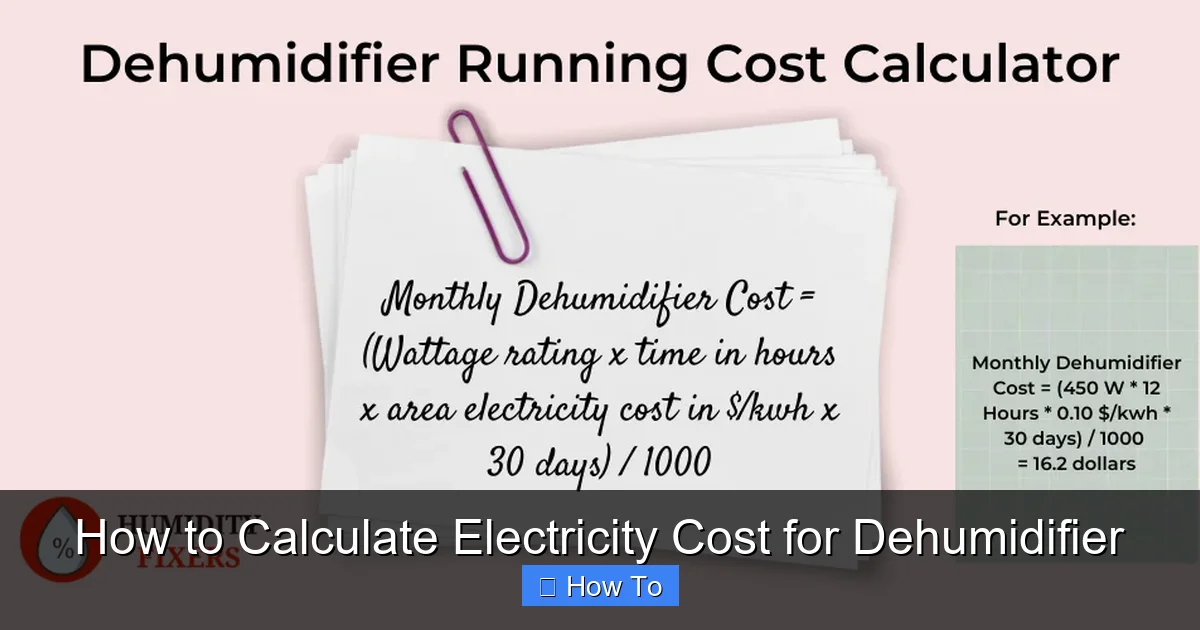
Understanding how to calculate electricity cost for dehumidifier helps you manage energy use and reduce bills. This guide walks you through simple steps to estimate costs based on wattage, runtime, and local electricity rates.
Quick Answers to Common Questions
Tip/Question?
How often should I clean my dehumidifier filter?
Clean the filter every 4–6 weeks during heavy use, or monthly if running daily. A clean filter improves airflow and reduces energy use.
Tip/Question?
Can I run my dehumidifier 24/7?
Yes, but it’s not always necessary. Use a humidistat to auto-regulate. Running non-stop increases wear and electricity costs.
Tip/Question?
Does a larger dehumidifier use more electricity?
Not necessarily. A properly sized unit runs efficiently. An oversized one may short-cycle, wasting energy.
Tip/Question?
Is it cheaper to run a dehumidifier or an air conditioner?
An AC removes moisture while cooling, but uses more energy. A dehumidifier is more efficient for humidity control alone.
Tip/Question?
Should I unplug my dehumidifier when not in use?
Yes, if not needed for days. Even in standby, some units draw small amounts of power.
How to Calculate Electricity Cost for Dehumidifier
If you’ve ever wondered how much your dehumidifier is adding to your monthly electricity bill, you’re not alone. Dehumidifiers are essential for maintaining healthy indoor air quality, especially in humid climates or damp basements. But like any appliance, they consume electricity—and that costs money. The good news? Calculating the electricity cost for your dehumidifier is simpler than you might think.
In this comprehensive guide, you’ll learn exactly how to calculate the electricity cost for your dehumidifier. We’ll walk you through each step, from finding your unit’s power rating to using your local electricity rate. You’ll also discover practical tips to reduce energy use and save money. Whether you’re using a small 30-pint unit in a closet or a large 70-pint model in a basement, this guide applies to all dehumidifiers.
By the end, you’ll be able to estimate your monthly and annual costs with confidence—and make smarter decisions about when and how to use your dehumidifier.
Why Calculating Electricity Cost Matters
Before diving into the math, it’s important to understand why this calculation matters. Many people assume dehumidifiers are low-energy appliances, but that’s not always true. Depending on the size, efficiency, and usage, a dehumidifier can consume a surprising amount of electricity.
For example, a standard 50-pint dehumidifier might use between 500 and 700 watts per hour. If it runs for 8 hours a day, that’s 4 to 5.6 kilowatt-hours (kWh) daily. At an average electricity rate of $0.13 per kWh, that’s about $0.52 to $0.73 per day—or over $20 per month. Over a year, that adds up to $240 or more.
Knowing this helps you:
– Budget for utility bills
– Compare different dehumidifier models
– Identify energy-saving opportunities
– Avoid unexpected spikes in electricity costs
Plus, understanding your dehumidifier’s energy use empowers you to use it more efficiently—keeping your home comfortable without overspending.
Step 1: Find Your Dehumidifier’s Power Rating
The first step in calculating electricity cost is determining how much power your dehumidifier uses. This is measured in watts (W) or sometimes in amps (A). You’ll need this number to estimate energy consumption.
Check the Label or Manual
Most dehumidifiers have a label or sticker on the back or bottom that lists technical specifications. Look for:
– **Watts (W):** This is the most direct number you need.
– **Volts (V) and Amps (A):** If watts aren’t listed, you can calculate them using the formula:
**Watts = Volts × Amps**
For example, if your dehumidifier runs on 120 volts and draws 5 amps:
120 V × 5 A = 600 watts
Look for the Energy Guide Label
In the U.S., many dehumidifiers come with an ENERGY STAR or Federal Energy Guide label. This label often includes:
– Annual energy consumption (in kWh)
– Estimated yearly operating cost
– Comparison to similar models
This is a quick way to get a rough estimate, but for precise calculations, you’ll still want the wattage.
Use the Model Number to Search Online
If you can’t find the label or manual, search for your dehumidifier’s model number online. Most manufacturers list power consumption in the product specifications. Websites like EnergyGuide.com or the manufacturer’s official site are reliable sources.
Example: Finding Wattage
Let’s say you have a Frigidaire 50-pint dehumidifier, model FAD504DWD. A quick search shows it uses 520 watts. That’s your starting point.
Step 2: Determine Daily Usage Hours
Next, you need to know how many hours per day your dehumidifier runs. This varies based on:
– Humidity levels in your home
– Size of the space
– Dehumidifier capacity and settings
– Season (e.g., more use in summer)
Estimate Based on Humidity
If your home feels damp or you see condensation on windows, your dehumidifier may run frequently—possibly 8 to 12 hours a day. In drier conditions, it might only run 2 to 4 hours.
Use a Timer or Smart Plug
For accuracy, use a smart plug with energy monitoring (like a TP-Link Kasa or Wyze Plug). These devices track how long your dehumidifier is on and how much power it uses. Some even show real-time cost estimates.
Alternatively, set a timer and log usage for a week. For example:
– Monday: 6 hours
– Tuesday: 7 hours
– Wednesday: 5 hours
Average: 6 hours per day
Consider Auto Mode
Many modern dehumidifiers have a humidistat and auto mode. They turn on only when humidity exceeds a set level (e.g., 50%). This reduces runtime and saves energy. If yours has this feature, it likely runs less than you think.
Step 3: Find Your Electricity Rate
Your electricity cost depends on where you live. Utility rates vary widely—from under $0.10 per kWh in some states to over $0.30 in others.
Check Your Utility Bill
Look at your most recent electricity bill. Find the section labeled “kWh used” and “cost per kWh.” This is usually listed as “rate” or “price per unit.”
For example:
– Total kWh used: 900
– Total cost: $117
– Cost per kWh: $117 ÷ 900 = $0.13
Some bills show tiered rates (higher costs for higher usage), so use the average rate for simplicity.
Use National or State Averages
If you can’t access your bill, use national averages:
– U.S. average: ~$0.15 per kWh (as of 2024)
– State averages range from $0.10 (Louisiana) to $0.30+ (Hawaii, California)
Websites like the U.S. Energy Information Administration (EIA) provide up-to-date rate data.
Include Delivery Charges
Some bills separate “supply” and “delivery” charges. For accuracy, use the total cost per kWh, including all fees.
Step 4: Use the Electricity Cost Formula
Now it’s time to calculate. Use this simple formula:
Daily Cost = (Wattage × Hours Used Per Day ÷ 1,000) × Cost Per kWh
Visual guide about How to Calculate Electricity Cost for Dehumidifier
Image source: archute.com
Let’s break it down:
– **Wattage:** Power consumption of your dehumidifier (in watts)
– **Hours Used Per Day:** How long it runs daily
– **÷ 1,000:** Converts watts to kilowatts (since electricity is billed per kWh)
– **Cost Per kWh:** Your electricity rate
Example Calculation
Using the Frigidaire example:
– Wattage: 520 W
– Hours per day: 8
– Electricity rate: $0.13 per kWh
Step-by-step:
1. 520 W × 8 hours = 4,160 watt-hours
2. 4,160 ÷ 1,000 = 4.16 kWh
3. 4.16 kWh × $0.13 = $0.54 per day
So, your dehumidifier costs about 54 cents per day to run.
Calculate Monthly and Annual Costs
– Monthly: $0.54 × 30 = $16.20
– Annual: $0.54 × 365 = $197.10
That’s nearly $200 per year—just for the dehumidifier.
Step 5: Adjust for Real-World Conditions
The formula gives a baseline, but real usage varies. Here’s how to refine your estimate.
Factor in Seasonal Use
You probably don’t run your dehumidifier year-round. In many areas, it’s only needed during humid months (e.g., May to September).
If you use it 5 months a year:
– Daily cost: $0.54
– Annual cost: $0.54 × 150 days = $81
That’s less than half the full-year estimate.
Account for Efficiency Improvements
Newer dehumidifiers are more efficient. ENERGY STAR models use about 15–30% less energy than standard units. If you upgrade, your cost will drop.
For example, a 50-pint ENERGY STAR dehumidifier might use only 450 watts. At 8 hours/day and $0.13/kWh:
– (450 × 8 ÷ 1,000) × 0.13 = $0.47 per day
– Annual savings: ($0.54 – $0.47) × 365 = $25.55
Consider Defrost Cycles and Fan Use
Some dehumidifiers use extra energy for defrosting (in cold environments) or running the fan continuously. Check your manual—these features can increase power use by 10–20%.
Step 6: Compare Different Dehumidifier Models
Use your calculation method to compare models before buying. Look at:
– Wattage
– Capacity (pints per day)
– ENERGY STAR certification
– Estimated annual energy use
Example Comparison
| Model | Capacity | Wattage | Daily Cost (8 hrs, $0.13/kWh) |
|——-|———|——–|——————————-|
| Standard 50-pint | 50 pints | 600 W | $0.62 |
| ENERGY STAR 50-pint | 50 pints | 450 W | $0.47 |
| Compact 30-pint | 30 pints | 350 W | $0.36 |
Even though the compact model uses less power, it may not remove enough moisture for a large space—leading to longer run times. Balance capacity with efficiency.
Tips to Reduce Dehumidifier Electricity Costs
Once you know your cost, here’s how to lower it.
1. Use a Hygrometer
A hygrometer measures indoor humidity. Aim for 30–50% humidity. If it’s already low, turn off the dehumidifier. No need to run it unnecessarily.
2. Seal Air Leaks
Keep humid outdoor air out by sealing windows, doors, and cracks. This reduces the workload on your dehumidifier.
3. Improve Ventilation
Use exhaust fans in bathrooms and kitchens. Vent dryers outside. Better airflow reduces moisture buildup.
4. Run During Off-Peak Hours
Some utilities offer lower rates at night. If your dehumidifier has a timer, set it to run overnight.
5. Clean the Filter Regularly
A dirty filter restricts airflow, making the unit work harder. Clean it monthly to maintain efficiency.
6. Choose the Right Size
An oversized dehumidifier cycles on and off frequently, wasting energy. An undersized one runs constantly. Match the capacity to your space.
7. Upgrade to an ENERGY STAR Model
If your unit is over 10 years old, consider replacing it. Newer models are significantly more efficient.
Troubleshooting Common Issues
Sometimes, your dehumidifier may use more power than expected. Here’s how to fix it.
High Energy Use
– **Cause:** Dirty coils or filter
– **Fix:** Clean the air filter and condenser coils every 1–2 months.
Unit Runs Constantly
– **Cause:** High humidity, poor ventilation, or undersized unit
– **Fix:** Check humidity levels, improve airflow, or upgrade to a larger model.
Increased Bill Without Usage Change
– **Cause:** Rising electricity rates or faulty unit
– **Fix:** Verify your rate on the bill. If the unit is old or making noise, have it inspected.
Moisture Not Reducing
– **Cause:** Unit too small, door/window open, or refrigerant leak
– **Fix:** Ensure the room is closed off. If the problem persists, call a technician.
Conclusion
Calculating the electricity cost for your dehumidifier doesn’t require a degree in engineering—just a few simple steps and some basic information. By finding your unit’s wattage, tracking usage hours, and using your local electricity rate, you can estimate daily, monthly, and annual costs with confidence.
This knowledge helps you make smarter decisions about energy use, compare appliance efficiency, and reduce your utility bills. Plus, small changes—like cleaning the filter, using a hygrometer, or upgrading to an ENERGY STAR model—can lead to big savings over time.
Remember, a dehumidifier is an investment in your home’s comfort and health. But like any investment, it pays to understand the costs. With the tools and tips in this guide, you’re well-equipped to manage both.
So go ahead—plug in those numbers, track your usage, and take control of your energy spending. Your wallet (and your walls) will thank you.