
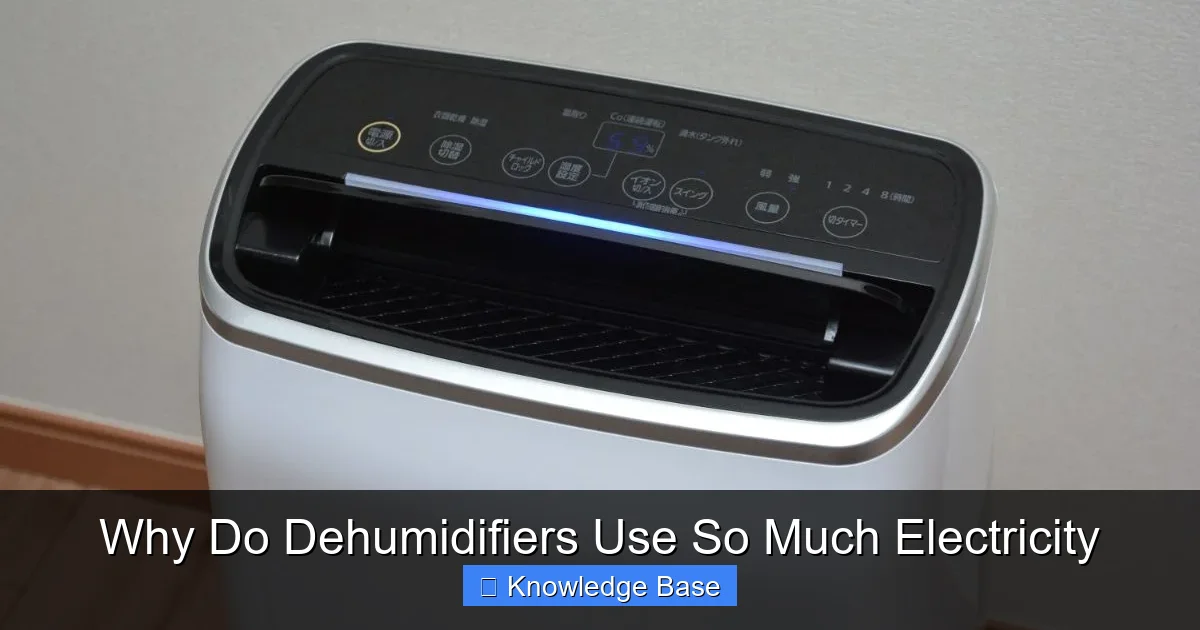
Dehumidifiers use significant electricity because they run compressors, fans, and refrigeration systems continuously to remove moisture from the air. While essential for comfort and health, their energy use depends on size, efficiency, and operating conditions—making smart usage key to lowering costs.
Key Takeaways
- Dehumidifiers consume electricity primarily to power compressors and fans that cool and circulate air. These components work hard to extract moisture, especially in humid environments.
- The larger the unit and the higher the humidity, the more energy it uses. High-capacity models in damp basements or tropical climates run longer and draw more power.
- Energy efficiency varies widely between models. ENERGY STAR-certified units use up to 30% less electricity than standard models.
- Running a dehumidifier continuously can add $20–$50+ per month to your electric bill. Usage duration and local electricity rates greatly impact costs.
- Smart settings like timers, humidity sensors, and auto-shutoff reduce unnecessary runtime. These features help maintain comfort while cutting energy waste.
- Proper placement, regular maintenance, and seasonal use improve efficiency. Clean filters and strategic positioning boost performance and lower consumption.
- Alternative solutions like ventilation, insulation, and moisture-absorbing materials can reduce reliance on dehumidifiers. Combining methods leads to better energy savings.
📑 Table of Contents
- Why Do Dehumidifiers Use So Much Electricity?
- How Dehumidifiers Work: The Science Behind the Energy Use
- Factors That Influence a Dehumidifier’s Energy Consumption
- How Much Electricity Does a Dehumidifier Actually Use?
- Tips to Reduce Dehumidifier Energy Consumption
- Are Dehumidifiers Worth the Energy Cost?
- Conclusion: Balancing Comfort and Efficiency
Why Do Dehumidifiers Use So Much Electricity?
If you’ve ever plugged in a dehumidifier and noticed your electricity bill creeping up, you’re not alone. Many homeowners are surprised by how much power these seemingly simple appliances consume. While dehumidifiers are essential for controlling indoor humidity, preventing mold, and improving air quality, their energy use can be substantial—especially if they run for long periods.
At first glance, a dehumidifier might look like a basic box with a fan and a hose. But inside, it’s a complex system that mimics a mini air conditioner. It pulls in moist air, cools it to condense the water, then reheats and releases dry air back into the room. This process requires continuous mechanical work, which translates directly into electricity consumption. The more humid the air, the harder the unit has to work—and the more energy it uses.
Understanding why dehumidifiers use so much electricity starts with knowing how they operate. Unlike fans or lights that simply move air or produce light, dehumidifiers perform a thermodynamic cycle involving compression, condensation, and evaporation. Each of these stages demands energy, and when combined with long runtimes, the total power draw adds up quickly. But that doesn’t mean you have to choose between comfort and high energy bills. With the right knowledge and habits, you can use your dehumidifier efficiently and keep costs under control.
How Dehumidifiers Work: The Science Behind the Energy Use

Visual guide about Why Do Dehumidifiers Use So Much Electricity
Image source: hvac-boss.com
To grasp why dehumidifiers use so much electricity, it helps to understand the mechanics behind their operation. Most residential dehumidifiers use a refrigeration-based system, similar to an air conditioner or refrigerator. Here’s a step-by-step breakdown of how they work and where the energy goes.
The Refrigeration Cycle: Cooling and Condensing Moisture
The core of a dehumidifier is its refrigeration system, which includes a compressor, condenser, evaporator coils, and a refrigerant gas. When the unit is turned on, the compressor pressurizes the refrigerant, turning it into a hot, high-pressure gas. This gas flows into the condenser coils, where it releases heat and condenses into a liquid.
Next, the liquid refrigerant passes through an expansion valve, which reduces its pressure and temperature dramatically. It then enters the evaporator coils, which are cold enough to cool the incoming air. As warm, humid air from the room is drawn over these cold coils by a fan, the moisture in the air condenses into water droplets—just like how dew forms on a cold glass. This water collects in a tank or drains out through a hose.
Finally, the now-cooled, dry air passes over the warm condenser coils, where it’s reheated slightly before being blown back into the room. This reheating step ensures the air doesn’t feel chilly, maintaining room comfort.
Energy-Intensive Components: Compressor and Fan
The two biggest energy consumers in a dehumidifier are the compressor and the fan. The compressor is the heart of the system—it’s what drives the refrigerant cycle and enables moisture removal. Compressors are powerful motors that require a lot of electricity to start and run, especially in high-humidity conditions where they must work harder and longer.
The fan, while less energy-intensive than the compressor, also contributes to overall power use. It continuously pulls air into the unit and circulates it through the system. In larger or more powerful models, the fan may run at higher speeds, increasing energy consumption.
Because both components often run simultaneously, their combined load can result in significant electricity draw. For example, a typical 50-pint dehumidifier might use between 500 and 700 watts per hour. If it runs for 8 hours a day, that’s 4,000 to 5,600 watt-hours—or 4 to 5.6 kilowatt-hours (kWh)—daily. At an average electricity rate of $0.13 per kWh, that’s about $0.52 to $0.73 per day, or $15 to $22 per month.
Why Continuous Operation Increases Energy Use
One of the main reasons dehumidifiers use so much electricity is that they often run for extended periods. Unlike a toaster or microwave that operates in short bursts, dehumidifiers are designed to maintain a set humidity level over time. In humid climates or damp spaces like basements, they may run nearly nonstop during peak seasons.
This continuous operation means the compressor cycles on and off frequently, but even during “off” periods, some units still draw standby power. Additionally, if the unit lacks smart controls, it may over-dehumidify, running longer than necessary and wasting energy.
For instance, a basement in Florida during summer might require a dehumidifier to run 12–16 hours a day to keep humidity below 60%. Over a 90-day humid season, that’s over 1,000 hours of operation—resulting in hundreds of kWh of electricity use. Without efficiency features, this can lead to a noticeable spike in your utility bill.
Factors That Influence a Dehumidifier’s Energy Consumption
Visual guide about Why Do Dehumidifiers Use So Much Electricity
Image source: hvac-boss.com
Not all dehumidifiers use the same amount of electricity. Several factors determine how much power your unit consumes, from its size and design to where and how you use it. Understanding these variables can help you choose a more efficient model and operate it wisely.
Size and Capacity: Bigger Isn’t Always Better
Dehumidifiers are rated by how many pints of moisture they can remove in 24 hours under standard conditions (typically 60% relative humidity at 80°F). Common sizes include 30, 50, and 70-pint models. Larger units have bigger compressors and fans, which means higher wattage and greater energy use.
While a 70-pint dehumidifier can handle a large, damp basement, it will use significantly more electricity than a 30-pint model—even if the smaller unit runs longer. Oversizing your dehumidifier can lead to short cycling (frequent on/off cycles), which is inefficient and can wear out the compressor faster.
For example, a 30-pint unit might use 300–400 watts, while a 70-pint model could draw 600–800 watts. If both run for the same amount of time, the larger unit will consume nearly twice as much electricity. Choosing the right size for your space is crucial for balancing performance and energy efficiency.
Humidity Levels and Climate Conditions
The ambient humidity and temperature of your environment directly affect how hard your dehumidifier works. In hot, humid climates like the southeastern U.S. or tropical regions, dehumidifiers must remove more moisture from the air, requiring longer runtimes and more energy.
Conversely, in drier climates or during cooler months, a dehumidifier may only need to run intermittently. For instance, a basement in Arizona might only need dehumidification during monsoon season, while one in Louisiana could require year-round use.
Temperature also plays a role. Most dehumidifiers are designed to work best between 65°F and 80°F. In colder spaces like unheated garages or crawl spaces, the coils can frost over, reducing efficiency and forcing the unit to work harder. Some models include auto-defrost features, but these add to energy use.
Energy Efficiency Ratings and Certifications
Not all dehumidifiers are created equal when it comes to energy use. Look for models with the ENERGY STAR label, which indicates they meet strict efficiency guidelines set by the U.S. Environmental Protection Agency. ENERGY STAR-certified dehumidifiers use about 30% less energy than standard models, saving you money over time.
Efficiency is measured by the Energy Factor (EF), expressed in liters of water removed per kilowatt-hour of electricity. Higher EF values mean better efficiency. For example, a unit with an EF of 2.0 removes 2 liters of water per kWh, while one with an EF of 1.5 removes only 1.5 liters.
When shopping, compare the EF ratings and annual energy consumption (usually listed in kWh/year). A more efficient model may cost more upfront but can pay for itself in energy savings within a few years.
Usage Patterns and Runtime
How you use your dehumidifier has a major impact on electricity consumption. Running it 24/7 will obviously use more energy than using it only when needed. Fortunately, many modern units come with features that help reduce unnecessary runtime.
Humidity sensors allow the dehumidifier to monitor indoor moisture levels and turn on only when needed. Auto-shutoff stops the unit when the water tank is full, preventing overflow and wasted energy. Timers let you schedule operation during off-peak hours or only when humidity is highest.
For example, instead of running your dehumidifier all day, you might set it to operate for 4 hours in the morning and 4 hours in the evening—times when humidity tends to peak. This can cut energy use in half while still maintaining a comfortable environment.
How Much Electricity Does a Dehumidifier Actually Use?
If you’re wondering whether your dehumidifier is a major energy hog, the answer depends on several factors—but the numbers might surprise you. Let’s break down the actual electricity consumption and what it means for your wallet.
Calculating Energy Use: Watts, kWh, and Costs
To estimate how much electricity your dehumidifier uses, start by checking its wattage. This is usually listed on the unit’s label or in the manual. For example, a typical 50-pint dehumidifier might use 500 watts.
To find daily energy use, multiply the wattage by the number of hours it runs, then divide by 1,000 to convert to kilowatt-hours (kWh):
Energy (kWh) = (Watts × Hours) ÷ 1,000
So, if your 500-watt dehumidifier runs for 8 hours:
(500 × 8) ÷ 1,000 = 4 kWh per day
Now, multiply by your electricity rate. If you pay $0.13 per kWh:
4 kWh × $0.13 = $0.52 per day
Over a month (30 days), that’s $15.60. Over a 3-month humid season, it’s nearly $47.
Larger units or longer runtimes can push this much higher. A 700-watt model running 12 hours a day would use 8.4 kWh daily, costing about $1.10 per day or $33 per month.
Comparing to Other Household Appliances
To put this in perspective, let’s compare dehumidifier energy use to other common appliances:
– Refrigerator: ~1–2 kWh per day (runs 24/7 but very efficiently)
– Air conditioner (window unit): ~3–5 kWh per day (depending on size and use)
– Clothes dryer: ~3–6 kWh per load (used a few times a week)
– Dehumidifier: ~2–6 kWh per day (depending on size and runtime)
As you can see, a dehumidifier can use as much or more electricity than a refrigerator, especially if it runs frequently. While it’s not the biggest energy consumer in most homes, it’s certainly not negligible—particularly during humid months.
Real-World Examples: Case Studies
Let’s look at two real-world scenarios to illustrate how dehumidifier energy use varies.
Case 1: Small Apartment in Seattle
A 30-pint dehumidifier (350 watts) runs 4 hours a day during the rainy season.
Daily use: (350 × 4) ÷ 1,000 = 1.4 kWh
Monthly cost: 1.4 × 30 × $0.12 = $5.04
Case 2: Large Basement in Atlanta
A 70-pint dehumidifier (750 watts) runs 14 hours a day during summer.
Daily use: (750 × 14) ÷ 1,000 = 10.5 kWh
Monthly cost: 10.5 × 30 × $0.14 = $44.10
These examples show how location, unit size, and usage patterns dramatically affect energy consumption. The Atlanta basement uses nearly 9 times more electricity than the Seattle apartment—highlighting the importance of matching the dehumidifier to your needs.
Tips to Reduce Dehumidifier Energy Consumption
The good news is that you don’t have to sacrifice comfort to save energy. With a few smart strategies, you can significantly reduce how much electricity your dehumidifier uses—without compromising performance.
Choose an ENERGY STAR-Certified Model
When buying a new dehumidifier, prioritize energy efficiency. ENERGY STAR-certified models are independently tested and proven to use less electricity while delivering the same or better performance. They often include advanced features like variable-speed compressors, better insulation, and improved coil designs.
For example, an ENERGY STAR dehumidifier with an EF of 2.2 might use 20% less energy than a standard model with an EF of 1.8. Over time, this can save you $50–$100 in electricity costs.
Use Smart Features: Humidity Sensors and Timers
Modern dehumidifiers often come with built-in hygrometers (humidity sensors) that automatically adjust operation based on current conditions. Set your desired humidity level (ideally between 30% and 50%), and the unit will turn on only when needed.
Timers allow you to schedule operation during specific hours. For instance, run the dehumidifier during the night when electricity rates are lower (in areas with time-of-use pricing) or only when you’re home.
Some smart models even connect to Wi-Fi, letting you control them via smartphone apps and monitor energy use in real time.
Optimize Placement and Airflow
Where you place your dehumidifier affects its efficiency. Keep it away from walls, furniture, and curtains to ensure proper airflow. Blocked vents force the fan to work harder, increasing energy use.
Place the unit in the most humid area—like a basement corner near a water source—and close doors to other rooms to concentrate dehumidification. Avoid placing it near heat sources like furnaces or water heaters, which can raise the ambient temperature and make the unit work harder.
Maintain Your Dehumidifier Regularly
A well-maintained dehumidifier runs more efficiently. Clean the air filter every 2–4 weeks to prevent dust buildup, which restricts airflow and reduces performance. Check the water tank and drain hose for clogs, and wipe down the coils if you notice frost or dirt.
If your unit has a washable filter, rinse it with warm water and let it dry completely before reinstalling. For permanent filters, replace them as recommended by the manufacturer.
Regular maintenance not only saves energy but also extends the life of your dehumidifier.
Use It Seasonally and Supplement with Other Methods
You don’t need a dehumidifier year-round in most climates. Use it only during humid months—typically spring through fall in many regions. During dry winter months, indoor air is often too dry, not too moist.
Supplement dehumidification with other moisture-control strategies:
– Use exhaust fans in bathrooms and kitchens to vent humid air outside.
– Fix leaks in pipes, roofs, or foundations promptly.
– Improve basement insulation and ventilation.
– Use moisture-absorbing materials like silica gel or calcium chloride in small spaces.
By combining these methods, you can reduce reliance on your dehumidifier and cut energy use.
Are Dehumidifiers Worth the Energy Cost?
Given their electricity consumption, you might wonder: are dehumidifiers really worth it? The answer is a resounding yes—for most people, the benefits far outweigh the energy costs.
Health and Comfort Benefits
High humidity creates a breeding ground for mold, mildew, dust mites, and bacteria—all of which can trigger allergies, asthma, and respiratory issues. By maintaining optimal humidity levels (30–50%), dehumidifiers improve indoor air quality and reduce health risks.
They also enhance comfort. Humid air feels sticky and oppressive, making it harder for sweat to evaporate and cool your body. Lower humidity makes rooms feel cooler, allowing you to raise your thermostat and save on air conditioning.
Protecting Your Home and Belongings
Excess moisture can damage your home’s structure and contents. It can warp wood floors, peel paint, ruin furniture, and promote rust on metal surfaces. In basements, it can lead to foundation cracks and musty odors.
A dehumidifier helps preserve your investment by preventing moisture-related damage. The cost of one unit is far less than repairing water damage or replacing ruined belongings.
Long-Term Savings and Peace of Mind
While dehumidifiers use electricity, they can actually save you money in the long run. By reducing humidity, they help your air conditioner work more efficiently, lowering cooling costs. They also prevent costly repairs from mold and moisture damage.
Plus, the peace of mind that comes from a healthy, comfortable home is priceless. For families with allergies, asthma, or respiratory conditions, a dehumidifier can be a vital tool for well-being.
Conclusion: Balancing Comfort and Efficiency
So, why do dehumidifiers use so much electricity? Because they perform a complex, energy-intensive task—removing moisture from the air to create a healthier, more comfortable living environment. Their compressors, fans, and refrigeration systems require significant power, especially in humid conditions or when running continuously.
But that doesn’t mean you’re stuck with high energy bills. By choosing an efficient model, using smart features, maintaining your unit, and operating it wisely, you can enjoy the benefits of dehumidification without breaking the bank.
Remember: the goal isn’t to eliminate energy use, but to use energy wisely. A well-managed dehumidifier is not just a luxury—it’s a smart investment in your health, home, and long-term savings. With the right approach, you can keep your indoor air dry, fresh, and energy-efficient.
Frequently Asked Questions
How much electricity does a dehumidifier use per day?
A typical 50-pint dehumidifier uses about 4–6 kWh per day if it runs 8–12 hours. This can cost $0.50–$0.80 daily, depending on your electricity rate.
Is it expensive to run a dehumidifier all the time?
Yes, running a dehumidifier 24/7 can add $20–$50 or more to your monthly bill. Use timers and humidity sensors to reduce runtime and save energy.
Do ENERGY STAR dehumidifiers really save money?
Yes. ENERGY STAR models use up to 30% less electricity than standard units, saving $50–$100 over their lifetime in energy costs.
Can I reduce dehumidifier energy use without buying a new unit?
Absolutely. Clean the filter regularly, place the unit in a well-ventilated area, use a timer, and only run it when humidity is high.
Should I run my dehumidifier in winter?
Usually not. Indoor air is often dry in winter due to heating. Only use it if you notice condensation, mold, or musty odors.
What’s the ideal humidity level for my home?
Keep indoor humidity between 30% and 50%. This range prevents mold growth, dust mites, and discomfort while minimizing dehumidifier runtime.